

- a) Name and registration code of the study programme:
- Veterinary surgery, orthopaedics and radiology · 103996 · UIPŠ 4321V00
- b) Degree of study and ISCED level:
- Third degree · ISCED 8
- c) Place of delivery:
- University of Veterinary Medicine and Pharmacy in Košice · Komenského 73, 041 81 Košice
- d) Field of study and ISCED-F code:
- Veterinary Medicine
- e) Type of study programme:
- Single degree study
- f) Awarded academic degree:
- PhD (philosophiae doctor)
- g) Form of study:
- part-time study
- h) Partner universities and distribution of study obligations in a joint study programme
- i) Language of instruction:
- English language
- j) Standard duration of study:
- 5 years
- k) Programme capacity and applicants over the last six academic years
-
Planned student capacity Applicants over the last 6 academic years Admitted students over the last 6 academic years Enrolled students over the last 6 academic years — 0 0 0 - l) Information about the study programme:
- Programme details
Study programme description
Veterinary surgery, orthopaedics and radiology
part-time study ·  · 103996 · 2026/2027
Last updated: 30.10.2026
- Higher education institution
- University of Veterinary Medicine and Pharmacy in Košice
- Registered address
- Komenského 73, 041 81 Košice
- Institution identification number
- 00397474
- Programme approval body
- UVMP Accreditation Commission in Košice
- Approval date
- 27.08.2024
1. Basic data on the study programme
2. Profile of a graduate and aims of education
- a) Educational objectives and main learning outcomes
-
The learning objectives
The learning objectives achieved in the study programme Veterinary Surgery, Orthopaedics and Radiology are methodologically based on the European Qualifications Framework for Lifelong Learning (EQF). This defines the requirements for learning outcomes for knowledge, skills and competences. For level 8, the learning outcomes required are broad knowledge in the field of work or field of study, including a critical understanding of theories and principles, professional and methodological knowledge in several areas of the field or practice, serving as a basis for innovation and originality in practice and research necessary for research design
research and development, or the development of an area of professional practice. The carriers of the core knowledge are the profile courses, which have the knowledge described in the information sheets as learning outcomes. Additional knowledge is achieved by completing the compulsory optional courses of the study programme. The essence of the education of a third-level graduate in the study programme of veterinary surgery, orthopaedics and radiology is the study of veterinary surgery and anaesthesiology, veterinary orthopaedics and diagnostic imaging, veterinary neurology and neurosurgery, regenerative medicine and pathological anatomy.In this study programme, the graduate acquires knowledge at the level of the current state of scientific knowledge and masters the scientific methods of research, which he acquires not only by studying, but also by independent creative scientific activity, which is carried out under the guidance and guarantee of his supervisor. The graduate is able to formulate a scientific problem, he/she knows the ethical aspect of solving scientific parts of research both in the experimental and clinical part. He/she is able to orientate and actively establish interdisciplinary cooperation with individual specialists and work teams involved in the preparation and implementation of a scientific project at the national and international level. The graduate is able to apply the results of global research to his/her scientific work and apply them in the development of the scientific field. Together with his/her supervisor, he/she contributes to the development of the study programme.
- Graduates of the study programme
In terms of clinical expertise, a graduate of the 3rd degree study programme in veterinary surgery, orthopaedics and radiology acquires clinical knowledge in veterinary surgery, orthopaedics, radiology and its associated clinical and basic disciplines. He/she is able to develop competence in a variety of modern examination methods, acquiring all the knowledge necessary for the diagnosis and therapy of the most common acute and chronic diseases. Develops skills to identify and solve clinical problems in the specialty. Actively develops strategies to promote the well-being of patients and can establish a preventive clinical plan. Develops his/her communication skills to enhance clinical interaction between client and veterinarian and also develops his/her teaching experience and work with students.
- b) Occupations and graduate employment opportunities
- Not provided yet.
- c) Statements of relevant external stakeholders
-
Relevant external stakeholders who have provided a statement or a favourable opinion on the compliance of the acquired qualification with the sector-specific requirements for the exercise of the profession: Chamber of Veterinary Surgeons of the Slovak Republic.
Company or external stakeholder Statement Komora veterinárnych lekárov Slovenskej republiky View
3. Job prospects
- a) Assessment of graduate employability
-
- Graduates of the study programme in veterinary surgery, orthopaedics and radiology are applied as university teachers, scientific researchers, clinical specialists and experts in the field of consulting for the Chamber of Veterinary Surgeons (veterinary clinics and hospitals).
- During the history of the study programme Veterinary Surgery, Orthopaedics and Radiology there have been no graduates so far in the part-time study programme offered in English.
- b) Examples of successful graduates
- Not provided yet.
- c) Employer feedback on programme quality
-
Employers' evaluation of the quality of the study programme (feedback): Employers' evaluation of the quality of the study programme (feedback): However, the quality of the study programme can be positively evaluated indirectly on the basis of the interest of graduates of the second cycle of higher education from different areas (medical and pharmaceutical sciences, natural sciences and agricultural sciences) in this study programme. UVMP has prepared questionnaires about graduates for employers.
4. Structure and content of the study programme
- a) Rules for designing study plans
-
- The rules for the formation of study plans in the study programme of veterinary surgery, orthopaedics and radiology are based on the general provisions contained in Article 8 of the internal regulation Study Regulations of the UVMP in Košice, Part B.
- b) Recommended study plan:
- Study plan 2026/2027
- c) Information included in the study plan
-
- individual parts of the study programme (in the structure of profile and compulsory optional courses),
- for each educational part (course), the learning outcomes and related criteria and rules for their assessment are defined in the course information sheet so that all the educational objectives of the study programme are met,
- curriculum prerequisites,
- for each educational part of the curriculum (course), the course information sheet sets out the learning activities used that are suitable for achieving the learning outcomes,
- the course information sheet lists the methods by which the learning activity is carried out,
- the course information sheet indicates the student's workload,
- credits are allocated to each section on the basis of the learning outcomes achieved
and associated workload, - the course sponsor is designated and other persons providing the courses are also listed in the course information sheets.
- The number of credits to be achieved as a condition for the proper completion of studies and other conditions to be fulfilled by the student in the course of the study programme and for its proper completion, including the conditions of state examinations, rules for repeating studies
and rules for extension, interruption of studies:
The prerequisite for the proper completion of studies is the acquisition of 240 credits, which include credits for the preparation and defence of the dissertation.
e) Conditions for completion of the individual parts of the study programme and student progression
in the study programme structure:- number of credits for profile (compulsory) courses required for the proper completion of studies / completion of part of studies - 50,
- number of credits for compulsory optional courses required for the proper completion of studies/ completion of part of studies - 10
- number of credits for the final thesis and the defence of the final thesis required for the proper completion of studies - 30.
- Rules for the verification of learning outcomes and the assessment of students and the possibility of corrective procedures against this assessment:
Course information sheets for the Veterinary surgery, orthopaedics and radiology study programme are available through links directly in the study plan.
- d) Credits and other requirements for completion of study
- Not provided yet.
- e) Requirements for individual programme components and student progression
- Not provided yet.
- f) Assessment of learning outcomes and appeal procedures
- Not provided yet.
- g) Recognition of studies or parts of studies
- Not provided yet.
- h) Thesis topics
-
Thesis topics and supervisors are listed in Table 2 in section 7.e of this description.
- i) Other study rules and procedures
-
UVMP in Košice has described the rules for the verification of learning outcomes and evaluation of students and the possibilities of corrective procedures against this evaluation in Articles 16-17 of the internal regulation Study Regulations of UVMP in Košice, Part B.
- Conditions for the recognition of studies or part of studies:
UVMP in Košice also accepts graduates of other universities in the Slovak Republic and abroad to study doctoral programmes if they provide a sufficient theoretical and practical basis for successful completion of the relevant study programme. Recognition of a part of doctoral studies is possible in the sense of the Bologna Convention.
- Topics of the final theses of the study programme:
UVMP in Košice annually publishes a list of topics of the final theses of the veterinary surgery, orthopaedics and radiogy study programme in a table overview as well as on the UVMP in Košice website.
In the study programme veterinary surgery, orthopaedics and radiogy provided in the English language in the full-time form of study, no doctoral student has studied so far, and no topic has been announced in this study programme, form and language version.
- UVMP in Košice has described:
- the rules for assigning, processing, opposing, defending and evaluating final theses in Articles 1, 8, 9, 10, 25, 2ž and 27 of the internal regulation Study Regulations of the UVMP in Košice, Part B,
- possibilities and procedures for participation in student mobility in Article 42 of the internal regulation Study Regulations of UVMP in Košice, Part A,
- the rules for observing academic ethics and drawing consequences in the internal regulation Disciplinary Regulations for Students
- of the University of Veterinary Medicine and Pharmacy in Košice, in the internal regulations of the Code of Ethics of UVMP Employees and in the internal regulations of the Code of Ethics of UVMP Students,
- the procedures for filing complaints and appeals by the student are provided, in addition to the Study Regulations of UVMP in Košice, in particular the internal regulation Directive on the handling of complaints at UVMP in Košice.
5. Study programme’s information letters
- Course information sheets
-
Course information sheets are available through links directly in the study plan. Study plan 2026/2027
6. Current schedule of the academic year and current timetables
- Current academic calendar and timetables
- Not provided yet.
7. Staff
- a) Person responsible for the delivery, development and quality of the study programme
- Prof. Trbolová Alexandra, DVM, PhD
- b) Teachers of profile courses
- c) Research/art/teaching profiles of teachers of profile courses
- d) Teachers, courses and links to the central register of university employees
-
(Click the teacher’s name to open their profile and contact details, where available.)
- e) Thesis supervisors and topics 5 years
-
(Click the teacher’s name to open their profile and contact details, where available.)
Table 2 – Thesis supervisors and topics Teacher Thesis topics Academic year — - f) Research/art/teaching profiles of thesis supervisors
-
The supervisors’ research/art/teaching profiles are available through their personal profiles using the name buttons in the preceding table.
- g) Student representatives and contacts
-
The members of the committee for the preparation of study programmes for the third level of higher education are the students Marek Ratvay, DVM (3rd year of SP Immunology); e-mail: marek.ratvay@student.uvlf.sk; Teodora Blatníková, DVM (3rd year of SP Veterinary Morphology and Physiology); e-mail: teodora.blatnikova@student.uvlf.sk and Pavel Gomulec, DVM (1st year of SP Internal Diseases of Animals); e-mail: pavel.gomulec@student.uvlf.sk
- Other study program support staff - assigned study officer, career counselor:
For doctoral students, Mgr. Júlia Jančura, julia.jancura@uvlf.sk, is assigned as a study officer; the function of career advisor is performed by the doctoral student's supervisor.
- h) Study adviser
- Not provided yet.
- i) Other support staff
- Not provided yet.
8. Premises, tools and technical equipment
- a) Teaching premises and their technical equipment
-
Course
Characteristics of material and technical equipment
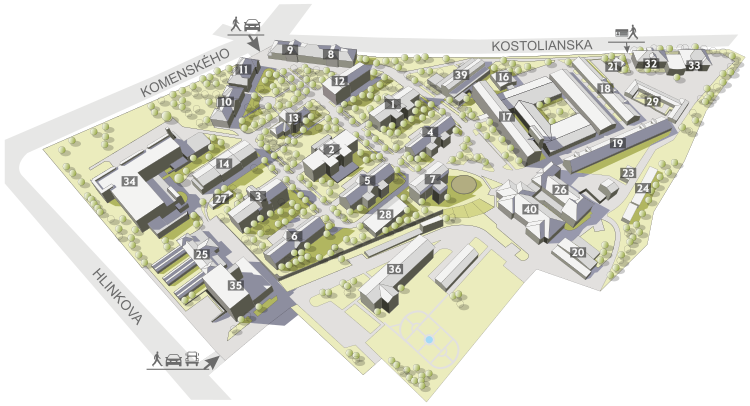
Location Pathological anatomy
Complete equipment for animal autopsies; histological preparations of pathological conditions in animals; laboratories for immunohistochemical examinations
P-34 autopsy room; P-17 histology training room; laboratories
Regenerative medicine
Material and equipment for isolation, fixation and processing of histological samples, cryotome, microtome, histological staining kits, immunohistochemical staining kits, light microscopes, fluorescence microscope with apotome, electron microscope. Material and equipment for isolation and characterisation of cell populations: thermostats, autoclaves, refrigerators, BSL2 laminar boxes, PCR box, centrifuges and ultracentrifuge, thermocyclers for PCR and qPCR, Synergy 2 spectrophotometer with culture device, fluorescence microscope with apotome and culture device, CO2 incubator, electrophoretic apparatus, deep freezing boxes
P 3
P 36
Veterinary Surgery and Anaesthesiology
Anesthesia machine Komesaroff Mini - Kom VIC, Anesthesia machine KRUUSE with 2 vaporizers on stand, Defibrillator HEART SAVE ONE with accessories, Electrocautery - electrosurgery., micropr. controller, BABYTHERM incubator for babies, Dixion infusion pump, Instilar, Beneview T8/T1 modular vital signs monitor, VAPORISOR VOC isoflurane vaporizer, v.no. 106101
UVN, P-40, operating theatres and outpatient clinics
Veterinary neurology and neurosurgery
Electrocautery - electrosurgery, microprocessor, Dixion infusion pump, Instilar, Operating table ceiling lamp with integ. camera. system, Negatoscope viewing field LED MST - 4000 double, Stereomicroscope STEMI 508C, v.no. 3943001949 - body; Bathtub with treadmill for rehabilitation, v.no. 14/008/10-15
UVN, P-40, operating theatres and outpatient clinics
Veterinary ophthalmology
FAKOemulsifier, Optomed ocular background camera, Smart VET2, Slit lamp SL - 17, Inami microscope, L - 0980A ophthalmoscope; Ophthalmoscope Omega 500 indirect, Intraocular pressure measuring device TA01i
UVN, P-40, operating theatres and outpatient clinics
Veterinary orthopaedics and diagnostic imaging
Operating table ceiling lamp with integrated. cameras. system., Negatoscope viewing field LED MST - 4000 double, Modular monitor of vital functions Beneview T8/T1, Vaporizer isoflurane VAPORISOR VOC, v.no. 106102; Inhalation anaesthesia monitoring device VF A6; Set Air Pen Drive Synthes, APD, v.No. 100249, Set Battery Power Line (Synthes, TRS); Set Compact Air Drive Synthes, CAD II, v.no. 35510, Ultrasound device ALOKA Prosound Alpha 6+3 probes; USG with Doppler ALOKA PROSOUND ALPHA 6+3 probes
UVN, P-40, operating theatres and outpatient clinics
Veterinary dentistry
VOC evaporator Izofluran, v.no. 106100, Sonica ultrasonic cleaner, v.no. 2015012833; Periomat plus automatic machine for recall. Dental X-ray images, Dental drill ENGLER, Scale - Aire, v.no. SO67720-2; Dental X-ray machine ENDOS AC, v.no. 31150329
UVN, P-40, operating theatres and outpatient clinics
Internal diseases of livestock
Biochemical and haematological laboratory (A Analyst 100 Perkin Elmer, ICP Perkin Elmer, haematological analyser BC-2800 Vet, biochemical analyser ALIZE, spectrophotometer Specol 211 (Carl Zeiss Jena), housing facilities with the possibility of animal fixation
P17, P18, P19
Equine internal diseases
Bed side monitor/ Omeda vital signs monitor and General Electric software
Anaesthetic machine Komesaroff Australia
Smith Respirator for horses Australia
Positioning table Haico Oy Josef Boening edition Finland
Gantry crane/portal crane Schilling
X-ray Gierth HF 400
RTG Orange 902 HF
Karl Storz rigid laparoscope, arthroscope; horse flexibile endoscope 180cm, 320cm;
USG SS600 Sonoscape
Radiographic unit with direct X-ray digitization
P 17
Internal diseases of pets
Cobas 111 - biochemical analyser
IDEXX Pro Cyte - haematology analyser
IDEXX Catalyst - Biochemical Analyzer (on-call)
Centrifuge
Microscopes
Coagucheck - blood coagulation analyzer
Ultrasound for echocardiography
ECG machine
Pressure gauge
Infusion pumps
Medication dispensers
Oxygen generator
Otoscope with PC visualisation
Ultrasonography machine
Gastroscope
P - 26, outpatient clinic and laboratory
Anatomy
Material and equipment for animal dissection and other examinations:
- dissection tables
- e-learning room
- rotary microtome: Leica RM 2245
- light microscope with camera: Olympus CX63 with PROMICAM 3-3CP camera
- Olympus SZ61 stereomicroscope with PROMICAM 3-3CP camera
- thermostats, refrigerators, incubators, vortexes
PCR box, centrifuge, pH meter, sonicator
P39 Autopsies
P34 laboratory
Department of Morphological Disciplines
Biochemistry
PhastSystem electrophoretic separation system
Ultimate 3000/Thermo Scientific liquid chromatograph with accessories
ISO-3100SD/Dionex compact isocratic system
UV-VIS spectrophotometer Cary 60 with Peltier/Agilent Technologies
Mastersizer 3000/Malvern laser particle counter
P35-411
P35-211
P35-211, P35-014
P35-016
P35-211
Pathological anatomy
Material and equipment for the animal's autopsy and for further examinations:
1. histological . sledge microtomes (pfm Slide 2003 - pfm medical Germany and Histoslide 2000, Leica - Reichert - Jung), Shandon Citadel - tissue processor, WD4 pouring apparatus, light microscopes with camera: MOTIC + photocamera MOTICAM 2330, NICON Eclipse Tí + photocamera), thermostat, refrigerator,
2. PCR: PCR box, PCR thermocycler, CO2 incubator, deep freezer box,
3. cytological: cytocentrifugation
4. flow cytometry: flow cytometer Becton Dickinson, centrifuge
P17/C
Dissection rooms and laboratories of the Department of Morphological Disciplines
Pathological physiology
ELISA reader (Apollo LB 913, Germany), spectrophotometer (Thermo Electron Corporation, Made in USA), spectrophotometer (VWR International bvba, Made in China), FRAS (FRAS BRAVO, H&H Parma Italy, light microscopes (Carl Zeiss Microscopy, Made in Germany), thermostat (Memmert, Made in Germany), freezer (Liebherr - MEDLine, Made in Austria), refrigerators (Gorenje, Made in Slovenia), centrifuge (Eppendorf, Made in Germany)
P8 ground floor
Department of Biology and Physiology
Regenerative medicine
Material and equipment for isolation and characterization of stem cells: thermostats, autoclaves, refrigerators, BSL2 laminar boxes, PCR box, centrifuges and ultracentrifuge, thermocyclers for PCR and qPCR, inverted microscope, fluorescence microscope with apotome and culture equipment, CO2 incubator, electrophoretic apparatus, deep freezing boxes, flow cytometer,
P17
P1
P3
Workplace Pri hati 10
- Characteristics of information provision of the study programme (access to study literature according to course information sheets), access to information databases
and other information resources, information technology, etc.):
All literary resources for study listed in the fact sheets are available in either print or electronic form, and all information databases purchased and licensed by the University are accessible to students.
- Characteristics and scope of distance learning applied in the curriculum with assignment to courses. Approaches, manuals of e-learning portals. Procedures for transition from full-time to distance learning.
UVMP also has distance education for all courses, which is currently provided through MOODLE and MSTeams platforms. Each student has manuals available either in electronic form or in the form of a video tutorial.
- b) Information resources
- Not provided yet.
- c) Distance learning, e-learning access and procedures
- Not provided yet.
- d) Partners involved in educational activities
-
The participation of the University's contractual partners, including the KVL SR, is envisaged in the provision of some activities, especially in the area of practical performance of activities of high societal importance.
- Characteristics of social, sporting, cultural, spiritual and community opportunities:
UVMP in Košice provides students with conditions for their enjoyment in the above areas within the limits of its possibilities.
- e) Social, sports, cultural, spiritual and community activities
- Not provided yet.
- f) Student mobility and placements
-
Students of the study programme of veterinary surgery, orthopaedics and radiology are guaranteed the opportunity to participate in mobility. The whole agenda, including the guidelines and conditions for applying for mobility, conditions and rules for participation in mobility, is covered by the Vice-Rector for International Relations and Internationalisation and the organisational unit managed by her, which is the UVMP Mobility Office. The whole process requires coordination with the supervisor and is recommended after the study part of the study plan has been fulfilled.
9. Required skills of the applicant and prerequisites
- a) Required abilities and admission prerequisites
-
They are laid down in Articles 1 and 2 of the Study Regulations of the UVMP in Košice, Part B, II. Part Organisation of studies.
- b) Admission procedures
-
They are laid down in Articles 3 and 4 of the Study Regulations of the UVMP in Košice, Part B, II. Part Organisation of studies.
- c) Admission results over the standard duration of study
-
Academic year Applicants Admitted Enrolled Graduates 2021/2022 0 — — — 2020/2021 0 — — — 2019/2020 0 — — — 2018/2019 0 — — — 2017/2018 0 — — —
10. Feedback regarding the quality of education provided
- a) Monitoring and assessment of student feedback
-
- Procedures for monitoring and evaluating students' views on the quality of the study programme:
Students of UVMP in Košice have the possibility of anonymous evaluation of the quality of teaching in the Academic Information System, where they evaluate the quality of a particular course and the quality of the teachers who provide that particular course. Monitoring of study programmes is also continuously carried out by the coordinators of individual domains of science and research at UVMP, while 5 domains of science and research are established at UVMP. At the end of the study programme, graduates fill in an anonymous questionnaire evaluating the course of study and cooperation with the supervisor.
UVMP has as one of its strategic goals in the field of education to maintain or increase the applicability of graduates in practice in accordance with the needs of the labour market and social order. It has developed a questionnaire on graduates for employers, in which we will ask for an opinion on how our graduates of the study programme in cynology meet the expectations of their employers. Employer evaluation of the quality of the programme (feedback) will be an important component in the process of continuous improvement of the quality of the programme.
- b) Student feedback and measures to improve programme quality
-
The results of the evaluation of doctoral studies are part of the Annual Reports on Scientific and Research Activities at UVMP in Košice for individual ARs and Annual Reports on the Quality of UVMP in Košice for individual ARs. They are also presented at the Teachers' Forum, which is held at the beginning of each academic year. In general, the principle that the results of the feedback are very important for drawing conclusions from the evaluations, which are implemented into concrete measures implemented with the aim of improving the quality of the study programme in its entire breadth and depth.
- c) Graduate feedback and measures to improve programme quality
-
The results of alumni feedback and related measures to improve the quality of the study programme are part of the Annual Reports on Scientific and Research Activities at UVMP in Košice for individual AR and Annual Reports on the Quality of UVMP in Košice for individual AR. The Vice-Rector for Science, Research and Doctoral Studies and the coordinators of the individual domains of science and research act within the framework of the measures to improve the quality of the study programme by personally entering into the solution of the problems arising from the results of the feedback.
11. Demonstration of long-term and continuous success in obtaining financial support
- a) Demonstration of long-term and continuous success in obtaining financial support
-
No
Project No
from
To
Project name
Ageny
investigator, co-investigator
1
1/0731/13
2013
2015
Etiopathogenesis, diagnosis and therapy of medial compartment disease of the elbow joint and patella in dogs
SGA
Marián Hluchý, DVM, PhD.
2
1/0090/14
2014
2017
Determination of tumor markers CEA, CA 15-3 and TPSA in clinically healthy dogs and dogs with tumors.
SGA
Alexandra Valenčáková, DVM, PhD
3
1/0225/15
2015
2017
Standardization and use of color Doppler ultrasonography and electroretinography in ophthalmologic and neuro-ophthalmologic diseases in dogs
SGA
Alexandra Trbolová, prof., DVM.,PhD.
4
1/0115/16
2016
2018
Guided periodontal regeneration and propofol continuous intravenous anesthesia in ASA III and IV patients
SGA
Igor Capík, Assoc. Prof. PhD.
5
1/0479/18
2018
2021
Analysis of the retinal aging process in dogs
SGA
Prof. Alexandra Trbolová, DVM., PhD.
6
001UVLF-4/2019
2019
2021
A sophisticated clinical skills laboratory for veterinary medical students
CEGA
Mária Kuricová, Assoc. prof., DVM., PhD.
7
1/0561/19
2019
2021
Study of morphometric changes of the knee joint in relation to anterior cruciate ligament rupture and the use of some elements of regenerative medicine in therapy modifying knee joint disease in dogs
SGA
Prof. Valent Ledecký, DVM., PhD.
8
APVV-19-0193
2020
2024
New players in nanotherapeutics for neurodegenerative diseases: conditioned medium (CM) and extracellular vesicles (EV) of somatic stem budding cells.
RDPA
Daša Čížková, prof., DVM., DrSc.
9
APVV-20-0068
2021
2024
Development of new bioresorbable alloys for in-body implants
RDPA
Assoc. Prof. Ladislav Molnár, DVM., PhD.
10
APVV-20-0278
2021
2024
Degradable metallic biomaterials with controlled drug release
RDPA
Martin Kožár, DVM., PhD.
12. Links to other relevant internal regulations and information regarding the study or the student of the study programme
- Relevant internal regulations and other information
If the window remains open, close this browser tab.