

- a) Name and registration code of the study programme:
- Parasitic diseases of animals · 104001 · UIPŠ 4322V03
- b) Degree of study and ISCED level:
- Third degree · ISCED 8
- c) Place of delivery:
- University of Veterinary Medicine and Pharmacy in Košice · Komenského 73, 041 81 Košice
- d) Field of study and ISCED-F code:
- Veterinary Medicine
- e) Type of study programme:
- Single degree study
- f) Awarded academic degree:
- PhD (philosophiae doctor)
- g) Form of study:
- full-time study
- h) Partner universities and distribution of study obligations in a joint study programme
- i) Language of instruction:
- English language
- j) Standard duration of study:
- 4 years
- k) Programme capacity and applicants over the last six academic years
-
Planned student capacity Applicants over the last 6 academic years Admitted students over the last 6 academic years Enrolled students over the last 6 academic years — 0 — — - l) Information about the study programme:
- Programme details
Study programme description
Parasitic diseases of animals
full-time study ·  · 104001 · 2023/2024
Last updated: 30.10.2026
- Higher education institution
- University of Veterinary Medicine and Pharmacy in Košice
- Registered address
- Komenského 73, 041 81 Košice
- Institution identification number
- 00397474
- Programme approval body
- UVMP Accreditation Commission in Košice
- Approval date
- 27.08.2024
1. Basic data on the study programme
2. Profile of a graduate and aims of education
- a) Educational objectives and main learning outcomes
-
The learning objectives achieved in the study programme Animal Parasitic Diseases are methodologically based on the European Qualifications Framework for Lifelong Learning (EQF). This defines the requirements for learning outcomes for knowledge, skills and competences.
For Level 3, a broad knowledge of the field of work or field of study, including scholarly and pedagogical work and a critical understanding of theories and principles, are required. The full-time doctoral study programme defines the prescribed course structure on the basis of which the doctoral student, in cooperation with his/her supervisor, develops his/her individual study plan and fills in the enrolment form in the AIS. The content of the doctoral studies is determined by the supervisor in an individual study plan. The study plan shall be drawn up on a uniform form within one month after the start of the studies, with regard to the specifics of the doctoral thesis, and approved by the person responsible for the implementation, development and quality assurance of the study programme. The study plan shall be supplemented by the basic methodology of the dissertation. The methodology, which shall be drawn up by the doctoral candidate in collaboration with his/her supervisor within three months of starting the studies, shall include in particular the basic scientific, social and implementation objectives and the timetable of the experimental activities. The doctoral student's study plan consists of a study part, which ends with the dissertation examination, a scientific part and the defence of the dissertation. Individual courses in the study part and activities in the scientific part were assigned credits (ECTS, Art. 10, Credit System). The study part represents 1/3 of the study programme. It focuses on the acquisition of in-depth theoretical knowledge and the acquisition of a methodological system supported by knowledge of selected courses. The doctoral candidate's individual study plan includes a list of courses, including a foreign language, a list of dissertation examination courses selected from a list approved by the study programme committee, and a list of required and recommended literature to be studied by the doctoral candidate as part of his/her individual preparation for the dissertation examination. The compulsory courses are picked given the requirements for in the field of study. The compulsory and compulsory optional courses are chosen by the student from the offer of courses of the study programme (Catalogue of compulsory and compulsory optional courses for the third level of higher education) in accordance with the topic of the dissertation and supplemented with the required number of credits. Courses usually end with an examination. By completing the compulsory courses, the doctoral student will acquire knowledge in the field of helminthology, parasitology of bees and wildlife, protozoology and parasitozoonoses. By completing the compulsory optional courses, the graduate will acquire general knowledge of parasitology, including parasitic diseases of fish, arachnoentomology and molecular parasitology, where the graduate will acquire knowledge of the molecular properties and genomics of parasites.
In the context of disease processes, the graduate will have knowledge of investigative diagnostic methods of parasitoses; have scientific knowledge of parasitic diseases of companion animals with emphasis on zoonoses classified according to OIE and WHO; also the graduate is able to navigate pathological processes and recognize clinical signs of parasitoses; he/she is proficient in the management of veterinary care of patients and clients and is proficient in laboratory techniques and scientific methods; he/she is proficient in the management of the administration of therapy for individual diseases; he/she is proficient in preventive veterinary health programmes for different species of animals; he/she has acquired scientific knowledge, knowledge and skills in the field of parasitology. It follows that the graduate will acquire the advanced and specialised skills, including the ability to synthesise and evaluate, required to solve fundamental problems in research and/or innovation and to extend and redefine existing knowledge or professional practices.
The graduate of the study programme of parasitic diseases of animals is qualified to work in various fields (private veterinarians, diagnostic laboratories, specialized scientific workplaces of the Slovak Academy of Sciences), perform epidemiological and epidemiological activities in the protection of the health of animals and humans, as well as in the prevention of parasitic diseases and the protection of the environment. The scientific part represents 2/3 of the study programme. It is carried out systematically by independent and team scientific research activities in line with the topic of the dissertation. An integral part of the study is the active participation of the student in conferences, seminars and his/her publishing activity. The individual study plan of the doctoral student includes the topic of the dissertation, which may be modified by the supervisor in the doctoral student's enrolment letter following the approval of the chairman of the third-degree study programme committee and the UVMP management in the period before the dissertation examination. By completing the profile courses, the graduate will acquire skills that will enable him/her to master the practical skills and scientific knowledge necessary to implement and complete scientific methods, including laboratory diagnostic methods in the instrumentation of individual workplaces. He/she will have the skills necessary to collect biological samples and to perform laboratory methodological procedures in the field of parasitology. Broadly defined competencies for this level are - ability to manage complex technical or professional activities or projects, to be accountable for decision making
in unpredictable work or study environments, to accept responsibility for scientific work and for publishing the results of scientific objectives in national and international journals, to manage the professional development of individuals and groups.The graduate is characterised by the ability to display considerable authority, innovation, autonomy, scholarly and professional integrity, and a sustained commitment to developing new ideas or practices that are at the forefront of a given work or study environment, including research, as well as independent, critical and analytical thinking. The graduate takes into account social, scientific and ethical considerations when formulating research intentions and interpreting research results. The graduate’s work will contribute to the development of science and knowledge in the chosen field. He/she presents the results of research and development independently to the professional community. The graduate able to determine the path of the research and coordinate a team in the relevant study programme, independently design, validate and implement new research and working practices based on their outputs and findings
- Graduates of the study programme Parasitic Diseases of Animals can work as assistants in veterinary practice, as university teachers of natural and medical sciences, in animal protection organisations, as researchers in veterinary and pharmaceutical practice, in veterinary publishing, as experts in parasitic animal diseases, as laboratory supervisors, as consultants in animal husbandry and in zoos, etc.
- b) Occupations and graduate employment opportunities
- Not provided yet.
- c) Statements of relevant external stakeholders
-
Relevant external interested parties who have provided a statement or a favourable opinion on the compliance of the acquired qualification with the sector-specific requirements for the exercise of the profession: Institute of Parasitology of the Slovak Academy of Sciences.
Company or external stakeholder Statement Parazitologický ústav Slovenskej akadémie vied, v. v. i. View
3. Job prospects
- a) Assessment of graduate employability
-
- Graduates of the study programme Parasitic Diseases of Animals can work as university teachers of medical or natural sciences, in the field of agriculture, in diagnostic laboratories in science and research departments of the Slovak Academy of Sciences and the Slovak State Veterinary and Pharmaceutical Society.
- b) Examples of successful graduates
-
Examples of successful graduates of the study programme Parasitic Diseases of Animals: There have been no graduates so far in the full-time study programme Parasitic Diseases of Animals offered in English.
- c) Employer feedback on programme quality
-
Employers' evaluation of the quality of the study programme (feedback): the quality of the study programme can be positively assessed indirectly given the interest in this study programme among graduates of the second level of higher education from various fields (medical and pharmaceutical sciences, natural sciences and agricultural sciences. UVMP has prepared questionnaires about graduates for employers.
4. Structure and content of the study programme
- a) Rules for designing study plans
-
- The rules for the formation of study plans in the study programme of Parasitic Diseases of Animals are based on the general provisions contained in No. 8 of the internal regulation Study Regulations of the UVMP in Košice, Part B.
- The recommended framework study plan for full-time doctoral students is presented in Table 1.
Table 1 Framework study plan for PhD students in the external form of study in the study programme parasitic diseases of animals
Year
Study
Study part
Evaluation
Number of credits
Scientific part
Number of credits
End
1.
Parasitozoonoses
Helminthology
Diseases of bees
Pov. elective course1
Pov. elective course2
Foreign Language - Course
S
S
S
S
S
Z
10
10
10
5
5
Dissertation methodology
20
Total number of credits: 60
40
20
2.
Protozoology
Parasitic diseases of game
Foreign language - exam
Pedagogical activity
S
S
S
10
10
5
5
Experimental work Dissertation exam
10
20
SB
Total number of credits: 60
30
30
3.
Pedagogical activity
5
Experimental work
Publication activity
30
25
Total number of credits: 60
5
55
4.
Pedagogical activity
5
Publication activity Defended dissertation thesis
25
30
SB
Total number of credits: 60
5
55
Total number of credits: 240
80
160
Explanatory notes: S - exam, SŠ - state exam, Z - credit
Compulsory optional courses (the doctoral student chooses a total of 2 compulsory optional courses based on the focus of the dissertation) from the following courses:
- General parasitology
- Arachnoentomology
- Molecular parasitology
- Pathological anatomy
The dissertation examination may be taken by a student who has achieved 50 credits for five CSs and at least 10 credits for two selected OCSs during the study period, no later than 24 months from the start of the doctoral studies. A minimum of 240 credits is required for graduation.
- The study plan includes:
- listed individual parts of the study programme (core and compulsory optional coursess),
- allocated credits to each section based on the learning outcomes achieved
- and the associated workload,
- the listed locations of the course (if the study programme is carried out at more than one location),
- the course syllabi for each educational part (course) include the following:
- learning outcomes and related criteria and rules for their assessment so that all the learning objectives of the study programme are met,
- learning activities through which the learning outcomes are achieved,
- the methods by which the educational activity is carried out,
- the designated course guarantor as well as other persons providing teaching of the course,
- course topics,
- the student's stated workload.
- The condition for the proper completion of studies is the acquisition of 240 credits, which include credits for passing the dissertation examination and defending the dissertation. Other conditions that the student must fulfil during the study programme and for its proper completion, including the conditions of state examinations, rules for repeating the study and rules for extension, interruption of the study are specified in Articles 2, 15, 18, 19 and 29 of the internal regulation Study Regulations of UVMP in Košice, Part B.
- The conditions for completing the individual parts of the study programme and the student's progress
in the study programme in the structure:
- number of credits per core courses required for proper completion of the studies/completion of part of the study : 50
- number of credits for compulsory courses required for proper completion of the studies/completion of part of the study : 10,
- number of credits for the dissertation examination: 20
- number of credits for the defence of the final thesis required for proper completion of studies: 30
- b) Recommended study plan:
- Study plan 2023/2024
- c) Information included in the study plan
-
Course information sheets for the Parasitic diseases of animals study programme are available through links directly in the study plan.
- d) Credits and other requirements for completion of study
- Not provided yet.
- e) Requirements for individual programme components and student progression
- Not provided yet.
- f) Assessment of learning outcomes and appeal procedures
- Not provided yet.
- g) Recognition of studies or parts of studies
- Not provided yet.
- h) Thesis topics
-
Thesis topics and supervisors are listed in Table 2 in section 7.e of this description.
- i) Other study rules and procedures
-
UVMP in Košice has laid down the rules for the verification of learning outcomes and evaluation of students and the possibilities of repeating exams in Articles 17, 18 and 25 of the internal regulation Study Regulations of UVMP in Košice, Part B.
- Conditions for the recognition of studies or part of studies:
UVMP in Košice addresses the conditions for recognition of studies or parts of studies in Articles 19, 38 and 42 of the internal regulation Study Regulations of UVMP in Košice, Part B.
- Topics of the final theses of the study programme:
UVMP in Košice annually publishes a list of topics of the final theses in study programme Parasitic Diseases of Animals on the UVMP in Košice website.
No doctoral student has been enrolled so far, and no topic has been announced in this study programme, form of study and language.
- UVMP in Košice has laid down:
- the rules for assigning, processing, opposing, defending and evaluating final theses in Articles 1, 8, 9, 10, 25, 26, 27 and 28 of the internal regulation Study Regulations of the UVLF in Košice, Part B,
- possibilities and procedures for participation in student mobility in Article 42 of the internal regulation Study Regulations of UVLF in Košice, Part B,
- Code of Academic Ethics in the internal regulation Disciplinary rules for Students of the University of Veterinary Medicine and Pharmacy in Košice in the internal regulation UVLF Employee Code of Ethics and in the internal regulation UVLF Student Code of Ethics,
- procedures applicable to students with special needs in Part II, Article 2, point 7; Article 3, point 12 of the internal regulation Study Regulations of the UVLF in Košice, Part B,
- the procedures for filing complaints and appeals by the student are specified, in addition to the Study Regulations of UVLF in Košice, in particular in the internal regulation Directive on the handling of complaints at UVLF in Košice.
5. Study programme’s information letters
- Course information sheets
-
Course information sheets are available through links directly in the study plan. Study plan 2023/2024
6. Current schedule of the academic year and current timetables
- Current academic calendar and timetables
- Not provided yet.
7. Staff
- a) Person responsible for the delivery, development and quality of the study programme
- Prof. Alica Kočišová, DVM, PhD
- b) Teachers of profile courses
- c) Research/art/teaching profiles of teachers of profile courses
- d) Teachers, courses and links to the central register of university employees
-
(Click the teacher’s name to open their profile and contact details, where available.)
Table 1 – Teachers and courses of the study programme Teacher Courses Portál VŠ Assoc. prof. Čurlík Ján, DVM, PhD Parasitozoonoses Portál VŠ Assoc. prof. Halán Miloš, DVM, PhD General parasitology Portál VŠ Assoc. prof. Lazár Peter, DVM, PhD Parasitic diseases of game Portál VŠ Assoc. prof. Štrkolcová Gabriela, DVM, PhD Helminthology; Protozoology Portál VŠ Assoc. prof. Toporčák Juraj, DVM, PhD Diseases of bees Portál VŠ Assoc. prof. Valenčáková Alexandra, DVM, PhD Molecular parasitology Portál VŠ Bartková Valéria, M.A. Foreign language Portál VŠ Dvorská Oľga, M.Sc. Foreign language Portál VŠ Eibenová Andrea, M.Sc. Foreign language Portál VŠ Petrillová Monika, M.Sc. Foreign language Portál VŠ Prof. Kočišová Alica, DVM, PhD Helminthology; Veterinary arachnoentomology Portál VŠ Prof. Ševčíková Zuzana, DVM, PhD Pathological anatomy Portál VŠ Straková Katarína, M.Sc. Foreign language Portál VŠ - e) Thesis supervisors and topics 4 years
-
(Click the teacher’s name to open their profile and contact details, where available.)
Table 2 – Thesis supervisors and topics Teacher Thesis topics Academic year — - f) Research/art/teaching profiles of thesis supervisors
-
The supervisors’ research/art/teaching profiles are available through their personal profiles using the name buttons in the preceding table.
- g) Student representatives and contacts
-
The member of the committee responsible for the study programme of Parasitic Animal Diseases was a student of the study programme of general veterinary medicine Mgr. Miriam Sondorova; e-mail miriam.sondorova@student.uvlf.sk.
- h) Study adviser
-
Study programme advisor: vice-rector for research and doctoral studies at UVMP in Košice
- Other study programme support staff - assigned study officer: Mgr. Júlia Jančura, e-mail julia.jancura@uvlf.sk; career counsellor: the function of the career counsellor is performed by the doctoral student's supervisor.
- i) Other support staff
- Not provided yet.
8. Premises, tools and technical equipment
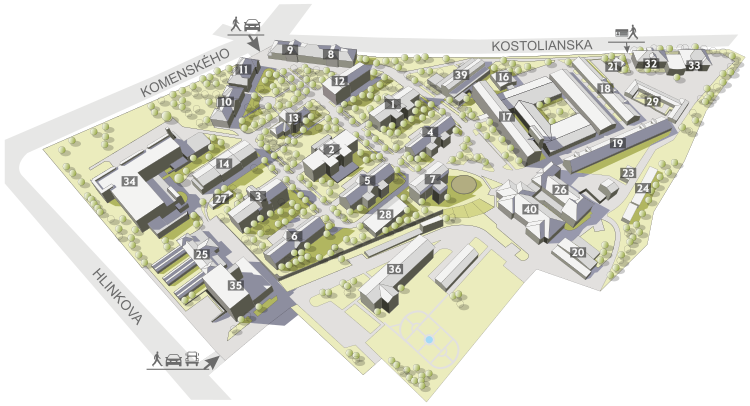
- a) Teaching premises and their technical equipment
-
Course
Characteristics of material and technical equipment
Location Helminthology
centrifuge, Elisa reader, electrophoresis, thermocycler, PCR boxes.
ZEISS AXIO; Nikon; Olympus BX41 microscopes with camera, camera, computer and measurement software, and software for professional microscope photography;
Building No. 2 - second floor;
Seminar room 3
Coprology Laboratory L1;
Laboratory No. 106
L3 PCR Laboratory
Electrophoresis - L4
Autopsy room No. 111
Training room 1 and 2 (Building No. 2, first floor)
Diseases of bees
Training room for bee diseases equipped with data projector and computer, ambulance and seminar room, Laboratory of haematology I. and Laboratory of biochemistry II., apiary, bee hives, meadery and storehouse.
P 26
Training room No. 38
Outpatient clinic 3-4, SM 4, laboratory No. 17, bee hive UVMP campus
Protozoology
centrifuge, Elisa reader, electrophoresis, thermocycler, PCR boxes.
ZEISS AXIO; Nikon; Olympus BX41 microscopes with camera, camera, computer and measurement software, and software for professional microscope photography;
Building No. 2 - second floor;
Seminar room 3
Coprology Laboratory L1;
Laboratory No. 106
L3 PCR Laboratory
Electrophoresis - L4
Autopsy room No. 111
Training room 1 and 2 (Building No. 2, first floor)
Parasitic diseases of game
Technical equipment: microscopes - Zeis PrimoStar; Olympus BX41, 2x Motic BA 310, Stereomicroscopes - binocular magnifier Zeis Stemi 508; Motic SMZ 168, Camera for microscope (with software for measuring morphological structures) - Zeis AxioCam ERc5S, Moticam 2300, Camera for stereomicroscope (with software for measuring morphological structures) - Zeis AxioCam ERc5s. Material and equipment: permanent preparations of selected species of game parasites; fixation solutions for primary fixation of parasites and formation of permanent preparations. Thanks to cooperation with several hunting associations we will be able to obtain a sufficient number and diversity of samples (with positive results). The UVMP purpose-built facility in Rozhanovce is also used for teaching.
Theoretical teaching: lecture room P2
Practical training: training room 1 (ground floor of Pavilion 2);
Laboratory 1 and 2
Parasitozoonoses
Technical equipment: microscopes - Zeis PrimoStar; Olympus BX41, 2x Motic BA 310, Stereomicroscopes - binocular magnifier Zeis Stemi 508; Motic SMZ 168, Camera for microscope (with software for measuring morphological structures) - Zeis AxioCam ERc5S, Moticam 2300, Camera for stereomicroscope (with software for measuring morphological structures) - Zeis AxioCam ERc5s. Material and equipment: fixation solutions for performing primary fixation of parasites and making permanent slides. The UVMP purpose-built facility in Rozhanovce is also used for teaching.
Theoretical teaching: lecture room P2
Practical training: training room 1 (ground floor of Pavilion 2),
Laboratory 1 and 2
General parasitology
Microscope - Olympus CX23
Centrifuge
Permanent micro and macro preparations
Building No. 2 - second floor;
Seminar room 3
Coprology Laboratory L1;
Laboratory No. 2
Laboratory No. 106
Training room 1 and 2 (Building No. 2, first floor)
Arachnoentomology
Binocular magnifiers ZEISS Stemi DV4; Nikon SMZ 1500 with camera and connection to computer with software for measuring;
Building No. 2 - second floor;
Seminar room 3
Entomological Laboratory L2
Laboratory No. 107
L3 PCR Laboratory
Parasitic diseases of fish
Technical equipment: microscopes - Zeis PrimoStar; Olympus BX41, 2x Motic BA 310, Stereomicroscopes - binocular magnifier Zeis Stemi 508; Motic SMZ 168, Camera for microscope (with software for measuring morphological structures) - Zeis AxioCam ERc5S, Moticam 2300, Camera for stereomicroscope (with software for measuring morphological structures) - Zeis AxioCam ERc5s. Material and equipment: permanent slides of selected freshwater parasite species; fixation solutions for primary fixation of parasites and formation of permanent slides. Good diversity of ornamental fish species, fish for consumption and fish from open waters – these will be used for parasitological examination . The pond of the UVMP Special Purpose Facility in Rozhanovce is also used for teaching.
Theoretical teaching: lecture room P2
Practical training: training room 1 (ground floor of Pavilion 2)
Laboratory 1
Pathological anatomy
Material and equipment for the animal's autopsy and for further examinations:
1. histological sledge microtomes (pfm Slide 2003 - pfm medical Germany and Histoslide 2000, Leica - Reichert - Jung), Shandon Citadel - tissue processor, WD4 pouring apparatus, light microscopes with camera: MOTIC + photocamera MOTICAM 2330, NICON Eclipse Tí + photocamera), thermostat, refrigerator,
2. PCR: PCR box, PCR thermocycler, CO2 incubator, deep freezer box,
3. cytological: cytocentrifugation
4. flow cytometry: flow cytometer Becton Dickinson, centrifuge
P17/C
Autopsy rooms and laboratories of the Department of Morphology
Molecular parasitology
Fully equipped laboratory for molecular diagnostics of parasitic diseases
P 1
Laboratories 2-3 floor
Seminar room 4
- b) Information resources
-
All literary resources for study outlined in the syllabi are available either in print or electronic form, all information databases purchased and licensed by the university are widely available to students.
- c) Distance learning, e-learning access and procedures
-
Description and scope of distance education in the study programme with per course. Access data, manuals of e-learning portals. Procedures for the transition from in-person to distance learning.
UVLF in Košice also provides distance learning for all courses via the MOODLE and MS Teams platforms. Each student can access manuals either in electronic form or in the form of video instructions.
- d) Partners involved in educational activities
-
Partners of the university in the provision of educational activities of the study programme and characteristics of their participation: the SAV and the ŠVPS SR.
- Characteristics Social, sports, cultural, spiritual and social life:
UVLF in Košice provides excellent conditions for the above.
- e) Social, sports, cultural, spiritual and community activities
- Not provided yet.
- f) Student mobility and placements
-
Students of the Immunology study programme are guaranteed the opportunity to participate in mobilities. The entire agenda containing instructions and conditions for applying for mobility, conditions and rules of participation as well as rules for recognizing mobility as part of the study plan is covered by the Vice-Rector for International Relations and Internationalisation and the organisational unit managed by her, which is the UVMP Mobility Office. The whole process requires coordination with the supervisor, and is recommended after the study part of the study plan has been completed. Participation in mobility and other contexts are regulated Article 42 of the Internal Regulations of the Study Regulations of the UVMP in Košice, Part B.
9. Required skills of the applicant and prerequisites
- a) Required abilities and admission prerequisites
-
They are laid down in Article 1 of the Study Regulations of the UVMP in Košice, Part B, II. Part Organisation of studies.
- b) Admission procedures
-
Admission procedures: are laid down in Article 3 of the Study Regulations of the UVMP in Košice, Part B, II. Part Organisation of studies. Examination boards for admission examinations are at least 4 members and are appointed by the Rector on an ad hoc basis according to the study programmes to which students apply.
- c) Admission results over the standard duration of study
-
Academic year Applicants Admitted Enrolled Graduates 2021/2022 0 0 0 — 2020/2021 0 — — — 2019/2020 0 — — — 2018/2019 0 — — —
10. Feedback regarding the quality of education provided
- a) Monitoring and assessment of student feedback
-
- Procedures for monitoring and evaluating students' views on the quality of the study programme:
The students of UVMP in Košice can evaluate the quality of teaching anonymously through an anonymous questionnaire after graduation, where they evaluate the quality of a particular study programme and the quality of the lecturers who provide the course. Monitoring of study programmes is also continuously carried out by the coordinators of individual fields (5) of science and research at UVMP.
- b) Student feedback and measures to improve programme quality
-
The feedback and measures to improve the quality of the study programme are part of the Annual Reports on the Educational Activity at UVLF in Košice for individual academic years and the Annual Reports on the Quality of UVLF in Košice for individual academic years. They are also presented at the Teachers' meeting, which is held at the beginning of each academic year. In general, the principle that the results of the feedback are very important for drawing conclusions from the evaluations, as these are implemented into concrete measures aimed at improving the quality of the study programme.
- c) Graduate feedback and measures to improve programme quality
-
The results of alumni feedback and related measures to improve the quality of the study programme are part of the Annual Reports on Scientific and Research Activities at UVMP in Košice for individual AY and Annual Reports on the Quality of UVMP in Košice for individual AY. The Vice-Rector for Science, Research and Doctoral Studies and the coordinators of the individual domains of science and research act within the framework of the measures to improve the quality of the study programme by personally entering into the solution of the problems arising from the results of the feedback.
11. Demonstration of long-term and continuous success in obtaining financial support
- a) Demonstration of long-term and continuous success in obtaining financial support
-
P.no.
Project number
From
To
Project name
Provider
Principal Investigator / Co-Principal Investigator
1
1/0063/13
2013
2015
DNA analysis and genotypic spectrum of medically important agents of opportunistic parasitoses.
SGA
Assoc. Prof. Alexandra Valenčáková, DVM PhD.
2
1/0080/15
2015
2018
Study of the ecology and epidemiological role of blood-sucking dipterans (DIPTERA) in the spread of global zoonotic and parasitic pathogens in climate-changing Slovakia
SGA
Prof. Alica Kočišová, DVM PhD.
3
APVV-15-0134
2016
2019
Genetic diversity of selected medically important new and emerging pathogens with zoonotic potential."
RDPA
Assoc. Prof. Alexandra Valenčáková, DVM PhD.
4
01/2016
2016
2017
Genotyping of Giardia duodenalis in humans and animals
IGA
Assoc. Prof. Gabriela Štrkolcová, DVM PhD.
5
009UVLF-4/2018
2018
2020
Modernization of the technical equipment of the parasitology laboratory and creation of study permanent slides and materials for e-learning
CEGA
Miloš Halán, DVM PhD.
6
1/0536/18
2018
2021
New aspects of the circulation of intestinal parasitic infections in animals and humans
SGA
Assoc. Prof. Gabriela Štrkolcová, DVM PhD.
7
1/0043/19
2019
2022
Molecular epidemiology and risk of spread of game parasites in current ecological conditions in Slovakia
SGA
Prof. Alica Kočišová, DVM PhD.
8
015UVLF-4/2020
2020
2022
Increasing the level of the pedagogical process by modernizing the training room and laboratory for practical teaching and the preparation of teaching texts for the disciplines "Breeding and Diseases of Game I" and "Breeding and Diseases of Game"
CEGA
Assoc. Prof. Peter Lazár, DVM PhD.
9
1/0113/20
2020
2022
Molecular characterization of selected zoonotic species and genotypes of enteric pathogens in the environment in Slovakia
SGA
Assoc. Prof. Alexandra Valenčáková, DVM PhD.
10
APVV-21-0185
2022
2026
Impact of environmental pollution on the incidence of nosematosis in bees
RDPA
Assoc. Prof. Alexandra Valenčáková, DVM PhD.
12. Links to other relevant internal regulations and information regarding the study or the student of the study programme
- Relevant internal regulations and other information
If the window remains open, close this browser tab.