

- a) Name and registration code of the study programme:
- Infectious diseases of animals · 104002 · UIPŠ 4322V02
- b) Degree of study and ISCED level:
- Third degree · ISCED 8
- c) Place of delivery:
- University of Veterinary Medicine and Pharmacy in Košice · Komenského 73, 041 81 Košice
- d) Field of study and ISCED-F code:
- Veterinary Medicine
- e) Type of study programme:
- Single degree study
- f) Awarded academic degree:
- PhD (philosophiae doctor)
- g) Form of study:
- part-time study
- h) Partner universities and distribution of study obligations in a joint study programme
- i) Language of instruction:
- English language
- j) Standard duration of study:
- 5 years
- k) Programme capacity and applicants over the last six academic years
-
Planned student capacity Applicants over the last 6 academic years Admitted students over the last 6 academic years Enrolled students over the last 6 academic years — 0 0 0 - l) Information about the study programme:
- Programme details
Study programme description
Infectious diseases of animals
part-time study ·  · 104002 · 2023/2024
Last updated: 30.10.2026
- Higher education institution
- University of Veterinary Medicine and Pharmacy in Košice
- Registered address
- Komenského 73, 041 81 Košice
- Institution identification number
- 00397474
- Programme approval body
- UVMP Accreditation Commission in Košice
- Approval date
- 26.08.2022
1. Basic data on the study programme
2. Profile of a graduate and aims of education
- a) Educational objectives and main learning outcomes
-
The learning objectives achieved in the study programme in infectious animal diseases are methodologically based on the European Qualifications Framework for Lifelong Learning (EQF). This defines the requirements for learning outcomes for knowledge, skills, responsibility and autonomy.
For level 8, the required learning outcomes are 'knowledge at the highest level in the field of work or field of study as well as at the interface between fields/fields'.
The carriers of the graduate's core knowledge are profile courses in the field of animal diseases and animal health protection, zoonoses and protection of common health, predictive epidemiology, risk assessment in epidemiology and prevention of infectious diseases in animals, which are described in the information sheets as knowledge achieved as learning outcomes. Additional knowledge is achieved by completing compulsory optional courses in the study programme in the fields of molecular epidemiology, general and special virology, general and special bacteriology, diagnostic pathology, veterinary immunology, infectious diseases of wildlife, public and forensic veterinary medicine, and ecology and environmental protection. The graduate has extensive professional knowledge in several areas of the study programme or discipline, which he/she uses as a basis for conducting research and development in the field of infectious animal diseases. It aims at acquiring the latest theoretical knowledge based on the current state of scientific knowledge in the various areas of infectious animal diseases.
Its study builds on the knowledge acquired through second-level higher education at veterinary and medical universities and colleges (faculties), pharmaceutical, natural sciences, or other faculties of medicine and natural sciences. On this basis, the principles of education in the 3rd stage are built for the acquisition of knowledge so that the graduate can master the scientific methods of research and solving the problems of infectious diseases of animals and infectious diseases common to humans and animals - zoonoses. The graduate knows the laws of the origin, course and termination of infectious diseases, knows the factors influencing the course of epizootological processes. The student knows the biological properties of etiological agents, pathogenesis of individual diseases and immunological properties of antigens for their use and applicability in the prevention of diseases. Knows the different forms and methods of depistribution and monitoring of infectious diseases; is able to independently carry out surveillance of diseases (including zoonoses), epidemiological analyses and forecasting of disease situations. Can define and evaluate risks in epizootiology and develop preventive measures to protect animal health and the common health of animals and humans (One health).
For level 8, the most 'advanced and specialised skills and techniques, including the ability to synthesise and evaluate, are required to solve fundamental problems in research and/or innovation and to extend and redefine existing knowledge or professional practices'.
The graduate of the study programme in infectious diseases of animals knows the most modern methods used in the diagnosis, differential diagnosis, prevention, control and therapy of infectious diseases. The graduate will acquire knowledge for the development of new diagnostic methods, new immunological preparations, drugs, devices and instruments. He/she will acquire the skills to organize epidemiological field research, legal and environmental aspects of disease control, ethical and social aspects of scientific work, the correct way of presenting the results of his/her work and the principles for the development of the study programme and the contribution to practice.
He is technically skilled not only in routine laboratory procedures but also in working with software-intensive instrumentation for epidemiological research. He is able to formulate scientific problems, conduct creative, independent research and independently present the results of his work in internationally accepted journals or present them at scientific events. The results of creative experimental work not only contribute to the development of science and scientific knowledge, but their appropriate scientific value allows their application in human and veterinary medicine, agriculture, pharmacology and the protection of animal and human health.
Responsibility and autonomy, defined for Level 8, is "the ability to display considerable authority, innovation, independence, scholarly and professional integrity, and a sustained commitment to developing new ideas or practices that are at the forefront of a given work or learning environment, including research."
The graduate is characterized by independent, critical and analytical thinking. He/she takes into account social, scientific and ethical aspects when formulating research intentions and interpreting research results. The results of his/her own creative work contribute to the development of science, scientific knowledge and the application of acquired knowledge in practice. He/she presents the results of research and development independently to the professional community. Can determine the focus of research and coordinate a team in the relevant study programme. Can independently design, validate and implement new research and working practices based on their outputs and findings.
- Graduates of the study programme of infectious animal diseases can apply as an infectologist/ epizootologist - expert in basic and applied research of infectological and epizootological focus in the Department of Health, Agriculture, Environment, Ministry of Defence and the Ministry of the Interior.
- b) Occupations and graduate employment opportunities
- Not provided yet.
- c) Statements of relevant external stakeholders
-
Company or external stakeholder Statement Komora veterinárnych lekárov Slovenskej republiky View
3. Job prospects
- a) Assessment of graduate employability
-
- On the basis of previous long experience with graduates of the study programme of infectious animal diseases, it can be stated that graduates find employment at all schools where infectious animal diseases, epizootology, epidemiology are taught within the biological disciplines, as well as at research institutes where theoretical and practical aspects of infectious animal diseases, zoonoses, protection of animal and human health against animal-borne diseases are addressed. It will find application in the Ministry of Health, Ministry of Agriculture, Ministry of Environment, Ministry of Defence and Ministry of the Interior, especially in laboratories dealing with diagnostics of infectious animal diseases, infectious agents as causative agents of zoonoses, epizootics, enzootics and epidemics.
- b) Examples of successful graduates
-
Examples of successful graduates of the study programme of infectious diseases of animals: There have been no graduates so far in the full-time study programme infectious diseases of animals offered in English.
- c) Employer feedback on programme quality
-
Employers' evaluation of the quality of the study programme (feedback): However, the quality of the study programme can be positively evaluated indirectly on the basis of the interest of graduates of the second cycle of higher education from different areas (medical and pharmaceutical sciences, natural sciences and agricultural sciences) in this study programme. UVMP has prepared questionnaires about graduates for employers.
4. Structure and content of the study programme
- a) Rules for designing study plans
-
- The rules for the formation of study plans in the study programme of infectious animal diseases are based on the general provisions contained in Article 8 of the internal regulation Study Regulations of the UVMP in Košice, Part B.
- b) Recommended study plan:
- Study plan 2023/2024
- c) Information included in the study plan
-
Course information sheets for the Infectious diseases of animals study programme are available through links directly in the study plan.
- d) Credits and other requirements for completion of study
- Not provided yet.
- e) Requirements for individual programme components and student progression
- Not provided yet.
- f) Assessment of learning outcomes and appeal procedures
- Not provided yet.
- g) Recognition of studies or parts of studies
- Not provided yet.
- h) Thesis topics
-
Thesis topics and supervisors are listed in Table 2 in section 7.e of this description.
- i) Other study rules and procedures
-
UVMP in Košice has described the rules for the verification of learning outcomes and evaluation of students and the possibilities of corrective procedures against this evaluation in Articles 17, 18 and 25 of the internal regulation Study Regulations of UVMP in Košice, Part B.
- Conditions for the recognition of studies or part of studies:
UVMP in Košice has regulated the conditions for recognition of studies or part of studies in Articles 19, 38 and 42 of the internal regulation Study Regulations of UVMP in Košice, Part B.
- Topics of the final theses of the study programme:
UVMP in Košice annually lists the topics of the final theses of the study programme of infectious animal diseases in a tabular overview as well as on the UVMP in Košice website.
In the study programme infectious diseases of animals offered in English in the part-time form of study, no topic has been announced so far.
- UVMP in Košice has described:
- the rules for assigning, processing, opposing, defending and evaluating final theses in Articles 1, 8, 9, 10, 25 - 27 of the internal regulation Study Regulations of UVMP in Košice, Part B,
- possibilities and procedures for participation in student mobility in Article 42 of the internal regulation Study Regulations of UVMP in Košice, Part B,
- rules of observing academic ethics and drawing consequences in the internal regulation Disciplinary Regulations for Students of the University of Veterinary Medicine and Pharmacy in Košice, in the internal regulation Code of Ethics of UVMP in Košice employee and in the internal regulation Code of Ethics of UVMP in Košice student,
- procedures applicable to students with special needs in Part II, Article 2, point 7; Article 3, point 12 of the internal regulation Study Regulations of the UVMP in Košice, Part B,
- the procedures for filing complaints and appeals by the student are specified, in addition to the Study Regulations of UVMP in Košice, in particular in the internal regulation Directive on the handling of complaints at UVMP in Košice.
5. Study programme’s information letters
- Course information sheets
-
Course information sheets are available through links directly in the study plan. Study plan 2023/2024
6. Current schedule of the academic year and current timetables
- Current academic calendar and timetables
- Not provided yet.
7. Staff
- a) Person responsible for the delivery, development and quality of the study programme
- Dr. h. c. Prof. Jana Mojžišová, DVM, PhD
- b) Teachers of profile courses
- c) Research/art/teaching profiles of teachers of profile courses
- d) Teachers, courses and links to the central register of university employees
-
(Click the teacher’s name to open their profile and contact details, where available.)
Table 1 – Teachers and courses of the study programme Teacher Courses Portál VŠ Assoc. prof. Csank Tomáš, DVM, PhD General and special bacteriology; General and special virology Portál VŠ Assoc. prof. Čurlík Ján, DVM, PhD Infectious diseases of wild animals Portál VŠ Assoc. prof. Jacková Anna, DVM, PhD Contagious diseases of animals and animal health protection; Prevention of infectious diseases of animals; Predictive epizootology; Risk assessment in epizootology; Zoonoses and one health protection; Molecular epizootology Portál VŠ Assoc. prof. Korim Peter, DVM, CSc. Public and forensic veterinary medicine Portál VŠ Assoc. prof. Korytár Ľuboš, DVM, PhD Contagious diseases of animals and animal health protection; Prevention of infectious diseases of animals; Predictive epizootology; Risk assessment in epizootology; Zoonoses and one health protection; Molecular epizootology Portál VŠ Assoc. prof. Koščová Jana, DVM, PhD General and special bacteriology Portál VŠ Assoc. prof. Lazár Peter, DVM, PhD Infectious diseases of wild animals Portál VŠ Assoc. prof. Levkut Martin, DVM, PhD Diagnostic pathology Portál VŠ Assoc. prof. Prokeš Marián, DVM, PhD Contagious diseases of animals and animal health protection; Prevention of infectious diseases of animals; Predictive epizootology; Risk assessment in epizootology; Zoonoses and one health protection; Molecular epizootology Portál VŠ Assoc. prof. Revajová Viera, DVM, PhD Diagnostic pathology Portál VŠ Bartková Valéria, M.A. Foreign language Portál VŠ Dr. h. c. Prof. Mojžišová Vaščinec Jana, DVM, PhD Contagious diseases of animals and animal health protection Portál VŠ Drážovská Monika, DVM, PhD Contagious diseases of animals and animal health protection Portál VŠ Dvorská Oľga, M.Sc. Foreign language Portál VŠ Eibenová Andrea, M.Sc. Foreign language Portál VŠ Mandelík René, DVM, PhD Contagious diseases of animals and animal health protection Portál VŠ Petrillová Monika, M.Sc. Foreign language Portál VŠ Prof. Herich Róbert, DVM, PhD Diagnostic pathology Portál VŠ Prof. Kočišová Alica, DVM, PhD Contagious diseases of animals and animal health protection Portál VŠ Prof. Levkutová Mária, DVM, PhD Contagious diseases of animals and animal health protection; Prevention of infectious diseases of animals; Predictive epizootology; Risk assessment in epizootology; Zoonoses and one health protection; Molecular epizootology Portál VŠ Prof. Mudroňová Dagmar, DVM, PhD Veterinary immunology Portál VŠ Prof. Ondrejková Anna, DVM, PhD Contagious diseases of animals and animal health protection; Prevention of infectious diseases of animals; Predictive epizootology; Risk assessment in epizootology; Zoonoses and one health protection; Molecular epizootology Portál VŠ Prof. Pilipčinec Emil, DVM, PhD General and special bacteriology Portál VŠ Prof. Pistl Juraj, DVM, PhD General and special bacteriology; General and special virology Portál VŠ Prof. Ševčíková Zuzana, DVM, PhD Diagnostic pathology Portál VŠ Prof. Takáčová Daniela, DVM, PhD Public and forensic veterinary medicine Portál VŠ Prof. Tkáčiková Ľudmila, DVM, PhD Veterinary immunology Portál VŠ Straková Katarína, M.Sc. Foreign language Portál VŠ Vojtek Boris, DVM, PhD Contagious diseases of animals and animal health protection Portál VŠ - e) Thesis supervisors and topics 5 years
-
(Click the teacher’s name to open their profile and contact details, where available.)
Table 2 – Thesis supervisors and topics Teacher Thesis topics Academic year — - f) Research/art/teaching profiles of thesis supervisors
-
The supervisors’ research/art/teaching profiles are available through their personal profiles using the name buttons in the preceding table.
- g) Student representatives and contacts
-
The member of the committee for the preparation of the study programme infectious animal diseases was a student of the study programme general veterinary medicine Miriam Sondorova, Mgr.; e-mail: miriam.sondorova@student.uvlf.sk.
- h) Study adviser
-
Study programme advisor: vice-rector for research and doctoral studies at UVMP in Košice
- Other study programme support staff - assigned study officer: Júlia Jančura, Mgr., e-mail julia.jancuraa@uvlf.sk; career counsellor: the function of the career counsellor is performed by the doctoral student's supervisor.
- i) Other support staff
- Not provided yet.
8. Premises, tools and technical equipment
- a) Teaching premises and their technical equipment
-
Course
Characteristics of material and technical equipment
Location Animal diseases and animal health
The material and technical equipment of the workplace for teaching the course "Animal diseases and animal health protection" includes premises (training rooms and laboratories), which are arranged and equipped for the detection and study of pathogens - agents of infectious diseases or animal diseases. Two modern training rooms, which include changing rooms for students, a room for the preparation of material for exercises, are located in the P1 pavilion on the 2nd floor, where special laboratories of the Department are also set up: a bacteriological laboratory, a virological laboratory for the isolation and identification of RNA and DNA viruses, which are equipped with the following facilities: BSL2 laminar boxes, PCR boxes, robotic nucleic acid isolator, centrifuges, ultracentrifuge, thermocyclers for PCR, real-time PCR, digital droplet PCR; the department also has an imaging laboratory equipped with electrophoretic apparatus, automated imaging and documentation system, automated chip electrophoresis. The serology, immunology and cell culture laboratories are equipped with: BSL2 laminar boxes, centrifuges, thermostats, ELISA reader, Synergy HTX multi-mode reader, inverted microscope, spectrophotometer, amine acid separation equipment, lyophilization equipment and others. Labs include: deep freeze boxes, fluorescence microscopes, phase contrast microscope, thermostats, CO2 incubators, autoclaves, Dewar vessels, refrigerators, freezers, and more. Part of the teaching is carried out in the clinical area (outpatient clinic, isolation and quarantine rooms, laboratories), which is available to the Department in P40 (University Veterinary Hospital); field teaching is carried out at the Zemplínska Teplica SPS (livestock farms, training rooms, laboratories used for primary processing of material); at the special purpose workplaces of the University - Equestrian area, Special purpose facility for breeding and diseases of game, fish and bees in Rozhanovce; or at the University's special purpose facility for breeding and diseases of game, fish and bees in Rozhanovce. in livestock farms (contract with the ŠVPS, relevant RVPS, zoo garden, shelters, etc.).
P1 exercise rooms 335, 336, 337, 319, 329; bacteriology laboratory 331-332; virology laboratories 313-316; 304-306, 321; imaging techniques laboratory 311; serology, immunology and cell culture laboratories (308-310, 318)
P40 ambulance, isolation and quarantine premises, laboratories, rooms No. 114-120); ŠPP Zemplínska Teplica n.o., Equestrian area, Purpose-built facility for breeding and diseases of game, fish and bees in Rozhanovce.
Zoonoses and protection of the common health
The material and technical equipment of the workplace for teaching the course "Zoonoses and protection of common health" includes premises (training rooms and laboratories), which are arranged and equipped for the detection and study of zoonotic pathogens - zoonotic agents (viral, bacterial and mycotic). Two modern training rooms, which include changing rooms for students, a room for the preparation of material for exercises, are located in Pavilion P1 on the 2nd floor, where the special laboratories of the Department are also set up: a bacteriological laboratory, a virological laboratory for the isolation and identification of RNA and DNA viruses, which are equipped with the following: BSL2 laminar boxes, PCR boxes, robotic nucleic acid isolator, centrifuges, ultracentrifuge, thermocyclers for PCR, real-time PCR, digital droplet PCR; the department also has an imaging laboratory equipped with electrophoretic apparatus, automated imaging and documentation system, automated chip electrophoresis. The serology, immunology and cell culture laboratories are equipped with: BSL2 laminar boxes, centrifuges, thermostats, ELISA reader, Synergy HTX multi-mode reader, inverted microscope, spectrophotometer, amine acid separation equipment, lyophilization equipment and others. Labs include: deep freeze boxes, fluorescence microscopes, phase contrast microscope, thermostats, CO2 incubators, autoclaves, Dewar vessels, refrigerators, freezers, and more. Part of the teaching is carried out in the clinical area (outpatient clinic, isolation and quarantine rooms, laboratories), which is available to the Department in P40 (University Veterinary Hospital); field teaching is carried out at the Zemplínska Teplica SPS (livestock farms, training rooms, laboratories used for primary processing of material); at the special purpose workplaces of the University - Equestrian area, Special purpose facility for breeding and diseases of game, fish and bees in Rozhanovce; or at the University's special purpose facility for breeding and diseases of game, fish and bees in Rozhanovce. in livestock farms (contract with the ŠVPS, relevant RVPS, zoo garden, shelters, etc.).
P1 exercise rooms 335, 336, 337, 319, 329; bacteriology laboratory 331-332; virology laboratories 313-316; 304-306, 321; imaging techniques laboratory 311; serology, immunology and cell culture laboratories (308-310, 318)
P40 ambulance, isolation and quarantine premises, laboratories, rooms No. 114-120); ŠPP Zemplínska Teplica n.o., Equestrian area, Purpose-built facility for breeding and diseases of game, fish and bees in Rozhanovce.
Predictive epidemiology
The material and technical equipment of the workplace for the teaching of the course "Predictive Epidemiology" (training rooms and laboratories) are arranged and equipped specifically for the detection and study of pathogens - agents of infectious diseases (viral, bacterial and mycotic), including the conduct of epidemiological studies aimed at analysis, evaluation, modelling and forecasting in epidemiology. Two modern training rooms, which include changing rooms for students, a room for the preparation of material for exercises, are located in Pavilion P1 on the 2nd floor, where the special laboratories of the department are also established: bacteriological laboratory, virological laboratory for the isolation and identification of RNA and DNA viruses, which are equipped: BSL2 laminar boxes, PCR boxes, robotic nucleic acid isolator, centrifuges, ultracentrifuge, thermocyclers for PCR, real-time PCR, digital droplet PCR; the department also has an imaging laboratory equipped with electrophoretic apparatus, automated imaging and documentation system, automated chip electrophoresis. The serology, immunology and cell culture laboratories are equipped with: BSL2 laminar boxes, centrifuges, thermostats, ELISA reader, Synergy HTX multi-mode reader, inverted microscope, spectrophotometer, amine acid separation equipment, lyophilization equipment and others. Labs include: deep freeze boxes, fluorescence microscopes, phase contrast microscope, thermostats, CO2 incubators, autoclaves, Dewar vessels, refrigerators, freezers, and more. Part of the teaching is carried out in the clinical area (outpatient clinic, isolation and quarantine rooms, laboratories), which is available to the Department in P40 (University Veterinary Hospital); field teaching is carried out at the Zemplínska Teplica SPS (livestock farms, training rooms, laboratories used for primary processing of material); at the special purpose workplaces of the University - Equestrian area, Special purpose facility for breeding and diseases of game, fish and bees in Rozhanovce; or at the University's special purpose facility for breeding and diseases of game, fish and bees in Rozhanovce. in livestock farms (contract with the ŠVPS, relevant RVPS, zoo garden, shelters, etc.).
P1 exercise rooms 335, 336, 337, 319, 329; bacteriology laboratory 331-332; virology laboratories 313-316; 304-306, 321; imaging techniques laboratory 311; serology, immunology and cell culture laboratories (308-310, 318)
P40 ambulance, isolation and quarantine premises, laboratories, rooms No. 114-120); ŠPP Zemplínska Teplica n.o., Equestrian area, Purpose-built facility for breeding and diseases of game, fish and bees in Rozhanovce.
Risk assessment in epidemiology
The material and technical equipment of the workplace for teaching the course "Risk assessment in epidemiology" (training rooms and laboratories) are arranged and equipped for the detection and study of pathogens - agents of infectious diseases (viral, bacterial and mycotic), including the implementation of epidemiological studies aimed at analysis, evaluation, modelling and forecasting in epidemiology. Two modern training rooms, which include changing rooms for students, a room for the preparation of material for exercises, are located in Pavilion P1 on the 2nd floor, where the special laboratories of the department are also established: bacteriological laboratory, virological laboratory for the isolation and identification of RNA and DNA viruses, which are equipped: BSL2 laminar boxes, PCR boxes, robotic nucleic acid isolator, centrifuges, ultracentrifuge, thermocyclers for PCR, real-time PCR, digital droplet PCR; the department also has an imaging laboratory equipped with electrophoretic apparatus, automated imaging and documentation system, automated chip electrophoresis. The serology, immunology and cell culture laboratories are equipped with: BSL2 laminar boxes, centrifuges, thermostats, ELISA reader, Synergy HTX multi-mode reader, inverted microscope, spectrophotometer, amine acid separation equipment, lyophilization equipment and others. Labs include: deep freeze boxes, fluorescence microscopes, phase contrast microscope, thermostats, CO2 incubators, autoclaves, Dewar vessels, refrigerators, freezers, and more. Part of the teaching is carried out in the clinical area (outpatient clinic, isolation and quarantine rooms, laboratories), which is available to the Department in P40 (University Veterinary Hospital); in livestock farms (contract with the ŠVPS, relevant RVPS, zoo garden, shelters, etc.).
P1 training rooms 335, 336, 337, 319, 329; bacteriology laboratory 331-332; virology laboratories 313-316; 304-306, 321; imaging techniques laboratory 311; serology, immunology and cell culture laboratories (308-310, 318)
P40 ambulance, isolation and quarantine premises, laboratories, rooms No. 114-120); ŠPP Zemplínska Teplica n.o., Equestrian area, Purpose-built facility for breeding and diseases of game, fish and bees in Rozhanovce.
Prevention of infectious diseases in animals
The material and technical equipment of the workplace for teaching the course "Prevention of infectious diseases in animals" (training rooms and laboratories) are arranged and equipped for the detection and study of pathogens - agents of infectious diseases (viral, bacterial and mycotic), including the implementation of epidemiological studies aimed at the prevention and control of infectious diseases in animals. Two modern training rooms, which include changing rooms for students, a room for preparation of material for exercises, are located in Pavilion P1 on the 2nd floor, where special laboratories of the Department are also established: bacteriological laboratory, virological laboratory for isolation and identification of RNA and DNA viruses, which are equipped: BSL2 laminar boxes, PCR boxes, robotic nucleic acid isolator, centrifuges, ultracentrifuge, thermocyclers for PCR, real-time PCR, digital droplet PCR; the department also has an imaging laboratory equipped with electrophoretic apparatus, automated imaging and documentation system, automated chip electrophoresis. The serology, immunology and cell culture laboratories are equipped with: BSL2 laminar boxes, centrifuges, thermostats, ELISA reader, Synergy HTX multi-mode reader, inverted microscope, spectrophotometer, amine acid separation equipment, lyophilization equipment and others. Labs include: deep freeze boxes, fluorescence microscopes, phase contrast microscope, thermostats, CO2 incubators, autoclaves, Dewar vessels, refrigerators, freezers, and more. Part of the teaching is carried out in the clinical area (outpatient clinic, isolation and quarantine rooms, laboratories), which is available to the Department in P40 (University Veterinary Hospital); in livestock farms (contract with the ŠVPS, relevant RVPS, zoo garden, shelters, etc.).
P1 training rooms 335, 336, 337, 319, 329; bacteriology laboratory 331-332; virology laboratories 313-316; 304-306, 321; imaging techniques laboratory 311; serology, immunology and cell culture laboratories (308-310, 318)
P40 ambulance, isolation and quarantine premises, laboratories, rooms No. 114-120); ŠPP Zemplínska Teplica n.o., Equestrian area, Purpose-built facility for breeding and diseases of game, fish and bees in Rozhanovce.
Molecular epidemiology
The material and technical equipment of the workplace for teaching the course "Molecular Epidemiology" (training rooms and laboratories) are arranged and equipped for the detection and study of pathogens - infectious disease agents from the point of view of molecular epidemiology. Two modern training rooms, which include changing rooms for students, a room for the preparation of material for exercises, are located in Pavilion P1 on the 2nd floor, where the special laboratories of the Department are also set up: a bacteriological laboratory, a virological laboratory for the isolation and identification of RNA and DNA viruses, which are equipped with the following: BSL2 laminar boxes, PCR boxes, robotic nucleic acid isolator, centrifuges, ultracentrifuge, thermocyclers for PCR, real-time PCR, digital droplet PCR; the department also has an imaging laboratory equipped with electrophoretic apparatus, automated imaging and documentation system, automated chip electrophoresis. The serology, immunology and cell culture laboratories are equipped with: BSL2 laminar boxes, centrifuges, thermostats, ELISA reader, Synergy HTX multi-mode reader, inverted microscope, spectrophotometer, amine acid separation equipment, lyophilization equipment and others. Labs include: deep freeze boxes, fluorescence microscopes, phase contrast microscope, thermostats, CO2 incubators, autoclaves, Dewar vessels, refrigerators, freezers, and more.
P1 exercise rooms 335, 336, 337, 319, 329; bacteriology laboratory 331-332; virology laboratories 313-316; 304-306, 321; imaging techniques laboratory 311; serology, immunology and cell culture laboratories (308-310, 318).
General and special virology
Material and equipment for bacteriological and virological diagnostics and molecular biology: Thermostats, autoclaves, refrigerators, BSL2 laminar boxes, PCR boxes, conventional and refrigerated benchtop centrifuges, benchtop ultracentrifuge, thermocyclers for PCR and qPCR, Synergy 2 multidetection equipment, light inverted microscopes, Axio Observer fluorescence microscope (Zeiss) extended with Apotome 3 (Zeiss), technical extension of the Axio Observer microscope for "live cell imaging", CO2 incubator, electrophoretic apparatus, deep freezing boxes, isolates for gnotobiotic animals
P3
General and special bacteriology
Material and equipment for bacteriological and virological diagnostics and molecular biology: Thermostats, autoclaves, refrigerators, BSL2 laminar boxes, PCR boxes, conventional and refrigerated benchtop centrifuges, benchtop ultracentrifuge, thermocyclers for PCR and qPCR, Synergy 2 multidetection equipment, light inverted microscopes, Axio Observer fluorescence microscope (Zeiss) extended with Apotome 3 (Zeiss), technical extension of the Axio Observer microscope for "live cell imaging", CO2 incubator, electrophoretic apparatus, deep freezing boxes, isolates for gnotobiotic animals
P3
Workplace Pri hati 10
Diagnostic pathology
The spatial provision of the teaching of the course "Diagnostic Pathology" includes the premises of autopsy rooms for the dissection of large and small animals, histological laboratories and training rooms. Material and technical equipment includes sledge microtomes (Slide 2003 - Medical Germany and Histoslide 2000, Leica - Reichert - Jung), tissue processor - Shandon Citadel, watering device WD4, light microscopes with camera: Motic, Nikon Eclipse - camera, image analysis software NIS Elements ADR - fy. Nikon, instruments, equipment and aids for dissection, thermostats, cooling and freezing equipment, didactic equipment.
P17/C
Veterinary immunology
Material and equipment for bacteriological and virological diagnostics and molecular biology: Thermostats, autoclaves, refrigerators, BSL2 laminar boxes, PCR boxes, conventional and refrigerated benchtop centrifuges, benchtop ultracentrifuge, thermocyclers for PCR and qPCR, Synergy 2 multidetection equipment, light inverted microscopes, Axio Observer fluorescence microscope (Zeiss) extended with Apotome 3 (Zeiss), technical extension of the Axio Observer microscope for "live cell imaging", CO2 incubator, electrophoretic apparatus, deep freezing boxes, isolates for gnotobiotic animals
P3
Workplace Pri hati 10
Infectious diseases of wild game
The training room and laboratories are equipped to process samples from wild animal species specifically for the detection and study of infectious and parasitic agents of infectious diseases; in the case of infectious diseases, diagnostics is based on examinations at specialized UVMP and ŠVPS workplaces. Technical equipment is standard for the initial processing of field samples - freezers, microscopes, thermostats, autoclaves, refrigerators and others.
P2
Purpose-built facility for breeding and diseases of game, fish and bees Rozhanovce - field practical training
Public and forensic veterinary medicine
Computer technology, data projector, software equipment for the performance of official veterinary activities
P5 - training room No. 2
Ecology and environmental protection
Laboratory for microbiological analysis of water samples, excreta, etc., analysis of bacteriological swabs to check the effectiveness of disinfection (nutrient media, petri dishes, etc.). Laboratory for physico-chemical analyses, pH and conductivity meter, Oxymeter (LDO electrode with HQ Series Portable Meters fy. Hach, dryer (105 ºC), muffle furnace (550 ºC), water bath, spectrophotometer DR 2 800 phy. Hach, reactor for determination of COD, reactor for determination of COD, reactor for determination of COD, reactor for determination of COD. Hach, Digestdahl reactor fy. Hach, case set (VISOCOLOR® ECO for colorimetric testing of drinking water by Merck)
P3-2. NP, training room 1 and 2, laboratory 1
- Characteristics of information provision of the study programme (access to study literature according to course information sheets), access to information databases
and other information resources, information technology, etc.):
All literary resources for study listed in the fact sheets are available in either print or electronic form, and all information databases purchased and licensed by the University are accessible to students.
- Characteristics and scope of distance learning applied in the curriculum with assignment to courses. Approaches, manuals of e-learning portals. Procedures for transition from full-time to distance learning.
UVMP in Košice has also distance learning for all courses, which is currently provided through MOODLE and MS Teams platforms. Each student has manuals available either in electronic form or in the form of a video tutorial.
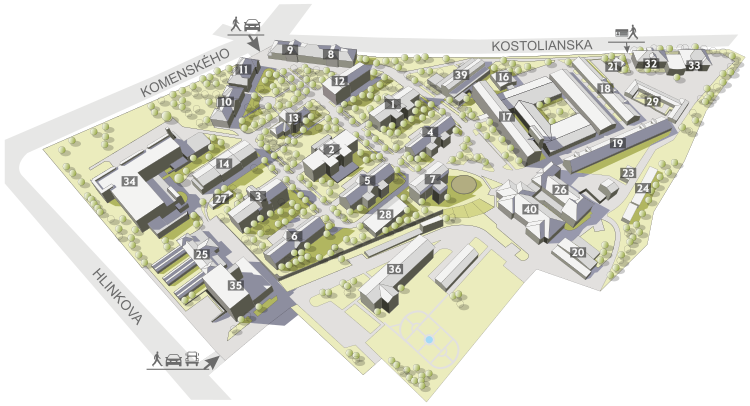
- Characteristics of information provision of the study programme (access to study literature according to course information sheets), access to information databases
- b) Information resources
- Not provided yet.
- c) Distance learning, e-learning access and procedures
- Not provided yet.
- d) Partners involved in educational activities
-
Partners of the university in the provision of educational activities of the study programme and characteristics of their participation.
- Characteristics on social, sporting, cultural, spiritual and social opportunities:
UVMP in Košice provides students with the maximum possible conditions for their enjoyment in the above areas.
- e) Social, sports, cultural, spiritual and community activities
- Not provided yet.
- f) Student mobility and placements
-
Students of the study programme in infectious animal diseases are guaranteed the opportunity to participate in mobility. The whole agenda of the guidelines and conditions for applying for mobility, the conditions and rules of participation as well as the rules of recognition of participation in mobility as part of the study plan is covered by the Vice-Rector for International Relations and Internationalisation and the organisational unit managed by her, which is the UVMP Mobility Office. The whole process requires coordination with the supervisor and is recommended after the study part of the study plan has been completed. Participation in mobility and other contexts are regulated in Article 42 of the Internal Regulations of the Study Regulations of the UVMP in Košice, Part B.
9. Required skills of the applicant and prerequisites
- a) Required abilities and admission prerequisites
- Not provided yet.
- b) Admission procedures
-
Admission procedures: they are laid down in Article 3 and Article 4, Part B, Part II Organisation of Studies of the Internal Regulations of the Study Regulations of the UVMP in Košice. The examination boards for admission examinations are at least 4-member and are appointed by the Rector on an ad hoc basis according to the focus of the study programmes to which students apply.
- c) Admission results over the standard duration of study
-
Academic year Applicants Admitted Enrolled Graduates 2021/2022 0 0 — —
10. Feedback regarding the quality of education provided
- a) Monitoring and assessment of student feedback
-
- Procedures for monitoring and evaluating students' views on the quality of the study programme:
Students of UVMP in Košice have the possibility of anonymous evaluation of the quality of teaching by an anonymous questionnaire after graduation, where they evaluate the quality of a particular study programme and the quality of the instructors who provide the course. Monitoring of study programmes is also continuously carried out by the coordinators of individual domains of science and research at UVMP, while 5 domains of science and research are established at UVMP.
- b) Student feedback and measures to improve programme quality
-
The results of the evaluation of doctoral studies are part of the Annual Reports on Scientific and Research Activities at UVMP in Košice for individual ARs and Annual Reports on the Quality of UVMP in Košice for individual ARs. They are also presented at the Teachers' Forum, which is held at the beginning of each academic year. In general, the principle that the results of the feedback are very important for drawing conclusions from the evaluations, which are implemented into concrete measures implemented with the aim of improving the quality of the study programme in its entire breadth and depth.
- c) Graduate feedback and measures to improve programme quality
-
The results of alumni feedback and related measures to improve the quality of the study programme are part of the Annual Reports on Scientific and Research Activities at UVMP in Košice for individual AR and Annual Reports on the Quality of UVMP in Košice for individual AR. The Vice-Rector for Science, Research and Doctoral Studies and the coordinators of the individual domains of science and research act within the framework of the measures to improve the quality of the study programme by personally entering into the solution of the issues arising from the results of the feedback.
11. Demonstration of long-term and continuous success in obtaining financial support
- a) Demonstration of long-term and continuous success in obtaining financial support
-
P.no.
Project number
From
To
Project name
Provider
Principal Investigator / Co-Principal Investigator
1
1/0886/11
2011
2013
Cytokines and receptor expression on immunocompetent cells in the active phase of Salmonella infection in chickens and hens
SGA
Prof. Mária Levkutová, DVM PhD.
2
APVV-0379-10
2011
2014
Classical, genomic and proteomic approaches to the investigation of economically important viral diseases in livestock
RDPA
Prof. Štefan Vilček, Ing. DSc.
3
APVV-12-0605
2013
2017
Potentiating the efficacy of vaccines against rabies and other lyssavirus infections with a new type of adjuvant, studying selected pathogens in bat populations
RDPA
Prof. Anna Ondrejková, DVM PhD.
4
1/0379/13
2013
2015
Study of selected etiological agents of infectious diseases of wild birds, their zoonotic potential and public health threats
SGA
Assoc. Prof. Marián Prokeš, DVM PhD.
5
1/0342/14
2014
2016
Identification and analysis of agents in mixed viral infections of pigs and wild boars
SGA
Prof. Štefan Vilček, Ing. DSc.
6
1/0553/15
2015
2017
Study of the effect of selected immunomodulatory agents in relation to therapy and prevention of infectious diseases in animals
SGA
Dr. h. c. Prof. Jana Mojžišová, DVM PhD.
7
1/0591/15
2015
2017
Study of selected pathogens in insectivorous bat populations
SGA
Prof. Anna Ondrejková, DVM PhD.
8
1/0483/15
2015
2017
In vitro immunological selection of probiotic bacterial strains for their use in the prevention of intestinal infectious diseases
SGA
Prof. Mária Levkutová, DVM PhD.
9
2/0125/15
2015
2017
Analysis of post-traumatic inflammatory and regenerative processes along the rostro-caudal axis of the spinal cord after mesenchymal stem cell administration: an immunohistochemical and neuroproteomic study
SGA
Milan Čížek, DVM PhD.
10
08/2016
2016
2017
Serological monitoring of Usutu virus infection and detection of Borrelia myiamotoi in wild birds in Slovakia
IGA
Assoc. Prof. Ľuboš Korytár, DVM PhD.
11
APVV-15-0415
2016
2020
Porcine and wild boar gastrointestinal tract virus: identification and analysis of viral agents.
RDPA
Prof. Štefan Vilček, Ing. DSc.
12
002UVLF-4/2017
2017
2019
BVDV recovery programmes in cattle: knowledge transfer on the practice-teaching-practice axis
CEGA
Prof. Štefan Vilček, Ing. DSc.
13
04/2018
2018
2019
Study of anaplasmosis in horse breeding in selected localities in Slovakia
IGA
Monika Drážovská, DVM PhD.
14
014UVLF-4/2019
2019
2021
Tropical veterinary medicine
CEGA
Assoc. Prof. Marián Prokeš, DVM PhD.
15
1/0429/20
2020
2022
Molecular genetic characterization of hepatitis E virus in food animals and risks to the human population
SGA
Assoc. Prof. Anna Jacková, DVM PhD.
16
1/0368/21
2021
2024
Toll-like receptor 3 mutations and their impact on cell-mediated immune response in relation to susceptibility to selected flavivirus infections in animals
SGA
Monika Drážovská, DVM PhD.
17
008UVLF-4/2022
2022
2024
Animal coronavirus diseases
CEGA
Boris Vojtek, DVM PhD.
12. Links to other relevant internal regulations and information regarding the study or the student of the study programme
- Relevant internal regulations and other information
If the window remains open, close this browser tab.