

- a) Name and registration code of the study programme:
- Animal hygiene and environment · 12249 · UIPŠ 4345V00
- b) Degree of study and ISCED level:
- Third degree · ISCED 8
- c) Place of delivery:
- University of Veterinary Medicine and Pharmacy in Košice · Komenského 73, 041 81 Košice
- d) Field of study and ISCED-F code:
- Veterinary Medicine
- e) Type of study programme:
- Single degree study
- f) Awarded academic degree:
- PhD (philosophiae doctor)
- g) Form of study:
- part-time study
- h) Partner universities and distribution of study obligations in a joint study programme
- i) Language of instruction:
- Slovak language
- j) Standard duration of study:
- 5 years
- k) Programme capacity and applicants over the last six academic years
-
Planned student capacity Applicants over the last 6 academic years Admitted students over the last 6 academic years Enrolled students over the last 6 academic years — — — — - l) Information about the study programme:
- Programme details
Study programme description
Animal hygiene and environment
part-time study ·  · 12249 · 2025/2026
Last updated: 30.10.2026
- Higher education institution
- University of Veterinary Medicine and Pharmacy in Košice
- Registered address
- Komenského 73, 041 81 Košice
- Institution identification number
- 00397474
- Programme approval body
- UVMP Accreditation Commission in Košice
- Approval date
- 22.08.2022
- Last assessment date
- 2021-06-18
- Last assessment and related information
- Decision No. 20221/57:2371-OAC of 18.6.2021, Slovak Accreditation Agency for Higher Education grants the right without time limitation
1. Basic data on the study programme
2. Profile of a graduate and aims of education
- a) Educational objectives and main learning outcomes
-
The learning objectives achieved in the study programme Animal Hygiene and the Environment are methodologically based on the European Qualifications Framework for Lifelong Learning (EQF). This defines the requirements for learning outcomes for knowledge, skills, responsibility and autonomy.
For level 8, the required learning outcomes are 'knowledge at the highest level in the field of work or field of study as well as at the interface between fields/fields'.
The carriers of the graduate's core knowledge are profile courses from the areas of livestock and pet animal breeding, toxicology, the environment in terms of its pollution, the impact of biological (microorganisms, parasites, pests), physical (radiation, noise, etc.) and chemical pollution on the individual components of the environment or ecosystems. The focus of the courses, the core knowledge and the required skills are described in detail in the information sheets of the compulsory courses. Additional knowledge is achieved by completing compulsory optional courses from related fields of study - analysis of contaminants, microbiology in animal hygiene and in individual environmental components including waste. Other complementary courses are environmental parasitology, ecotoxicology and ecoproduction of forages and feedstuffs. By studying the above compulsory and compulsory optional courses, the student should acquire a superstructural professional overview of the impact of negative factors (biological, physical and chemical) on the health of animals and their healthy breeding (including bees), on all components of the environment, learn about the fate of chemical substances in the environment, acquire methods of assessing biological, physical and chemical risks to animals and ecosystems and the environment as a whole.
The graduate acquires extensive professional knowledge in several areas of the study programme or field of study, which is used as a basis for research and development in the field of animal and environmental hygiene. It focuses on acquiring the latest theoretical knowledge and new scientific methods and practical skills based on the current state of scientific knowledge in individual areas of animal and environmental hygiene.
Its studies build on the knowledge acquired through second-level studies at veterinary and medical faculties (universities), as well as at pharmaceutical, natural sciences, and other faculties of medicine and natural sciences. On this basis, the principles of education in the 3rd stage are based on the acquisition of knowledge in the areas of livestock and pet animal husbandry, toxicology, the environment from the point of view of its protection, the impact of biological (microorganisms, parasites, pests), physical (radiation, noise, etc.) and chemical pollution on the individual components of the environment or ecosystems. Particular attention is paid to knowledge in the field of zoohygiene (hygiene of animal husbandry), toxicology, ecotoxicology, radiobiology, animal welfare, veterinary ethology, the production of quality or safe feed and fodder and the system of organic farming. It also focuses on the acquisition of the latest knowledge in the study of investigative, analytical, mathematical and statistical methods applied in scientific work and in the assessment of the risk of physical, biological and chemical factors on animals and the environment.
For level 8, the most 'advanced and specialised skills and techniques, including the ability to synthesise and evaluate, are required to solve fundamental problems in research and/or innovation and to extend and redefine existing knowledge or professional practices'.
The graduate of the study programme Animal Hygiene and Environment is qualified to perform highly qualified activities in state administration, research, veterinary care, environmental protection, organisation of organic agriculture, organisation of ecological and health-safe breeding of domestic and wild animals as well as bees. Graduates focused on the field of animal and environmental hygiene will improve their predisposition and are able to perform at the highest level, among other things, expert activities and act as specialists or highly educated experts studying the issues of environmental protection, animal breeding and health, quality and health safety of food, feed, organic farming and veterinary medicines, etc.
The focus of the professional profiling of the graduate of the School of Animal Hygiene and Environment is the orientation to master the functions of public veterinary medicine or expert in theoretical-cognitive, methodological and political-practical level. On the basis of the knowledge of theoretical possibilities, practical skills, methodological skills, graduates will be able to solve existing problems in the field of protection and recovery of the environment, in the field of healthy ecological animal husbandry with minimal impact on the environment, to minimize the negative impacts of animal husbandry while promoting its benefits on the environment, to assess and minimize the risks of physical, biological and chemical factors at the current level of scientific knowledge.
The graduate is able to formulate scientific problems (experimental, health, legal, environmental, ethical and other social aspects) to carry out creative and independent research in his/her field and independently present the results of his/her work in internationally accepted journals or present them at scientific events. The results of creative work not only contribute to the development of science and scientific knowledge, but their appropriate scientific value enables their application in human and veterinary medicine and agriculture.
- The graduate of the study programme Animal Hygiene and Environment can apply as an expert in basic and applied research of the relevant focus, in state administration bodies, in the department of agriculture and environment.
- b) Occupations and graduate employment opportunities
- Not provided yet.
- c) Statements of relevant external stakeholders
-
Relevant external stakeholders who have provided a statement or a favourable opinion on the compliance of the acquired qualification with the sector-specific requirements for the exercise of the profession: State Veterinary and Food Administration of the Slovak Republic.
Company or external stakeholder Statement Štátna veterinárna a potravinová správa Slovenskej republiky View
3. Job prospects
- a) Assessment of graduate employability
-
- On the basis of previous long experience with graduates of the study programme Animal Hygiene and Environment, it can be stated that graduates find employment in the State Veterinary and Food Administration of the Slovak Republic, in the Chamber of Veterinary Surgeons of the Slovak Republic, in universities where veterinary disciplines are taught, in research/diagnostic institutes where diagnostic methods in veterinary medicine and toxicology are implemented. It will also find application in laboratories of the Departments of Agriculture and Environment.
- b) Examples of successful graduates
-
Examples of successful graduates of the Animal Hygiene and Environment programme are: In the academic years evaluated, there were no successful graduates in this study programme in the external form of study.
- c) Employer feedback on programme quality
-
Employers' evaluation of the quality of the study programme (feedback): UVMP has prepared questionnaires about graduates for employers.
4. Structure and content of the study programme
- a) Rules for designing study plans
-
- The rules for the formation of study plans in the study programme Animal Hygiene and Environment are based on the general provisions contained in Article 8 of the internal regulation Study Regulations of the UVMP in Košice, Part B.
- The recommended framework study plan for doctoral students for the part-time form of study is given in Table 1.
Table 1 Framework curriculum for PhD students in the part-time form of study in the study programme Animal Hygiene and Environment
Year
Study
Study part
Teaching, termination
Number of credits
Scientific part
Number of credits
End
1.
Ecology and environmental protection
Toxicology and veterinary legislation
Foreign Language - Course
S
S
Z
10
10
Z
Dissertation methodology
20
Total number of credits: 40
20
20
2.
Animal hygiene and welfare
Veterinary ethology
Compulsory optional course 1
Foreign Language
S
S
S
S
10
10
5
5
Experimental work
10
Total number of credits: 40
30
10
3.
Environmental radiobiology
Compulsory optional course 2
Pedagogical activity
S
S
10
5
5
Experimental work
Dissertation Examination
10
20
SB
Total number of credits: 50
20
30
4.
Pedagogical activity
5
Experimental work
Publication activity
20
30
Total number of credits: 55
5
50
5.
Pedagogical activity
5
Publication activity
Defended dissertation
20
30
SB
Total number of credits: 55
5
50
Total number of credits: 240
80
160
Explanatory notes: S - examination, S - state examination, Z - credit
Compulsory elective courses (the postgraduate student chooses a total of 2 compulsory eoptional courses based on the focus of the dissertation) from the following courses:
- Analysis of contaminants in food and feed
- Microbiology in animal hygiene and the environment
- Waste from agricultural and food production
- Environmental parasitology
- Ecotoxicology
- Eco-production of fodder and forage
The dissertation examination may be taken by a student who has achieved 50 credits for five PPs and at least 10 credits for two selected PVPs during the study period, no later than 24 months from the start of the doctoral studies. A minimum of 240 credits is required for graduation.
- The study plan includes:
- listed individual parts of the study programme (in the structure of profile and compulsory optional courses),
- Allocate credits to each section based on the learning outcomes achieved
and the associated workload, - the specified locations of the course (if the study programme is carried out at more than one location),
- in the course information sheet for each educational part (course) are/is:
- defined learning outcomes and related criteria and rules for their assessment so that all the learning objectives of the study programme are met,
- set out the learning activities used that are appropriate to achieving the learning outcomes,
- the methods by which the educational activity is carried out,
- the designated course guarantor as well as other persons providing teaching of the course,
- the outline of the course (topics),
- the student's stated workload.
- The number of credits, the achievement of which is a condition for the proper completion of studies and other conditions that must be fulfilled by the student in the course of study of the study programme and for its proper completion, including the conditions of state examinations, the rules for repeating studies and the rules for extending, interrupting studies:
The condition for the proper completion of studies is the acquisition of 240 credits, which include credits for passing the dissertation examination and defending the dissertation. Other conditions that the student must fulfil during the study programme and for its proper completion, including the conditions of state examinations, rules for repeating the study and rules for extension, interruption of the study are specified in Articles 2, 15, 18, 19 and 29 of the internal regulation Study Regulations of UVMP in Košice, Part B.
- The conditions for completing the individual parts of the study programme and the student's progress in the study programme in the structure:
- Number of credits for profile (compulsory) courses required for full completion of studies/completion of part of studies: 50
- Number of credits for compulsory optional courses required for the proper completion of studies/completion of part of studies: 10,
- number of credits for the dissertation examination: 20
- number of credits for the defence of the final thesis required for proper completion of studies: 30
- Rules for the verification of learning outcomes and the assessment of students and the possibility of corrective procedures against this assessment:
- b) Recommended study plan:
- Study plan 2025/2026
- c) Information included in the study plan
-
Course information sheets for the Animal hygiene and environment study programme are available through links directly in the study plan.
- d) Credits and other requirements for completion of study
- Not provided yet.
- e) Requirements for individual programme components and student progression
- Not provided yet.
- f) Assessment of learning outcomes and appeal procedures
- Not provided yet.
- g) Recognition of studies or parts of studies
- Not provided yet.
- h) Thesis topics
-
Thesis topics and supervisors are listed in Table 2 in section 7.e of this description.
- i) Other study rules and procedures
-
UVMP in Košice has described the rules for the verification of learning outcomes and evaluation of students and the possibilities of corrective procedures against this evaluation in Articles 17, 18 and 25 of the internal regulation Study Regulations of UVMP in Košice, Part B.
- Conditions for the recognition of studies or part of studies:
UVMP in Košice has regulated the conditions for recognition of studies or part of studies in Articles 19, 38 and 42 of the internal regulation Study Regulations of UVMP in Košice, Part B.
- Topics of the final theses of the study programme:
Since the academic year 2008/2009 no dissertation topic has been announced in this study programme in the external form of study.
- UVMP in Košice has described:
- the rules for assigning, processing, opposing, defending and evaluating final theses in Articles 1, 8, 9, 10, 25, 26, 27 and 28 of the internal regulation Study Regulations of the UVMP in Košice, Part B,
- possibilities and procedures for participation in student mobility in Article 42 of the internal regulation Study Regulations of UVMP in Košice, Part B,
- rules of observing academic ethics and drawing consequences in the internal regulation Disciplinary Regulations for Students of the University of Veterinary Medicine and Pharmacy in Košice, in the internal regulation Code of Ethics of UVMP Employees and in the internal regulation Code of Ethics of UVMP Students,
- procedures applicable to students with special needs in Part II, Article 2, point 7; Article 3, point 12 of the internal regulation Study Regulations of the UVMP in Košice, Part B,
- the procedures for filing complaints and appeals by the student are specified, in addition to the Study Regulations of UVMP in Košice, in particular in the internal regulation Directive on the handling of complaints at UVMP in Košice.
5. Study programme’s information letters
- Course information sheets
-
Course information sheets are available through links directly in the study plan. Study plan 2025/2026
6. Current schedule of the academic year and current timetables
- Current academic calendar and timetables
- Not provided yet.
7. Staff
- a) Person responsible for the delivery, development and quality of the study programme
- Prof. Legáth Jaroslav, DVM, CSc.
- b) Teachers of profile courses
- c) Research/art/teaching profiles of teachers of profile courses
- d) Teachers, courses and links to the central register of university employees
-
(Click the teacher’s name to open their profile and contact details, where available.)
- e) Thesis supervisors and topics 5 years
-
(Click the teacher’s name to open their profile and contact details, where available.)
Table 2 – Thesis supervisors and topics Teacher Thesis topics Academic year Assoc. prof. Peter Korim, DVM, CSc. Animal diseases and economic efficiency of cattle 2021/2022 Prof. Daniela Takáčová, DVM, PhD Logistics and legal rules for the transport of companion animals for commercial and non-commercial purposes 2021/2022 - f) Research/art/teaching profiles of thesis supervisors
-
The supervisors’ research/art/teaching profiles are available through their personal profiles using the name buttons in the preceding table.
- g) Student representatives and contacts
-
The member of the committee for the preparation of the study programme was a student of veterinary medicine Marek Ratvay, DVM e-mail: marek.ratvay@student.uvlf; Teodora Blatníková, DVM e-mail: teodora.blatnikova@student.uvlf.sk; Pavel Gomulec, DVM e-mail: pavel.gomulec@student.uvlf.sk
- h) Study adviser
-
Study programme advisor: vice-rector for research and doctoral studies at UVMP in Košice
- Other study programme support staff - assigned study officer: Júlia Jančura, Mgr., e-mail julia.jancura@uvlf.sk; career advisor: the function of the career advisor is performed by the doctoral student's supervisor.
- i) Other support staff
- Not provided yet.
8. Premises, tools and technical equipment
- a) Teaching premises and their technical equipment
-
Course
Characteristics of material and technical equipment
Location Toxicology and veterinary legislation
Standard laboratory equipment, analytical sets, spectrophotometers, thin layer chromatography equipment, stereoscope, microscope, camera, histology equipment including microtome, imaging, staining equipment, analytical and evaluation software.
Material and equipment for animal dissection or for further diagnostic laboratory methods/examinations: sledge microtomes (pfm Slide 2003 - pfm medical Germany and Histoslide 2000, Leica - Reichert - Jung), Shandon Citadel - tissue processor, watering device WD4, light microscopes with camera: MOTIC + photocamera MOTICAM 2330, NICON Eclipse Tí + photocamera), thermostat, refrigerator, laminar box, PCR box, centrifuge and cytocentrifuge, thermocycler for PCR, CO2 incubator, deep freezer box.
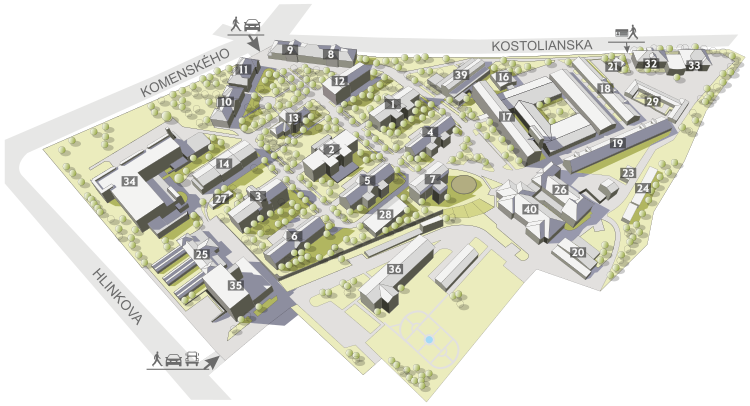
Pavilion 36: Department of Pharmacology and Toxicology - rooms 310, 311;
Pavilion 4: Department of Pharmacology and Toxicology
Ecology and environmental protection
Laboratory for microbiological analysis of water samples, excreta, etc., analysis of bacteriological swabs to check the effectiveness of disinfection (nutrient soils, petri dishes, etc.).
Laboratory for chemical analysis, pH and Conductometer, Oxymeter (LDO electrode with HQ Series Portable Meters fy. Hach, dryer (105 ºC), muffle furnace (550 ºC), water bath, spectrophotometer DR 2 800 phy. Hach, reactor for determination of COD, reactor for determination of COD, reactor for determination of COD, reactor for determination of COD. Hach, Digestdahl reactor fy. Hach, case set (VISOCOLOR® ECO for colorimetric testing of drinking water by Merck)
Pavilion No. 3, Department of Public Veterinary Medicine and Animal Welfare - laboratories and practical training room
Environmental radiobiology
Dosimeters of different types
Pavilion 13, Department of Biology and Physiology,
exercise room
Animal hygiene and welfare
Laboratory for microbiological analysis of water samples, excreta, etc., analysis of bacteriological swabs to check the effectiveness of disinfection (nutrient media, petri dishes, etc.).
Laboratory for chemical analysis, pH and Conductometer, Oxymeter (LDO electrode with HQ Series Portable Meters fy. Hach, dryer (105 ºC), muffle furnace (550 ºC), water bath, spectrophotometer DR 2 800 phy. Hach, reactor for determination of COD, reactor for determination of COD, reactor for determination of COD, reactor for determination of COD. Hach, Digestdahl reactor fy. Hach, case set (VISOCOLOR® ECO for colorimetric testing of drinking water by Merck)
Pavilion No. 3, Department of Public Veterinary Medicine and Animal Welfare - laboratories and practical training room
Veterinary ethology
The department has a computer training room (ground floor 5), a chemistry laboratory (1st floor), a room with a camera system for recording behaviour (basement), an Elisa machine, a biochemical and haematological analyser (2nd floor)
Pavilion 32, Department of Public Veterinary Medicine and Animal Welfare
Analysis of contaminants in food and feed
Standard laboratory equipment, analytical sets, spectrophotometers, thin layer chromatography equipment, stereoscope, microscope, camera, histology equipment including microtome, imaging, staining equipment, analytical and evaluation software.
Material and equipment for animal dissection or for further diagnostic laboratory methods/examinations: sledge microtomes (pfm Slide 2003 - pfm medical Germany and Histoslide 2000, Leica - Reichert - Jung), Shandon Citadel - tissue processor, watering device WD4, light microscopes with camera: MOTIC + photocamera MOTICAM 2330, NICON Eclipse Tí + photocamera), thermostat, refrigerator, laminar box, PCR box, centrifuge and cytocentrifuge, thermocycler for PCR, CO2 incubator, deep freezer box.
Pavilion 36: Department of Pharmacology and Toxicology - rooms 310, 311;
Pavilion 4: Department of Pharmacology and Toxicology
Microbiology in animal hygiene and the environment
Waste from agricultural and food production
Laboratory for microbiological analysis of water samples, excreta, etc., analysis of bacteriological swabs to check the effectiveness of disinfection (nutrient media, petri dishes, etc.).
Laboratory for chemical analysis, pH and Conductometer, Oxymeter (LDO electrode with HQ Series Portable Meters fy. Hach, dryer (105 ºC), muffle furnace (550 ºC), water bath, spectrophotometer DR 2 800 phy. Hach, reactor for determination of COD, reactor for determination of COD, reactor for determination of COD, reactor for determination of COD. Hach, Digestdahl reactor fy. Hach, case set (VISOCOLOR® ECO for colorimetric testing of drinking water by Merck)
Pavilion 36: Department of Pharmacology and Toxicology - rooms 310, 311;
Pavilion 4: Department of Pharmacology and Toxicology
Environmental parasitology
Centrifuge, Elisa reader, electrophoresis, thermocycler, PCR boxes.
ZEISS AXIO; Nikon; Olympus BX41 microscopes with camera, camera, computer and measurement software, and software for professional microscope photography;
Pavilion No. 2 - second floor; Department of Epidemiology, Parasitology and Protection of Common Health,
Seminar room 3
Coprology Laboratory L1;
Laboratory No. 106
L3 PCR Laboratory
Electrophoresis - L4
Autopsy room No. 111
Exercise room 1 and 2 (Pavilion No. 2, first floor)
Ecotoxicology
Standard laboratory equipment, analytical sets, spectrophotometers, thin layer chromatography equipment, stereoscope, microscope, camera, histology equipment including microtome, imaging, staining equipment, analytical and evaluation software.
Material and equipment for animal dissection or for further diagnostic laboratory methods/examinations: sledge microtomes (pfm Slide 2003 - pfm medical Germany and Histoslide 2000, Leica - Reichert - Jung), Shandon Citadel - tissue processor, watering device WD4, light microscopes with camera: MOTIC + photocamera MOTICAM 2330, NICON Eclipse Tí + photocamera), thermostat, refrigerator, laminar box, PCR box, centrifuge and cytocentrifuge, thermocycler for PCR, CO2 incubator, deep freezer box.
Pavilion 36: Department of Pharmacology and Toxicology - rooms 310, 311;
Pavilion 4: Department of Pharmacology and Toxicology
Eco-production of fodder and forage
Analytical scales
KJELTEC analyser
SOXLET system HT2
DOSI FIBER
Mineralizer
MILSTONE 1300
AAS UNICAM
DYNAREADER ELISA
Pavilion No. 12
Department of Animal Nutrition and Breeding,.
Nos 49, 48, 39, 19, 17, 16 and 15
- Characteristics of information provision of the study programme (access to study literature according to course information sheets), access to information databases
and other information resources, information technology, etc.):
All literary resources for study listed in the fact sheets are available in either print or electronic form, and all information databases purchased and licensed by the University are accessible to students.
- Characteristics and scope of distance learning applied in the curriculum with assignment to courses. Approaches, manuals of e-learning portals. Procedures for transition from full-time to distance learning.
UVMP in Košice has also distance learning for all courses, which is currently provided through MOODLE and MS Teams platforms. Each student has manuals available either in electronic form or in the form of a video tutorial.
- Characteristics of information provision of the study programme (access to study literature according to course information sheets), access to information databases
- b) Information resources
- Not provided yet.
- c) Distance learning, e-learning access and procedures
- Not provided yet.
- d) Partners involved in educational activities
-
Partners of the university in the provision of the educational activities of the study programme and characteristics of their participation: not the case
- Characteristics on social, sporting, cultural, spiritual and social opportunities:
UVMP in Košice provides students with the maximum possible conditions for their enjoyment in the above areas.
- e) Social, sports, cultural, spiritual and community activities
- Not provided yet.
- f) Student mobility and placements
-
Students of the Animal Hygiene and Environment study programme are guaranteed the opportunity to participate in mobility. The whole agenda of the guidelines and conditions for applying for mobility, the conditions and rules for participation as well as the rules for recognition of participation in mobility as part of the study plan is covered by the Vice-Rector for International Relations and Internationalisation and the organisational unit managed by her, which is the UVMP Mobility Office. The whole process requires coordination with the supervisor and is recommended after the study part of the study plan has been fulfilled. Participation in mobility and other contexts are regulated in Article 42 of the Internal Regulations of the Study Regulations of the UVMP in Košice, Part B.
9. Required skills of the applicant and prerequisites
- a) Required abilities and admission prerequisites
-
They are laid down in Article 1 and Article 2, Part B, Part II Organisation of Studies of the Internal Regulations of the Study Regulations of the UVMP in Košice.
- b) Admission procedures
-
They are laid down in Article 3 and Article 4, Part B, Part II Organisation of Studies of the Internal Regulations of the Study Regulations of the UVMP in Košice. Examination boards for admission examinations are at least 4-member and are appointed by the Rector on an ad hoc basis according to the focus of the study programmes to which students apply.
- c) Admission results over the standard duration of study
-
Academic year Applicants Admitted Enrolled Graduates 2021/2022 3 — — — 2020/2021 0 — — — 2019/2020 0 — — — 2018/2019 0 — — — 2017/2018 0 — — —
10. Feedback regarding the quality of education provided
- a) Monitoring and assessment of student feedback
-
- Procedures for monitoring and evaluating students' views on the quality of the study programme:
The students of UVMP in Košice have the possibility of anonymous evaluation of the quality of teaching through an anonymous questionnaire after graduation, where they evaluate the quality of a particular study programme and the quality of the instructors who provide the course. Monitoring of study programmes is also continuously carried out by the coordinators of individual domains of science and research at UVMP, while 5 domains of science and research are established at UVMP.
- b) Student feedback and measures to improve programme quality
-
The results of the evaluation of doctoral studies are part of the Annual Reports on Scientific and Research Activities at UVMP in Košice for individual ARs and Annual Reports on the Quality of UVMP in Košice for individual ARs. They are also presented at the Teachers' Forum, which is held at the beginning of each academic year. In general, the principle that the results of the feedback are very important for drawing conclusions from the evaluations, which are implemented into concrete measures implemented with the aim of improving the quality of the study programme in its entire breadth and depth.
- c) Graduate feedback and measures to improve programme quality
-
The results of alumni feedback and related measures to improve the quality of the study programme are part of the Annual Reports on Scientific and Research Activities at UVMP in Košice for individual AR and Annual Reports on the Quality of UVMP in Košice for individual AR. The Vice-Rector for Science, Research and Doctoral Studies and the coordinators of the individual domains of science and research act within the framework of measures to improve the quality of the study programme by personally entering into the solution of the problems arising from the results of the feedback.
11. Demonstration of long-term and continuous success in obtaining financial support
- a) Demonstration of long-term and continuous success in obtaining financial support
-
P.no.
Project number
From
To
Project name
Provider
Principal Investigator / Co-Principal Investigator
1
APVV-0009-10
2010
2013
Beta-lactamase genes in Enterobacteriaceae in the animal environment and in bioaerosols
RDPA
prof. MVDr. Ján Venglovský, PhD.
2
1/0415/13
2013
2015
Monitoring 137 Cs in the forest ecosystem in Slovakia.
SGA
Assoc. Prof. Katarína Beňová, DVM PhD.
3
008UVLF-4/2015
2015
2017
Implementation of new research trends into the methods of education of veterinary students in the subject Behavioural Disorders of Domestic Animals
CEGA
prof. MVDr. Jana Kottferová, PhD.
4
004UVLF-4/2015
2015
2017
Teaching texts for the subject Forages and poisonous plants
CEGA
Assoc. Prof. Pavel Naď, DVM PhD.
5
1/0080/15
2015
2018
Study of the ecology and epidemiological role of blood-sucking dipterans (DIPTERA) in the spread of global zoonotic and parasitic pathogens in climate-changing Slovakia
SGA
Prof. Alica Kočišová, DVM PhD.
6
003UVLF-4/2016
2016
2018
Fundamentals of Ecology and Applied Ecology for UVLF students
CEGA
MVDr. Rudolf Hromada, PhD.
7
1/0858/16
2016
2018
Negative effect of selected xenobiotics on the larval stage of the honey bee (Apis mellifera)
SGA
Prof. Jaroslav Legáth, DVM PhD.
8
2/0125/17
2017
2020
Impact of anthropogenic stress on the occurrence of microbial and parasitic organisms in the environment in urban and rural ecosystems
SGA
prof. MVDr. Ján Venglovský, PhD.
9
APVV-17-0017
2018
2022
Toxicological effects of snake venoms of selected species
RDPA
Prof. Jaroslav Legáth, DVM PhD.
10
002UVLF-4/2019
2019
2021
Modernizing professional ethics education and improving students' soft skills in the veterinary profession
CEGA
prof. MVDr. Jana Kottferová, PhD.
11
1/0043/19
2019
2022
Molecular epidemiology and risk of spread of game parasites in current ecological conditions in Slovakia
SGA
Prof. Alica Kočišová, DVM PhD.
12
001UVLF-4/2020
2020
2022
Applied Ecology for University Students
CEGA
Assoc. Prof. Naďa Sasáková, DVM PhD.
13
004UVLF-4/2020
2020
2022
Practical exercise for pharmacists as a tool for improving the quality of university teaching in the subject "Hygiene of medical and pharmaceutical facilities"
CEGA
MVDr. Mária Vargová, PhD.
14
1/0402/20
2020
2023
Impact of additives in monogastric animal nutrition on production health, production, product quality and the environment.
SGA
Assoc. Prof. Pavel Naď, DVM PhD.
15
001UVLF-4/2022
2022
2024
Use and implementation of new knowledge in teaching animal hygiene and welfare at the University of Veterinary Medicine and Pharmacy in Košice
CEGA
Gabriela Gregová, DVM PhD.
12. Links to other relevant internal regulations and information regarding the study or the student of the study programme
- Relevant internal regulations and other information
If the window remains open, close this browser tab.