

- a) Name and registration code of the study programme:
- Veterinary nurse · 185106 · UIPŠ 4318R02
- b) Degree of study and ISCED level:
- First degree · ISCED 6
- c) Place of delivery:
- University of Veterinary Medicine and Pharmacy in Košice · Komenského 73, 041 81 Košice
- d) Field of study and ISCED-F code:
- Veterinary Medicine
- e) Type of study programme:
- Single degree study
- f) Awarded academic degree:
- BSc. (bachelor)
- g) Form of study:
- part-time study
- h) Partner universities and distribution of study obligations in a joint study programme
- i) Language of instruction:
- Slovak language
- j) Standard duration of study:
- 3 years
- k) Programme capacity and applicants over the last six academic years
-
Planned student capacity Applicants over the last 6 academic years Admitted students over the last 6 academic years Enrolled students over the last 6 academic years — — — — - l) Information about the study programme:
- Programme details
Study programme description
Veterinary nurse
part-time study ·  · 185106 · 2025/2026
Last updated: 30.10.2026
- Higher education institution
- University of Veterinary Medicine and Pharmacy in Košice
- Registered address
- Komenského 73, 041 81 Košice
- Institution identification number
- 00397474
- Programme approval body
- UVMP Accreditation Commission in Košice
- Approval date
- 28.08.2026
- Last assessment date
- 2024-07-25
- Last assessment and related information
- Decision no.: 2024/58:560-VS-OAC dated July 25th, 2024
1. Basic data on the study programme
2. Profile of a graduate and aims of education
- a) Educational objectives and main learning outcomes
-
The educational goals of the Veterinary Nurse study programme are methodologically based on the European Qualifications Framework for Lifelong Learning (EQF). The Framework defines the requirements for learning outcomes for knowledge, skills, responsibility and independence. For Level 6, the learning outcomes required are broad knowledge in a given field of work or a given field of study, including a critical understanding of theories and principles. The syllabi of profile courses outline critical knowledge to be acquired by students. Additional knowledge is acquired by completing the other compulsory courses of the study programme. By completing profile courses, the graduate will acquire basic knowledge in the field of intensive care for companion animals, gain practical knowledge in the field of pathological changes in dead animals and become familiar with necrobiotic processes taking place in the organism; will be able to recognize acute and chronic inflammations and suggest treatment, has knowledge of the characteristics of tumors, developmental anomalies and immune system disorders, is able to identify lesions and pathogenetic mechanisms caused by disease, has knowledge of investigative diagnostic methods; has basic knowledge of parasitic and infectious diseases of companion animals with an emphasis on zoonoses classified according to OIE and WHO; the graduate is also able to recognize basic clinical symptoms in outpatients, knows how to manage veterinary outpatient clinic reception, how to handle patients and clients, knows outpatient laboratory techniques, manages records, course of therapy for individual diseases, manages preventive veterinary health programmes for newborns, adults and the elderly patients and patients with special needs, acquires knowledge in the field of caring for disabled, abandoned and zoo animals and has basic knowledge of the management of care for a hospitalized patient; the graduate will use all this acquired knowledge in outpatient clinics in various professions (working at private veterinarians, diagnostic laboratories), epizootiological and epidemiological activities when protecting animal and human health, as well as in the prevention of parasitic and infectious diseases and environmental protection.
The skills corresponding to level 6 can be characterized as broad skills, sense of innovation required to solve complex and unpredictable problems in a specialized field of study. Together, the skills achieved within individual courses represent an interconnected complex, the result of which are skills needed for successful implementation of competencies. By completing profile courses, the graduate will acquire skills that will enable him to master the practical skills and knowledge necessary for the implementation and completion of imaging methods, including X-ray, CT, ultrasound, health and safety regulations regarding equipment at individual workplaces, to keep records of equipment in accordance with applicable legislation; will have the skills necessary to collect biological samples and perform pathology-related procedures, including maintaining the integrity of samples and preparing shipments for diagnostic laboratories; will have the skills necessary to coordinate surgical plans, prepare the surgery and provide support to the veterinarian - before, during and after surgical procedures; skills needed to monitor patients during and after anaesthesia; skills necessary to provide high-quality nursing care to patients treated or placed in veterinary care. The graduate is proficient in providing advice to animal owners, monitoring health of animals and providing first aid to animals as needed, mastering the skills necessary to perform medical nursing procedures regarding the surgery, internal and reproductive issues, including preparation and handling of patients; knowledge regarding nutritional requirements of animals, skills necessary to provide advice to clients (animal owners) on animal health, behaviour, diseases and animal reproduction, skills needed to administer drugs and infusion giving sets to hospitalized patients, keep records of pharmaceuticals, warehouse management, storage and purchase according to warehouse cards; skills necessary to comply with biosecurity and infection control procedures in the workplace. Generally defined competences for level 6 EKR are - ability to manage complex technical or professional activities or projects, bear responsibility for decision-making in an unpredictable situations or environment, accept responsibility for managing the professional development of individuals and groups. Specific competencies depend on specific job positions.
- b) Occupations and graduate employment opportunities
-
A graduate of the Veterinary Nurse study programme can work as an assistant in veterinary practice, in animal protection organizations, as an animal charity worker (shelters and quarantine stations), for the pharmaceutical industry, for a veterinary publishing house, as an expert in animal nutrition, in the field of physiotherapy and rehabilitation of animals, as an inspector of animal care, as a scientist, teacher, trainer for companion animals, sales representative for dietary supplements for companion animals, as a laboratory technician, rescuer, adviser in animal husbandry and in zoos, etc.
- c) Statements of relevant external stakeholders
-
Company or external stakeholder Statement Chamber of Veterinary Surgeons of the Slovak Republic View
3. Job prospects
- a) Assessment of graduate employability
-
Job prospects and employability can be assessed only after the first students graduate the study programme.
- b) Examples of successful graduates
-
Information on successful graduates of the study programme will be available only after the first students graduate the study programme.
- c) Employer feedback on programme quality
-
Feedback regarding the quality of the study programme graduates will be available only after the first students graduate the study programme. Feedback is key to improving the study programme.
4. Structure and content of the study programme
- a) Rules for designing study plans
-
The rules for creating study plans for the Veterinary Nurse study programme are based on the general provisions contained in the internal regulation Study guidelines of UVMP in Košice, part A.
- b) Recommended study plan:
- Study plan 2025/2026
- c) Information included in the study plan
-
- individual parts of the study programme (compulsory courses, compulsory optional courses and optional courses),
- in the study plan, profile courses are marked in bold and with a letter (P).
The subject information sheet for each educational part (subject) contains:
- defined learning outcomes and related criteria and rules for their evaluation so that all educational objectives of the study programme are met,
- determined educational activities used suitable for achieving educational outcomes,
- stated methods by which educational activities are carried out,
- stated prerequisites for the subject,
- stated syllabi for the subject,
- assigned credits for each part based on the achieved learning outcomes and related workload,
- stated persons providing the subject; the subject guarantor is designated,
- places of implementation of the subject (if the study programme is implemented at multiple workplaces).
Information letters of the courses of the study programme are available through the links directly in the study plan:
Course information sheets for the Veterinary nurse study programme are available through links directly in the study plan.
- d) Credits and other requirements for completion of study
-
Obtaining 180 credits is a condition for proper completion of the studies (including credits for clinical practice). Other conditions that the student must fulfill to complete the studies, including the conditions of state exams, rules for retaking courses and rules for extension, interruption of studies are listed in the internal regulation Study guidelines of UVMP in Košice, part A.
the number of credits for state exams.
- e) Requirements for individual programme components and student progression
-
- number of credits per profile courses required for proper completion of the studies/completion of part of the study,
- number of credits for compulsory courses required for proper completion of the studies/completion of part of the study,
- number of credits for compulsory optional courses required for proper completion of the studies/completion of part of the study,
- f) Assessment of learning outcomes and appeal procedures
-
UVMP in Košice has described the rules regarding student evaluation and the possibility of repeating exams in the internal regulation Study guidelines of UVMP in Košice, part A.
- g) Recognition of studies or parts of studies
-
UVMP in Košice addresses the conditions for recognition of studies or parts of studies in the internal regulation Study guidelines of UVMP in Košice, part A.
- h) Thesis topics
-
Thesis topics and supervisors are listed in Table 2 in section 7.e of this description.
- i) Other study rules and procedures
-
- possibilities and procedures for participating in student mobility in the internal regulation Study guidelines of UVMP in Košice, part A and in the internal regulation Directive on the basic rules and principles of the KA1 project - higher education within the ERASMUS+ programme at UVMP in Košice, the mobility window is set for the 2nd year (third or fourth semester of study),
- Code of Ethics in the internal regulation Disciplinary procedure for Students of the University of Veterinary Medicine and Pharmacy in Košice, in the internal regulation Code of ethics for Employees of UVMP in Košice, in the internal regulation Student Code of Ethics of UVMP in Košice,
- rules applicable to students with special needs in the internal regulation Study guidelines of UVMP in Košice, part A.
- the procedures for submitting suggestions and appeals by the student are specified in the Directive on handling complaints at UVMP in Košice as well as the Study guidelines of UVMP in Košice.
5. Study programme’s information letters
- Course information sheets
-
Course information sheets are available through links directly in the study plan. Study plan 2025/2026
6. Current schedule of the academic year and current timetables
- Current academic calendar and timetables
-
The academic year schedule and the current timetable are always listed at the beginning of the academic year. The academic year schedule is available in document Study Guide Book at the UVMP in Košice study-guide-book-at-the-uvmp-in-kosice.pdf and on the UVMP´s website https://www.uvlf.sk/en/information-for-students/academic-year-schedule. The current timetable is available on the UVMP´s website https://www.uvlf.sk/en/information-for-students/timetables.
7. Staff
- a) Person responsible for the delivery, development and quality of the study programme
- Prof. Trbolová Alexandra, DVM, PhD
- b) Teachers of profile courses
- c) Research/art/teaching profiles of teachers of profile courses
- d) Teachers, courses and links to the central register of university employees
-
(Click the teacher’s name to open their profile and contact details, where available.)
Table 1 – Teachers and courses of the study programme Teacher Courses Portál VŠ Assoc. prof. Bílek Ján, DVM, PhD Radiology and imaging diagnostics; Care for a hospitalized patient; Intensive care of an acute patient; Post-traumatic and post-operative rehabilitation and physiotherapy; Clinical practice - Clinic of horses Portál VŠ Assoc. prof. Falis Marcel, DVM, PhD Toxicology Portál VŠ Assoc. prof. Fialkovičová Mária, DVM, PhD Care for a hospitalized patient Portál VŠ Assoc. prof. Halán Miloš, DVM, PhD Parasitic and infectious diseases of companion animals; Preventive veterinary medicine of companion animals Portál VŠ Assoc. prof. Horňák Slavomír, DVM, PhD Clinical internship at the Small Animal Clinic Portál VŠ Assoc. prof. Horňáková Ľubica, DVM, PhD Clinical internship at the Small Animal Clinic Portál VŠ Assoc. prof. Jacková Anna, DVM, PhD Parasitic and infectious diseases of companion animals Portál VŠ Assoc. prof. Korim Peter, DVM, CSc. Economics and management in practice Portál VŠ Assoc. prof. Korytár Ľuboš, DVM, PhD Parasitic and infectious diseases of companion animals; Preventive veterinary medicine of companion animals Portál VŠ Assoc. prof. Kostecká Zuzana, DVM, PhD Clinical biochemistry and haematology Portál VŠ Assoc. prof. Kožár Martin, DVM, PhD Anaesthesia and analgesia; Professional practice - private veterinarians; Clinical internship at the Small Animal Clinic Portál VŠ Assoc. prof. Kuricová Mária, DVM, PhD, MBA, MSc. Post-traumatic and post-operative rehabilitation and physiotherapy; Clinical internship at the Small Animal Clinic Portál VŠ Assoc. prof. Lazár Peter, DVM, PhD Cynology Portál VŠ Assoc. prof. Levkut Martin, DVM, PhD Pathological anatomy Portál VŠ Assoc. prof. Marcin Andrej, B.Sc., DVM, CSc. Industrial feeds and diets Portál VŠ Assoc. prof. Marcinčáková Dana, DVM, PhD Basics of pharmacology Portál VŠ Assoc. prof. Molnár Ladislav, DVM, PhD Ambulatory patient care; Clinical practice - Clinic of birds, exotic and free living animals; Welfare of handicapped, abandoned and zoo animals; Breeding and diseases of reptiles; Breeding and diseases of exotic birds Portál VŠ Assoc. prof. Prokeš Marián, DVM, PhD Preventive veterinary medicine of companion animals Portál VŠ Assoc. prof. Štrkolcová Gabriela, DVM, PhD Basics of microbiology, parasitology and immunology; Parasitic and infectious diseases of companion animals Portál VŠ Assoc. prof. Szabóová Renáta, DVM, PhD Pathological physiology Portál VŠ Assoc. prof. Toporčák Juraj, DVM, PhD Clinical practice - Clinic of birds, exotic and free living animals; Welfare of handicapped, abandoned and zoo animals; Breeding and diseases of reptiles; Breeding and diseases of exotic birds Portál VŠ Assoc. prof. Váczi Peter, DVM, PhD Basics of pharmacology Portál VŠ Bodnárová Libuša, DVM Work with professional literature — Čechová Pathological anatomy — Drahovská Zuzana, DVM, PhD Clinical internship at the Small Animal Clinic Portál VŠ Drážovská Monika, DVM, PhD Parasitic and infectious diseases of companion animals; Preventive veterinary medicine of companion animals Portál VŠ Figurová Mária, DVM, PhD Radiology and imaging diagnostics Portál VŠ Gajdošová Beáta, Ed.D. Physical education; Physical education; Physical education Portál VŠ Gomulcová Simona, DVM, PhD Intensive care of an acute patient Portál VŠ Hajdučková Vanda, DVM, PhD Basics of microbiology, parasitology and immunology Portál VŠ Hluchý Marian, DVM, PhD Radiology and imaging diagnostics; Clinical internship at the Small Animal Clinic Portál VŠ Hreško Šamudovská Alena, DVM, PhD Industrial feeds and diets Portál VŠ Hura Vladimír, DVM, PhD Clinical practice - Clinic of horses Portál VŠ Kapľavka Silvia, DVM, PhD Parasitic and infectious diseases of companion animals Portál VŠ Karasová Martina, DVM, PhD Ambulatory patient care Portál VŠ Koľvek Filip, DVM, PhD Clinical practice - Clinic of horses Portál VŠ Koščová Lenka, DVM, PhD Cynology Portál VŠ Kottferová Lucia, DVM, PhD Ambulatory patient care; Clinical practice - Clinic of birds, exotic and free living animals; Welfare of handicapped, abandoned and zoo animals; Breeding and diseases of reptiles; Breeding and diseases of exotic birds Portál VŠ Kuzyšinová Katarína, DVM, PhD Clinical practice - Clinic of birds, exotic and free living animals; Welfare of handicapped, abandoned and zoo animals; Breeding and diseases of reptiles; Breeding and diseases of exotic birds Portál VŠ Kyzeková Petronela, DVM, PhD Propaedeutics Portál VŠ Lapšanská Mária, DVM, PhD Anaesthesia and analgesia; Intensive care of an acute patient; Clinical internship at the Small Animal Clinic Portál VŠ Link Róbert, DVM, PhD Propaedeutics Portál VŠ Lipták Tomáš, DVM, PhD Anaesthesia and analgesia; Clinical internship at the Small Animal Clinic Portál VŠ Major Peter, DVM, PhD Ambulatory patient care; Clinical practice - Clinic of birds, exotic and free living animals; Welfare of handicapped, abandoned and zoo animals; Breeding and diseases of reptiles; Breeding and diseases of exotic birds Portál VŠ Maková Zuzana, DVM, PhD Pathological physiology Portál VŠ Mandelík René, DVM, PhD Parasitic and infectious diseases of companion animals; Preventive veterinary medicine of companion animals Portál VŠ Pettenello Martina, DVM, PhD Clinical practice - Clinic of horses — Prof. Kočišová Alica, DVM, PhD Parasitic and infectious diseases of companion animals Portál VŠ Prof. Ondrejková Anna, DVM, PhD Preventive veterinary medicine of companion animals Portál VŠ Prof. Takáčová Daniela, DVM, PhD Legislation in veterinary practice Portál VŠ Prof. Tkáčiková Ľudmila, DVM, PhD Basics of microbiology, parasitology and immunology Portál VŠ Prof. Trbolová Alexandra, DVM, PhD Anaesthesia and analgesia; Intensive care of an acute patient Portál VŠ Prof. Valocký Igor, DVM, PhD Clinical practice - Clinic of horses Portál VŠ Račka Karol, DVM, PhD Parasitic and infectious diseases of companion animals Portál VŠ Sabolová Fabianová Professional communication and psychology — Schreiberová Andrea, M.A., PhD Parasitic and infectious diseases of companion animals Portál VŠ Sesztáková Edina, DVM, PhD Ambulatory patient care; Clinical practice - Clinic of birds, exotic and free living animals; Welfare of handicapped, abandoned and zoo animals; Breeding and diseases of reptiles; Breeding and diseases of exotic birds Portál VŠ Šimková Jana, DVM, PhD Clinical biochemistry and haematology Portál VŠ Sokoli Libor, Pharm.D., PhD Basics of pharmacology Portál VŠ Tomko Martin, DVM, PhD Professional communication and psychology Portál VŠ Valenčáková Alexandra, DVM, PhD Clinical internship at the Small Animal Clinic Portál VŠ Valenčinová Petra, DVM, PhD Clinical practice - Clinic of horses Portál VŠ Varga Lukáš, M.Sc. Physical education; Physical education; Physical education Portál VŠ Vavreková Adriana, DVM, PhD Cynology Portál VŠ Vikartovská Zuzana, DVM, B.Sc., PhD Intensive care of an acute patient Portál VŠ Vojtek Boris, DVM, PhD Preventive veterinary medicine of companion animals Portál VŠ Vrabec Vladimír, DVM, PhD Ambulatory patient care; Clinical practice - Clinic of birds, exotic and free living animals; Welfare of handicapped, abandoned and zoo animals; Breeding and diseases of reptiles; Breeding and diseases of exotic birds Portál VŠ - e) Thesis supervisors and topics 3 years
-
(Click the teacher’s name to open their profile and contact details, where available.)
Table 2 – Thesis supervisors and topics Teacher Thesis topics Academic year Simona Gomulcová, DVM, PhD A review of new renal biomarkers in veterinary practice. 2024/2025 Erik Hudec, DVM, PhD Application of cytology and histology in ambulatory prax of small animals 2024/2025 Prof. Anna Ondrejková, DVM, PhD Aujeszky disease 2024/2025 Martina Vargová, DVM, PhD Current treatment options for demodicosis in dogs 2024/2025 Michal Dolník, DVM, PhD Examination of dog ejaculate and use in artificial insemination 2024/2025 Tatiana Weissová, DVM, PhD Feline-friendly handling in veterinary praxis 2024/2025 Zuzana Farkašová, DVM, PhD History, present and future of Norik of Muran in Slovakia 2024/2025 Lenka Lešková, DVM, PhD Low-stress handling and fear-free practices in patients in everyday veterinary care 2024/2025 Maroš Kostičák, DVM, PhD Management in veterinary patient with tick-borne disease 2024/2025 Mária Figurová, DVM, PhD Nuclear medicine 2024/2025 Zuzana Vikartovská, DVM, B.Sc., PhD Nursing care of the patient in status epilepticus 2024/2025 Vladimír Vrabec, DVM, PhD Oxyuris spp. prevalence in faecal samples of reptiles in captivity. 2024/2025 Edina Sesztáková, DVM, PhD Principles of nutrition of exotic birds and its disorders 2024/2025 Mária Figurová, DVM, PhD Radiological examination using contrast agents 2024/2025 Edina Sesztáková, DVM, PhD Reproduction and breeding of parrots 2024/2025 Assoc. prof. Ľubica Horňáková, DVM, PhD The concept of health care for puppies after birth 2024/2025 Zuzana Lacková, DVM, PhD The Picardy Sheepdog, the past and present of the shepherd's heritage 2024/2025 Assoc. prof. Ján Bílek, DVM, PhD Treatment of chronic wounds in animals using honey and its alternatives 2024/2025 René Mandelík, DVM, PhD Zoonotic bacterial agents affecting the gastrointestinal system of dogs. 2024/2025 - f) Research/art/teaching profiles of thesis supervisors
-
The supervisors’ research/art/teaching profiles are available through their personal profiles using the name buttons in the preceding table.
- g) Student representatives and contacts
-
The members of the committee for the preparation of the study programme in Veterinary Nurse are:
- Lucia Olešová (5th year of study, study programme General Veterinary Medicine) e-mail: lucia.olesova@student.uvlf.sk,
- Dominik Schön (5th year of study, study programme General Veterinary Medicine), e-mail: dominik.schon@student.uvlf.sk.
The members of the UVMP Accreditation Committee are:
- Dominik Borčík (5th year of study, study programme General Veterinary Medicine), e-mail: dominik.borcik@student.uvlf.sk,
- Norbert Emödi (4th year of study, study programme Pharmacy), e-mail: norbert.emodi@student.uvlf.sk.
- h) Study adviser
-
Assoc. prof. Dana Marcinčáková, DVM, PhD., e-mail: dana.marcincakova@uvlf.sk; tel. no.: +421 917 355 747.
- i) Other support staff
-
Michaela Paulíková, Ing. (michaela.paulikova@uvlf.sk).
8. Premises, tools and technical equipment
- a) Teaching premises and their technical equipment
-
Lectures, seminars, practical exercises, laboratory exercises and other pedagogical activities per individual study courses of the Veterinary Nurse study programme are held at the UVMP in Košice in lecture halls, libraries and seminar rooms of UVMP in Košice. The university has built fully furnished and modern laboratories. The list of buildings and rooms used for the above activities is shown in the table attached below. All buildings are located in the UVMP campus.
Course
Description of equipment and tools
Location Outpatient care
Outpatient room for dentistry, ophthalmology, oncology, traumatology, orthopedics, X-ray and USG, endoscopy, internal medicine
Seminar rooms equipped with data projectors and computers
P-26
Outpatient clinic room 3-4
Seminar room 4
Training room 1 a 2
P-40
Outpatient clinic room 222-226 a 1-2 RTG a USG 217-219B
Training rooms 40/A-40/C
P-17
Anatomy
P-39
Anesthesia and analgesia
Seminar rooms equipped with data projectors and computers, operating theaters (OT)
P-40
Training rooms 40/A-40/C, OT - urgent 230, delivery room 156
P-17
Economics and management in practice
Seminar room equipped with a data projector and computers
P-5
Training room2
Ethology and behavioral disorders of animals
Seminar room equipped with a data projector and computers
P-32
Physiology
Seminar room equipped with a data projector and computers
P-8
Hygiene of companion animal breeding and welfare
Seminar room equipped with a data projector and computers
P-3
Breeding and diseases of exotic birds
Seminar room equipped with a data projector and computers, outpatient clinic room and seminar room
P-26
Training room 1
Outpatient clinic room 3-4 and SM 4
Breeding and diseases of reptiles
Seminar room equipped with a data projector and computers, outpatient clinic room and room for terrariums,
P-26
Training room 1
Outpatient clinic room 3-4 and SM 4
Aqua Tera Club UVMP
Information technologies in the outpatient clinic
P-5
Intensive care for acute patients
Seminar room equipped with a data projector and computers, outpatient clinic
P-26
Training room 1, Outpatient clinic room 3
P-40
Training room 40/A, Intensive Care Unit4, Outpatient clinic room 222-226
P-17
Horseback riding
Riding area of UVMP
Clinical biochemistry and hematology
Biochemical and hematological laboratory, Seminar room equipped with a data projector and computers
P-35
P-26
Laboratory 1 and 2
Clinical practice – Clinical studies of horses
Outpatient clinic room
P-18
Clinical practice – Clinical studies of small animals
Outpatient clinic room
P-40
Outpatient clinic room 222-226
Clinical practice – Clinical studies of birds, exotic and free living animals
Outpatient clinic room
P-26
Outpatient clinic room 3-4
Cynology
Seminar room equipped with a data projector and computers
P-2
Legislation in veterinary practice
Seminar room equipped with a data projector and computers
P-5
Training room 2
Clinical practice – private veterinarians
Parasitic and infectious diseases of companion animals
Seminar room equipped with a data projector and computers
P-1
P-2
Pathological anatomy
Seminar room equipped with a data projector and computers, autopsy room
P-17
Pathological physiology
Seminar room equipped with a data projector and computers
P-17
Breeds and breeding of companion animals
Seminar room equipped with a data projector and computers
P-8
Post-traumatic and postoperative rehabilitation and physiotherapy
Seminar room equipped with a data projector and computers
P-26
Seminar room 4, Outpatient clinic room 3, External aviary P-40
Training rooms 40/A-40/C
P-17
Understanding field-specific books
Seminar room equipped with a data projector and computers
P-7
University library
Preventive veterinary medicine of companion animals
P-1
P-33
Industrial feeds and diet
Seminar room equipped with a data projector and computers
P-12
Theory and practice - basic veterinary nursing
Seminar room equipped with a data projector and computers
P-40
Training room 1
Final thesis
Equipment according to the topic of the bachelor thesis
Communication and psychology
Seminar room equipped with a data projector and computers
P-32
P-5
Training room2
Propedeutics
Seminar room equipped with a data projector and computers, internship at the clinic
P-17
Clinical Skills Center
Radiology and imaging diagnostics
Seminar room equipped with a data projector and computers, RTG and USG
P-40
Training room 40/A
Workplace 217, 218 and 219B
Care of a hospitalized patient
Seminar room equipped with a data projector and computers, hospitalization rooms for patients
P-26
Intensive Care Unit4
Training room 1 and External aviary P 40
Inpatient unit Training room 1
P-17
Care of the juvenile and geriatric patient
Seminar room equipped with a data projector and computers,
P-26
Seminar room 4
P-40
Training room 40/C
P-17
Physical education
The equipment of the gymnasium - sports activities, various ball games, fitness equipment,
Gym of UVMP
Toxicology
P-36
Animal nutrition, dietetics and feeding
P-12
Welfare of handicapped, abandoned and zoo animals
P-32
Basics of the English language
P-14
Basics of biology and genetics
P-16
Basics of pharmacology
P-4
Basics of laboratory diagnostics
Seminar room equipped with a data projector and computers, Biochemical and hematological laboratory
P-8
P-26
Laboratory 1 and 2
Basics of Latin terminology
P-14
Basics of microbiology, parasitology and immunology
P-2
P-3
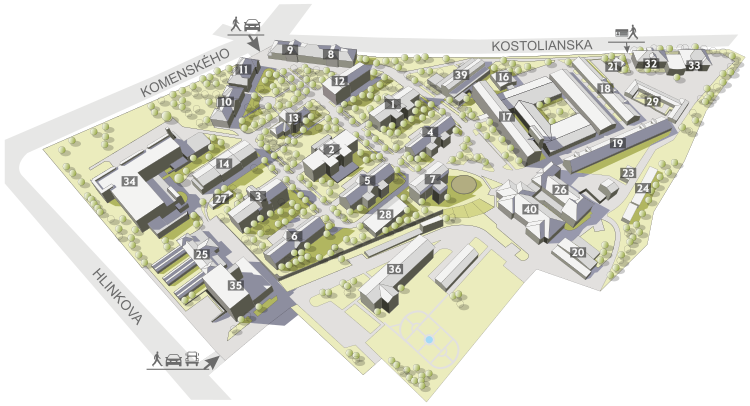
- b) Information resources
-
All literary resources for study outlined in the syllabi are available either in print or electronic form, all information databases purchased and licensed by the university are widely available to students.
- c) Distance learning, e-learning access and procedures
-
UVMP in Košice also provides distance learning for all courses via the MOODLE and MS Teams platforms. Each student can access manuals either in electronic form or in the form of video instructions.
- d) Partners involved in educational activities
-
When ensuring activities that have a high societal significance, especially in practical terms, the participation of contractual partners is expected, including those managed by the State Veterinary and Food Administration of the Slovak Republic, as well as private veterinarians, municipalities and cities, animal shelters.
- e) Social, sports, cultural, spiritual and community activities
-
UVMP in Košice provides its students with a wide range of opportunities for all-round enjoyment in all the above areas:
- provides students with adequate social security, regulated in the internal regulation Scholarship Regulations of UVLF in Košice,
- sports enjoyment of students is offered through the elective subject of physical education, as well as sections (canoeing, archery, equestrian and vaulting) of TJ Slávia UVLF, the "Rector´s Cup" competition in sports cynology, and a run around the dormitories,
- cultural and social enjoyment is offered to students through cultural and social events organized by the university and student clubs (matriculation ball, student breakthrough ball, sixth-grade banquet, welcome picnic for freshmen, traditional event Veterinary Days, St. Nicholas grill party, publication of student magazines ARDO and Fx News),
- in the premises of student dormitories, students regularly have the spiritual service of the University Pastoral Center Košice available.
- f) Student mobility and placements
-
Students of the Veterinary Nurse study programme are guaranteed the opportunity to participate in mobilities. The entire agenda containing instructions and conditions for applying for mobility, conditions and rules of participation as well as rules for recognizing mobility as part of the study plan is covered by the vice-rector for education MVDr. Martin Tomko, PhD., (+421 918 413 553; martin.tomko@uvlf.sk) and the organizational unit managed by him, which is the UVMP Mobility Department (Mario Segurado Benito; +421 917 171 108; mario.segurado@uvlf.sk). Mobilities and internships are regulated in Art. 41 of the internal regulation Study guidelines of UVMP in Košice, part A and specific requirements are stated in the internal regulation Directive on basic rules and principles of the project KA1 - higher education within the ERASMUS+ programme at UVMP in Košice.
9. Required skills of the applicant and prerequisites
- a) Required abilities and admission prerequisites
-
These are outlined in Art. 1 and Art. 2, part A, II. part Organization of studies - the internal regulation Study guidelines of UVMP in Košice.
- b) Admission procedures
-
They are outlined in Art. 3 and Art. 4, part A, II. part Organization of studies - the internal regulation Study guidelines of UVMP in Košice.
- c) Admission results over the standard duration of study
-
Academic year Applicants Admitted Enrolled Graduates —
10. Feedback regarding the quality of education provided
- a) Monitoring and assessment of student feedback
-
Students of the UVMP in Košice have the opportunity to anonymously evaluate the quality of teaching in the Academic Information System, where they evaluate the quality of a specific subject and the quality of the teachers who provide that subject. They have sufficient time for the evaluation, and this evaluation is carried out once a year after the end of the relevant academic year.
- b) Student feedback and measures to improve programme quality
-
Feedback regarding the Veterinary Nurse study programme are not available, as it is a newly created study programme. In general, feedback is very important as it allows for the implementation of concrete measures to improve the quality of the study programme.
- c) Graduate feedback and measures to improve programme quality
-
There is no feedback from graduates for the time being as the Veterinary Nurse study programme is a newly created study programme.
11. Links to other relevant internal regulations and information regarding the study or the student of the study programme
- Relevant internal regulations and other information
If the window remains open, close this browser tab.