

- a) Name and registration code of the study programme:
- Joint Bachelor Degree in Animal Science (joint study programme with Nord University) · 100768 · UIPŠ 4320R03
- b) Degree of study and ISCED level:
- First degree · ISCED 6
- c) Place of delivery:
- University of Veterinary Medicine and Pharmacy in Košice · Komenského 73, 041 81 Košice
- d) Field of study and ISCED-F code:
- Veterinary Medicine
- e) Type of study programme:
- Single degree study
- f) Awarded academic degree:
- BSc. (bachelor)
- g) Form of study:
- full-time study
- h) Partner universities and distribution of study obligations in a joint study programme
- i) Language of instruction:
- English language
- j) Standard duration of study:
- 3 years
- k) Programme capacity and applicants over the last six academic years
-
Planned student capacity Applicants over the last 6 academic years Admitted students over the last 6 academic years Enrolled students over the last 6 academic years 40 — 121 121 - l) Information about the study programme:
- Programme details
Study programme description
Joint Bachelor Degree in Animal Science (joint study programme with Nord University)
full-time study ·  · 100768 · 2026/2027
Last updated: 30.10.2026
- Higher education institution
- University of Veterinary Medicine and Pharmacy in Košice
- Registered address
- Komenského 73, 041 81 Košice
- Institution identification number
- 00397474
- Programme approval body
- UVMP Accreditation Commission in Košice
- Approval date
- 28.08.2026
- Last assessment date
- 2024-07-25
- Last assessment and related information
- Decision no.: 2024/58:560-VS-OAC dated July 25th, 2024
1. Basic data on the study programme
2. Profile of a graduate and aims of education
- a) Educational objectives and main learning outcomes
-
The educational goals of the Animal Science study programme are methodologically based on the European Qualifications Framework for Lifelong Learning (EQF). The Framework defines the requirements for learning outcomes for knowledge, skills, responsibility and independence.
For level 6, which also includes study programmes of the 1st level, practical and methodological knowledge from a key area of the field is assumed. This knowledge serves as a basis for future practice, research or artistic creation.
For level 6, the following are defined as cognitive skills – to propose solutions to methodological, professional, artistic or practical problems and to use general and professional knowledge when solving specific professional problems.
Using his practical skills, the graduate is able to propose solutions to methodological, professional, artistic or practical problems and creatively use methods, tools, devices and materials provided.
The graduate of a study programme under the level 6 is able to solve specific problems in a changing environment independently, plan his own education, be responsible for his own decision-making, present his own opinions, employ creative and flexible thinking. The carriers of the graduate's core knowledge are profile subjects.
- b) Occupations and graduate employment opportunities
-
Graduates of the Animal Science study programme could seek employment especially in the field of animal husbandry and veterinary medicine, and can built on their knowledge about the care, health and well-being of domestic animals. Graduates of the joint bachelor's degree programme, after obtaining a bachelor's degree, have acquired theoretical and practical knowledge based on current scientific knowledge and have mastered its use in the performance of their profession in the private veterinary sector, in the field of food safety or in the consulting, research and pedagogical fields or in further university studies in the field of veterinary medicine in doctoral studies, or master's studies in the field of biology and aquaculture.
3. Job prospects
- a) Assessment of graduate employability
-
Given many years of experience with graduates of the Animal Science study programme, we can state that graduates who obtained a bachelor's degree acquired theoretical and practical knowledge of biological sciences and are able to use it in the private veterinary sphere, in the field of food safety or in consulting, research and teaching. Graduates are also prepared for further university studies in the field of veterinary medicine or master's studies in the field of biology and aquaculture.
- b) Examples of successful graduates
-
All graduates of the study programme Animal Science have found employment and spread the good name of both universities, especially abroad.
- c) Employer feedback on programme quality
-
Evaluation of the quality of the study programme by employers of graduates (feedback): The quality of the Animal Science study programme is regularly evaluated mainly through feedback provided by employers themselves.
4. Structure and content of the study programme
- a) Rules for designing study plans
-
The rules for creating study plans for the Animal Science study programme are based on the general provisions contained in the internal regulation Study guidelines of UVMP in Košice, part A.
- The recommended study plan for the full-time study programme Animal Science:
- b) Recommended study plan:
- Study plan 2026/2027
- c) Information included in the study plan
-
- individual parts of the study programme (compulsory courses, compulsory optional courses and optional courses),
- profile courses marked in bold and with a letter (P).
The subject information sheet for each educational part (subject) contains:
- defined learning outcomes and related criteria and rules for their evaluation so that all educational objectives of the study programme are met,
- determined educational activities used suitable for achieving educational outcomes,
- stated methods by which educational activities are carried out,
- stated prerequisites for the subject,
- stated syllabi for the subject,
- assigned credits for each part based on the achieved learning outcomes and related workload,
- stated persons providing the subject; the subject guarantor is designated,
- places of implementation of the subject (if the study programme is implemented at multiple workplaces).
Information letters of the courses of the study programme are available through the links directly in the study plan:
Course information sheets for the Joint Bachelor Degree in Animal Science (joint study programme with Nord University) study programme are available through links directly in the study plan.
- d) Credits and other requirements for completion of study
-
Obtaining 180 credits is a condition for proper completion of the studies. Other conditions that a student must meet during the study of the study program and for its proper completion, including the conditions of state exams, rules for repeating studies and rules for extending and interrupting studies, are set out in the internal regulations Study guidelines of UVMP in Košice, part A.
the number of credits for state exams.
- e) Requirements for individual programme components and student progression
-
- number of credits per profile courses required for proper completion of the studies/completion of part of the study,
- number of credits for compulsory courses required for proper completion of the studies/completion of part of the study,
- number of credits for compulsory optional courses required for proper completion of the studies/completion of part of the study,
- f) Assessment of learning outcomes and appeal procedures
-
UVMP in Košice has described the rules regarding student evaluation and the possibility of repeating exams in the internal regulation Study guidelines of UVMP in Košice, part A.
- g) Recognition of studies or parts of studies
-
UVMP in Košice addresses the conditions for recognition of studies or parts of studies in the internal regulation Study guidelines of UVMP in Košice, part A.
- h) Thesis topics
-
Thesis topics and supervisors are listed in Table 2 in section 7.e of this description.
- i) Other study rules and procedures
-
- possibilities and procedures for participating in student mobility in the internal regulation Study guidelines of UVMP in Košice, part A and in the internal regulation Directive on the basic rules and principles of the KA1 project - higher education within the ERASMUS+ programme at UVMP in Košice, the mobility window is set for the 2nd year (third or fourth semester of study),
- Code of Ethics in the internal regulation Disciplinary procedure for Students of the University of Veterinary Medicine and Pharmacy in Košice, in the internal regulation Code of ethics for Employees of UVMP in Košice, in the internal regulation Student Code of Ethics of UVMP in Košice,
- rules applicable to students with special needs in the internal regulation Study guidelines of UVMP in Košice, part A.
- the procedures for submitting suggestions and appeals by the student are specified in the Directive on handling complaints at UVMP in Košice as well as the Study guidelines of UVMP in Košice.
5. Study programme’s information letters
- Course information sheets
-
Course information sheets are available through links directly in the study plan. Study plan 2026/2027
6. Current schedule of the academic year and current timetables
- Current academic calendar and timetables
-
The academic year schedule and the current timetable are always listed at the beginning of the academic year. The academic year schedule is available in document Study Guide Book at the UVMP in Košice study-guide-book-at-the-uvmp-in-kosice.pdf and on the UVMP´s website https://www.uvlf.sk/en/information-for-students/academic-year-schedule. The current timetable is available on the UVMP´s website https://www.uvlf.sk/en/information-for-students/timetables.
7. Staff
- a) Person responsible for the delivery, development and quality of the study programme
- Prof. Faixová Zita, DVM, PhD, MPH
- b) Teachers of profile courses
- c) Research/art/teaching profiles of teachers of profile courses
- d) Teachers, courses and links to the central register of university employees
-
(Click the teacher’s name to open their profile and contact details, where available.)
- e) Thesis supervisors and topics 3 years
-
(Click the teacher’s name to open their profile and contact details, where available.)
Table 2 – Thesis supervisors and topics Teacher Thesis topics Academic year Tatiana Szabóová, DVM, PhD Assessment of the impact of heat stress on health status and milk production in sheep farming 2025/2026 Jozef Lazár, DVM Breeding dogs with disproportionate dwarfism – Ethical concerns due to associated neurological disorders and reduced quality of life 2025/2026 Maroš Kostičák, DVM, PhD Canine infections caused by members of the order Rickettsiales: A comparative case study analysis of Anaplasma spp. and Rickettsia spp. 2025/2026 Prof. Pavol Mudroň, DVM, PhD, Dip. ECBHM Colostrum substitute in food animals 2025/2026 Assoc. prof. Lukáš Bujňák, DVM, PhD Common mycotoxins in equine feedstuffs 2025/2026 Assoc. prof. Mária Kuricová, DVM, PhD, MBA, MSc. Dental Health: New Insights in Pet Dental Hygiene 2025/2026 Marián Kadaši, DVM, PhD Diagnostic tests using blood or plasma for pregnancy detection in dairy cows 2025/2026 Assoc. prof. Gabriela Gregová, DVM, PhD Effects of ecotourism on animal populations' ecosystems 2025/2026 Assoc. prof. Magnhild Oust Torske, DVM, PhD Ethical Challenges in Euthanasia Decision-Making in Veterinary Practice 2025/2026 Prof. Hetroney Mweemba Munang’Andu, DVM, PhD Factors contributing to antibiotic resistance in bacterial biofilms 2025/2026 Prof. Zita Faixová, DVM, PhD, MPH Function of hemoglobin and its derivates in species 2025/2026 Assoc. prof. Peter Váczi, DVM, PhD General anaesthetic agents used in veterinary medicine 2025/2026 Martina Galdíková, DVM, PhD Heredity of coat colour in horses 2025/2026 Tatiana Szabóová, DVM, PhD Hygienic and health aspects of salmonid fish farming technology in Scandinavian countries 2025/2026 Marián Kadaši, DVM, PhD Metritis and endometritis in dairy cows 2025/2026 Marián Kadaši, DVM, PhD Neuroendocrine regulation of the ovarian cycle in dairy cows 2025/2026 Tomáš Mihok, DVM, PhD Nutrition of Female Dogs During Different Stages of the Reproductive Cycle 2025/2026 Lenka Koščová, DVM, PhD Operational Welfare Indicators for Atlantic Salmon in sea-cage farming: current practices and limitations 2025/2026 Assoc. prof. Mária Kuricová, DVM, PhD, MBA, MSc. Osteoarthritis and chronic pain in dogs - management options 2025/2026 Lenka Skurková, DVM, PhD Perception, cognition, and emotions of cats: understanding cat-human interactions to optimize feline welfare 2025/2026 Assoc. prof. Eva Dudriková, DVM, PhD Quality and safety of milk in the “One Health” concept 2025/2026 Jakub Lipinský, DVM Selected Zoonotic Pathogens in Bat Populations 2025/2026 Assoc. prof. Magnhild Oust Torske, DVM, PhD Stress in Shelter Dogs: Causes, Consequences, and Management 2025/2026 Assoc. prof. Andrej Marcin, B.Sc., DVM, CSc. Sustainable aquafeed solutions for Norwegian fish farms – possible innovations and nutritional impacts 2025/2026 Assoc. prof. Andrej Marcin, B.Sc., DVM, CSc. Sustainable substrate solutions for production of insect larvae for the improvement of fish farm efficiency in Norway 2025/2026 Veronika Šimaiová, DVM, PhD The cardiovascular system of the horse and its most common diseases 2025/2026 Jana Halušková, M.A., PhD The current status and prospects for the production of transgenic livestock 2025/2026 Assoc. prof. Viera Schwarzbacherová, DVM, PhD The genetically determined blood diseases of cattle 2025/2026 Assoc. prof. Viera Schwarzbacherová, DVM, PhD The genetically determined eye diseases of cattle 2025/2026 Assoc. prof. Viera Schwarzbacherová, DVM, PhD The genetically determined muscle function diseases of cattle 2025/2026 Prof. Oskar Nagy, DVM, PhD, Dip. ECBHM The importance of colostrum for young animals and the possibilities of assessing its quality 2025/2026 Veronika Šimaiová, DVM, PhD The locomotor system of the horse pelvic limb and its most common diseases 2025/2026 Nikola Dančová, M.A., PhD The role and importance of coagulase-negative staphylococci as opportunistic pathogens in cattle 2025/2026 Prof. Pavol Mudroň, DVM, PhD, Dip. ECBHM Umbilical pathology in food animals 2025/2026 Assoc. prof. Gabriela Gregová, DVM, PhD Wastewater treatment and public health 2025/2026 Prof. Hetroney Mweemba Munang’Andu, DVM, PhD Zoonoses as an occupational health hazard for veterinarians working on livestock diseases 2025/2026 Szabóová Tatiana, DVM, PhD Assessment of the impact of hygiene and housing technology on health and welfare of the cattle 2024/2025 Assoc. prof. Vatsos Ioannis, DVM, PhD Beekeeping – present and future 2024/2025 Assoc. prof. Korytár Ľuboš, DVM, PhD Bird banding and potential exposure to zoonotic pathogens 2024/2025 Assoc. prof. Kuricová Mária, DVM, PhD, MBA, MSc. Brain tumors in small animal clinical practice 2024/2025 Demčišáková Zuzana, M.A., PhD Chorioallantoic membrane assay as a model for angiogenesis in tissue engineering 2024/2025 Assoc. prof. Vatsos Ioannis, DVM, PhD Current methods for the control of sea lice in salmon farming 2024/2025 Prof. MSc. Emma Ternman, PhD Effects of sleep deprivation in mammals 2024/2025 Assoc. prof. Dudriková Eva, DVM, PhD Evaluation criteria of the quality and safety of raw milk used for further processing to human nutrition 2024/2025 Doc. MVDr. Magnhild Oust Torske, PhD Factors affecting piglet neonatal mortality in commercial pig farming 2024/2025 Drážovská Monika, DVM, PhD Factors influencing herpesvirus infection occurrence in dogs 2024/2025 Assoc. prof. Vatsos Ioannis, DVM, PhD Farming and diseases of land snails 2024/2025 Assoc. prof. Bujňák Lukáš, DVM, PhD Feed additives for improving health and performance in poultry 2024/2025 Assoc. prof. Holečková Beáta, M.A., PhD Genetic background of canine muscular dystrophies 2024/2025 Szabóová Tatiana, DVM, PhD Health and welfare problems of farming animals associated with the transport 2024/2025 Galdíková Martina, DVM, PhD Heritable Congenital Defects in Cattle 2024/2025 Assoc. prof. Holovská Katarína, DVM, PhD Histological structure of the blood-brain barrier 2024/2025 Koščová Lenka, DVM, PhD Importance and diversity of freshwater bivalves: from threatened and cultured to invasive species 2024/2025 Farbáková Jana, DVM, PhD Importance of the proper nail trimming in dogs 2024/2025 Maroš Kostičák, DVM Methods for diagnosis, treatment and prevention of anaplasmosis in animals 2024/2025 Assoc. prof. Holovská Katarína, DVM, PhD Morphological study of the placenta of ruminants 2024/2025 Prof. Mirossay Ladislav, M.D., DrSc. Nasopharyngeal myasis in red deer (Cervus elaphus) in district of Košice 2024/2025 Assoc. prof. Marcin Andrej, B.Sc., DVM, CSc. New protein sources for feed production 2024/2025 Koščová Lenka, DVM, PhD Non-native fish in freshwater ecosystems – dispersal and eradication techniques 2024/2025 Mihok Tomáš, DVM, PhD Nutritional Management in Hepatic Failure in Dogs and Cats 2024/2025 Assoc. prof. Pipová Monika, DVM, CSc. Organoleptic, chemical and microbiological indicators of fish freshness 2024/2025 Prof. MSc. Emma Ternman, PhD Physiological changes in sleep states in mammals 2024/2025 Sabová Lucia, DVM, PhD Prevention and control of bee brood diseases 2024/2025 Assoc. prof. Prokeš Marián, DVM, PhD Prevention of bacterial and viral tick-borne zoonoses in humans and animals and One Health approach 2024/2025 Doc. MVDr. Magnhild Oust Torske, PhD Teeth clipping/filing in newborn piglets 2024/2025 Halušková Jana, M.A., PhD The genetic mechanisms underlying retinal and some other hereditary eye diseases in dogs 2024/2025 Assoc. prof. Schwarzbacherová Viera, DVM, PhD The genetically determined diseases of the central nervous system of cattle 2024/2025 Assoc. prof. Schwarzbacherová Viera, DVM, PhD The genetically determined skeletal diseases of cattle 2024/2025 Assoc. prof. Gregová Gabriela, DVM, PhD The impact of heat stress on health, milk production, and reproduction in dairy cows 2024/2025 Šimaiová Veronika, DVM, PhD The locomotor system of the horse's thoracic limb and its most common diseases 2024/2025 Assoc. prof. Styková Eva, DVM, PhD The role of skin microbiome in the health and disease of companion animals 2024/2025 Šimaiová Veronika, DVM, PhD Topography of the organs in the pelvic cavity of the horse 2024/2025 Doc. MVDr. Magnhild Oust Torske, PhD Why do prospective dog owners choose to buy brachycephalic breeds? 2024/2025 Dr. h. c. Prof. Mojžišová Vaščinec Jana, DVM, PhD Zoonoses of wild hoofed animals and their epidemiological importance 2024/2025 - f) Research/art/teaching profiles of thesis supervisors
-
The supervisors’ research/art/teaching profiles are available through their personal profiles using the name buttons in the preceding table.
- g) Student representatives and contacts
-
The members of the committee for the preparation of the study programme in Animal Science are:
- Lucia Olešová (5th year of study, study programme General Veterinary Medicine) e-mail: lucia.olesova@student.uvlf.sk,
- Dominik Schön (5th year of study, study programme General Veterinary Medicine), e-mail: dominik.schon@student.uvlf.sk.
The members of the UVMP Accreditation Committee are:
- Dominik Borčík (5th year of study, study programme General Veterinary Medicine), e-mail: dominik.borcik@student.uvlf.sk,
- Norbert Emödi (4th year of study, study programme Pharmacy), e-mail: norbert.emodi@student.uvlf.sk.
- h) Study adviser
-
doc. MVDr. Gabriela Štrkolcová, PhD., e-mail: gabriela.strkolcova@uvlf.sk; tel. no.: +421 907 798 819; Department of Epizootology, Parasitology and Protection of One Health.
- i) Other support staff
-
Ing. Michaela Paulíková, e-mail: michaela.paulikova@uvlf.sk.
8. Premises, tools and technical equipment
- a) Teaching premises and their technical equipment
-
- List and description of seminar rooms and their technical equipment and their relation to the learning outcomes and course:
Lectures, seminars, practical exercises, laboratory exercises and other pedagogical activities per individual study courses of the Animal Science study programme in English are held at the UVMP in Košice in lecture halls, libraries and seminar rooms of the UVMP in Košice. The university has built modern laboratories with accessible equipment for students of this study program. The list of buildings and rooms used for the above activities is shown in the table attached below. All buildings are located in the UVMP campus.
Course
Description of equipment and tools
Location Animal anatomy I.
Freezer box, cooling box, maceration device, technical tools necessary for dissection, osteological material, plastinates, muscle system preparations.
P-39-autopsy rooms 1, 2, 3 and 4
Animal anatomy II.
Freezer box, cooling box, maceration device, technical tools necessary for dissection, corrosive preparations, plastinates, models, fixed preparations from splanchnology, vascular and nervous system.
P-39-autopsy rooms 1, 2, 3 and 4
Animal husbandry
Data projector, PC set, whiteboard, cabinet with fixing aids, animal models.
P-12-laboratory 3 a 6
Animal hygiene, welfare and behaviour of animals
Computer technology, data projector, measuring devices for determining the physical and chemical properties of the air.
P-3-2. NP, laboratory 1
Animal nutrition and feed control I.
Exercise room 2: Computer, monitor; projector, blackboard
Exercise room 3: Computer, monitor; projector; feed samples
Training room 7: 14 x PC; blackboard, projector.
P-12-exercise rooms 2, 3 a 7
Animal nutrition and feed control II.
Exercise room 2: Computer, monitor; projector, blackboard
Exercise room 3: Computer, monitor; projector; feed samples
Training room 7: 14 x PC; blackboard, projector.
P-12-exercise rooms 2, 3 and 7
Biochemistry
Data projector, laptop, hood, refrigerator, freezer, spectrophotometer, centrifuge, automatic pipettes, water bath, analytical scales, UV-spectrophotometer, electrophoresis, pH-meter, laboratory glass, diagnostic sets for determination of metabolites and enzymes, biological material (blood, blood serum, milk).
Faculty of Aquaculture and Biological Sciences, Nord University Bodø
Biomedical statistics and informatics
19 PC, dataprojektor. 19 personal computers, dataprojector.
P-5 computer seminar room
Chemistry and biophysics
Spectrophotometer, refractometer, centrifuges, water bath with thermostat, digital pressure gauge, oximeter, set for measuring electric membrane potential, freezers, refrigerator, laboratory glassware, automatic pipettes, data projector with laptop.
Faculty of Aquaculture and Biological Sciences, Nord University Bodø
Cell biology
Light microscopes, spectrophotometer, centrifuge, thermostat, laboratory glassware, refrigerators, freezers, automatic pipettes, pH meter, analytical scales, data projector with laptop.
Faculty of Aquaculture and Biological Sciences, Nord University Bodø
Introduction to business economics
Personal computers for students, data projector. Computing technology, software equipment for veterinary clinics.
Faculty of Aquaculture and Biological Sciences, Nord University Bodø
Epidemiology
Complex laboratory equipment for bacteriological, virological and serological diagnostic methods, computer technology, slide projector.
P1-laboratories, seminar rooms
Feed and toxic plants
Light microscopes, samples of feed and toxic plants, personal computers, dataprojector with laptop.
Faculty of Aquaculture and Biological Sciences, Nord University Bodø
Fish farming and health management
Microscopes - Zeis PrimoStar; Olympus BX41, 2x Motic BA 310, Stereomicroscopes – Zeis Stemi 508 binocular magnifier; Motic SMZ 168, Camera for a microscope (with software for measuring morphological structures) – Zeis AxioCam ERc5S, Moticam 2300, Camera for a stereomicroscope (with software for measuring morphological structures) – Zeis AxioCam ERc5s. Permanent preparations of selected freshwater parasite species; fixation solutions for primary fixation of parasites and creation of permanent preparations. The possibility of obtaining a sufficient diversity of ornamental fish species, fish intended for consumption and fish from open sea and fresh waters with use for parasitological examination (with a positive examination result).
Faculty of Aquaculture and Biological Sciences, Nord University Bodø
Genetics and evolution
Light microscopes, centrifuge, refrigerator, freezer, laboratory glassware, automatic pipettes, data projector with laptop.
Faculty of Aquaculture and Biological Sciences, Nord University Bodø
Histology
Light microscopes (Motica, Zeiss, Optica), Zeiss light microscope - trinocular with camera, Epson multimedia, LG monitor, 3-D models, Histological preparations, School ceramic white board.
P-17-141 and 145
Immunology
Laboratory equipment necessary for current laboratory immunological examinations and tests, PC, data projector.
P-3-ground floor, laboratories, exercise room
Latin terminology
Data projector, laptop, TV receiver.
P-14 and 9 – J1, J2, J3, J4
Microbiology
Laboratory equipment for modern investigation methods to determine the causative agents of bacterial animal diseases.
Faculty of Aquaculture and Biological Sciences, Nord University Bodø
Parasitology I.
Laboratory equipment for laboratory parasitological examinations and tests, PC, data projector.
P-2 laboratories, exercise room
Parasitology II.
Laboratory equipment for laboratory parasitological examinations and tests, PC, data projector.
P-2 laboratories, exercise room
Pathological anatomy I.
Histology training room: light microscopes, tables, chairs, overhead projector, ceiling projector mount, white magnetic board Autopsy - technical equipment: large and small stainless steel dissection tables, metal chairs, sterilizer, cooling boxes, refrigerator, metal cabinets, ceramic sinks, surgical stainless steel tables, stainless steel sinks, forklift, high-pressure cleaner for washing and disinfecting floors, racks for clothes and rubber galoshes, metal cabinets for storing clothes for students, plastic bench for sitting, electric boiler, plastic containers for liquid soap and disinfectant, plastic containers for paper towels, plastic waste skins, metal racks, traction equipment, stainless steel portable organ boxes, hoses in metal packaging Material: dissection tools: stainless steel, steel and kitchen knives of various sizes, straight scissors, curved scissors, intestinal scissors, large and small tweezers , peans, scalpels, knife sharpener, manual and electric saws, plastic mats, glass and plastic collection containers for samples, fixation solutions (10% formalin solution, physiological solution, ethanol, distilled water), rubber aprons, rubber galoshes, protective plastic shields and glasses.
P-17-histology exercise room, small and large autopsy room P-36-101
Pathological anatomy II.
Histology training room: light microscopes, tables, chairs, overhead projector, ceiling projector mount, white magnetic board Autopsy - technical equipment: large and small stainless steel dissection tables, metal chairs, sterilizer, cooling boxes, refrigerator, metal cabinets, ceramic sinks, surgical stainless steel tables, stainless steel sinks, forklift, high-pressure cleaner for washing and disinfecting floors, racks for clothes and rubber galoshes, metal cabinets for storing clothes for students, plastic bench for sitting, electric boiler, plastic containers for liquid soap and disinfectant, plastic containers for paper towels, plastic waste skins, metal racks, traction equipment, stainless steel portable organ boxes, hoses in metal packaging Material: dissection tools: stainless steel, steel and kitchen knives of various sizes, straight scissors, curved scissors, intestinal scissors, large and small tweezers , peans, scalpels, knife sharpener, manual and electric saws, plastic mats, glass and plastic collection containers for samples, fixation solutions (10% formalin solution, physiological solution, ethanol, distilled water), rubber aprons, rubber galoshes, protective plastic shields and glasses.
P-17-histology exercise room, small and large autopsy room P-36-101
Pathological physiology I.
Light microscopes, thermostat, centrifuge, spectrophotometers, refractometer, pH meter, automatic pipettes, laboratory glass, freezer, refrigerator, biological material (blood and its derivatives, urine, body fluids), data projector, personal computer.
P-8-exercise room 1, exercise room 2 and seminar room
Pathological physiology II.
Light microscopes, thermostat, centrifuge, spectrophotometer, refractometer, pH meter, automatic pipettes, laboratory glass, freezer, refrigerator, laboratory kits for determination of biochemical and hematological parameters, biological material (blood and its derivatives, urine, body fluids), data projector, personal computer.
P-8-exercise room 1, exercise room 2 and seminar room
Pharmacology and pharmacy I.
PC, dataprojektor. Laboratory equipment necessary for practical exercises, PC, data projector.
P-4-laboratories, exercise rooms
Pharmacology and pharmacy II.
Laboratory equipment necessary for practical exercises, PC, data projector.
P-4-laboratories, exercise rooms
Propedeutics
Technical equipment for the performance of preventive veterinary measures, PC, data projector
Freezer box, cooling box, maceration device, technical tools necessary for dissection, osteological material, plastinates, preparations of the muscular system.
Laboratory microscopes XSP 151
SonoScape ultrasonograph
Fritz endoscope
Fixation cage for small ruminants
Fixation cage for large ruminants
Fixation cage for horses
Investigation table
Technologically adapted exercise room for clinical and special diagnostic examination of all types of animals
Fixation cages, cavity openers, probes, endoscopes, cystoscopes, catheters, speculums, magnet feeders, pheroscopes, phonendoscopes, percussive hammers, plesimeters
ECG, USG, hematological and biochemical analyzer, centrifuges, pH meter
Laboratory for examination of biological material (blood, urine, droppings, rumen contents, cerebrospinal fluid) - microscopes
Use of animals and equipment in the stables of individual clinics, at ŠPP Zemplínska Teplica and in the Clinical Skills Center.
P-19 – 1048
P-19 – 1046
P-19 – 1046
P-19 – 145
P-18 – 160
P-17 – exercise room 1
P-17 – exercise room 2
P-17-1, 2, 3
ŠPP Zemplínska Teplica
the Clinical Skills Center
Protection of the environment
Laboratory for microbiological analysis of water samples, excrement, etc., analysis of bacteriological swabs to check the effectiveness of disinfection (culture media, Petri dishes, etc.). Laboratory for physicochemical analysis, pH and conductivity meter, Oxymeter (LDO electrode with HQ Series Portable Meters device by Hach, dryer (105 ºC), muffle furnace (550 ºC), water bath, spectrophotometer DR 2 800 by Hach, reactor for COD determination by Hach, Digestdahl reactor by Hach, case set (VISOCOLOR® ECO for colorimetric testing of drinking water by Merck).
Faculty of Aquaculture and Biological Sciences, Nord University Bodø
Practical training I.
Faculty of Aquaculture and Biological Sciences, Nord University Bodø
Parctical training II.
Toxicology
Instrumentation, material and technical equipment for the performance of toxicological analyses, PC, data projector.
Faculty of Aquaculture and Biological Sciences, Nord University Bodø
Introduction to veterinary legislation and work ethics
PC, data projector.
Faculty of Aquaculture and Biological Sciences, Nord University Bodø
Zoology
Data projector, computer, microscopes, camera, television, laptops.
Faculty of Aquaculture and Biological Sciences, Nord University Bodø
Zoophysiology and embryology
Light microscopes, spectrophotometer, thermostat, centrifuge, automatic pipettes, freezer, refrigerator, biological material (blood, rumen contents).
Faculty of Aquaculture and Biological Sciences, Nord University Bodø
Wildlife management
Microscopes - Zeis PrimoStar; Olympus BX41, 2x Motic BA 310, Stereomicroscopes – Zeis Stemi 508 binocular magnifier; Motic SMZ 168, Camera for a microscope (with software for measuring morphological structures) – Zeis AxioCam ERc5S, Moticam 2300, Camera for a stereomicroscope (with software for measuring morphological structures) – Zeis AxioCam ERc5s. Permanent preparations of selected species of animal parasites; fixation solutions for primary fixation of parasites and creation of permanent preparations. The possibility of obtaining a sufficient number and diversity of samples in cooperation with several hunting associations (with a positive result of the examination). The University facility for the breeding and diseases of game, fish and bees in Rozhanovci with farm breeding of pheasants, intensive breeding of mouflon and fallow deer , and a hunting area with breeding of wild boar, deer and roe deer are also used for teaching.
P2-exercise room and laboratory 1 and 2
Applied veterinary haematology
Light microscopes, thermostat, centrifuge, spectrophotometer, refractometer, pH meter, automatic pipettes, laboratory glass, freezer, refrigerator, laboratory kits for determination of hematological parameters, biological material (blood and its derivatives),permanent blood smears of various animal species, solutions for staining blood smears, data projector, personal computer.
P-8-exercise room 1, exercise room 2, seminar room
Cynology
Training area for dogs.
UVMP campus Pri hati
Physical education
Cardio and fitness equipment, sports equipment, tools and aids for individual sports activities, audio equipment, TV receiver.
Work place Physical Education and Sports , Department of General Competencies, Podhradová 11 – 2 cardio exercise rooms; gym
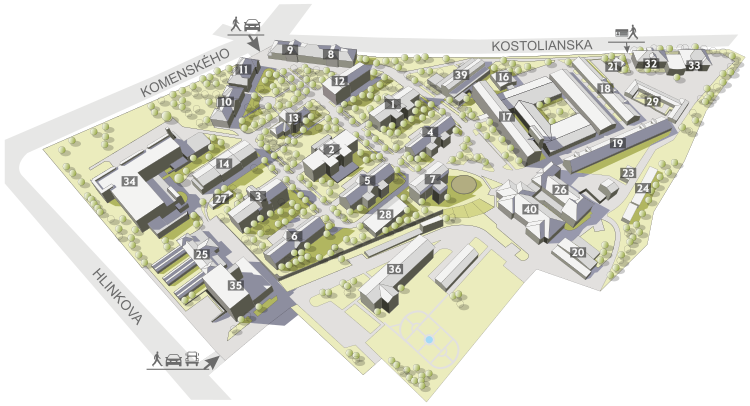
- b) Information resources
-
All literary resources for study outlined in the syllabi are available either in print or electronic form, all information databases purchased and licensed by the university are widely available to students.
- c) Distance learning, e-learning access and procedures
-
UVMP in Košice also provides distance learning for all courses via the MOODLE and MS Teams platforms. Each student can access manuals either in electronic form or in the form of video instructions.
- d) Partners involved in educational activities
-
State Veterinary and Food Administration and organizations managed by it, Chamber of Veterinary Surgeons of the Slovak Republic, food producers, slaughterhouses, breeding associations.
- e) Social, sports, cultural, spiritual and community activities
-
UVMP in Košice provides its students with a wide range of opportunities for all-round enjoyment in all the above areas:
- provides students with adequate social security, regulated in the internal regulation Scholarship Regulations of UVLF in Košice,
- sports enjoyment of students is offered through the elective subject of physical education, as well as sections (canoeing, archery, equestrian and vaulting) of TJ Slávia UVLF, the "Rector´s Cup" competition in sports cynology, and a run around the dormitories,
- cultural and social enjoyment is offered to students through cultural and social events organized by the university and student clubs (matriculation ball, student breakthrough ball, sixth-grade banquet, welcome picnic for freshmen, traditional event Veterinary Days, St. Nicholas grill party, publication of student magazines ARDO and Fx News),
- in the premises of student dormitories, students regularly have the spiritual service of the University Pastoral Center Košice available.
- f) Student mobility and placements
-
Students of the Animal Science study programme are guaranteed the opportunity to participate in mobilities. The entire agenda containing instructions and conditions for applying for mobility, conditions and rules of participation as well as rules for recognizing mobility as part of the study plan is covered by the vice-rector for education MVDr. Martin Tomko, PhD., (+421 918 413 553; martin.tomko@uvlf.sk) and the organizational unit managed by him, which is the UVMP Mobility Department (Mario Segurado Benito; +421 917 171 108; mario.segurado@uvlf.sk). Mobilities and internships are regulated in Art. 41 of the internal regulation Study guidelines of UVMP in Košice, part A and specific requirements are stated in the internal regulation Directive on basic rules and principles of the project KA1 - higher education within the ERASMUS+ programme at UVMP in Košice.
9. Required skills of the applicant and prerequisites
- a) Required abilities and admission prerequisites
-
These are outlined in part A, II. part Organization of studies – the internal regulation Study guidelines of UVMP in Košice.
- b) Admission procedures
-
They are outlined in part A, II. part Organization of studies – the internal regulation Study guidelines of UVMP in Košice.
- c) Admission results over the standard duration of study
-
Academic year Applicants Admitted Enrolled Graduates —
10. Feedback regarding the quality of education provided
- a) Monitoring and assessment of student feedback
-
Students of the UVMP in Košice have the opportunity to anonymously evaluate the quality of teaching in the Academic Information System, where they evaluate the quality of a specific subject and the quality of the teachers who provide that subject. They have sufficient time for the evaluation, and this evaluation is carried out once a year after the end of the relevant academic year.
- b) Student feedback and measures to improve programme quality
-
The principle applies that the results of feedback are very important for drawing conclusions from assessments that are implemented into specific measures implemented with the aim of improving the quality of the study programme. The results of student feedback and related measures to improve the quality of the study programme are part of the UVMP Annual Quality Report for academic year 2024/25. The feedback is also evaluated by the Quality Council, which subsequently recommends solutions to improve the quality of the relevant study programme. The relevant Commission for the Creation, Adjustment and Periodic Evaluation of the Study Programme also deals with feedback from students and prepares Annual evaluation of the quality of study programmes at UVMP in Košice for the academic year 2024/25.
- c) Graduate feedback and measures to improve programme quality
-
The results of graduate feedback and related measures to improve the quality of the study programme are part of the Annual report on activities UVMP and UVMP Annual Quality Report for academic year 2024/25. As part of improving the quality of the study programme, the results of graduate evaluations are discussed once a year at the relevant Commission for the Creation, Adjustment and Periodic Evaluation of Study Programmes, where individual comments and proposals for improving the quality of the study programme are discussed. The UVMP has also been evaluating the readiness of graduates in the form of an electronic questionnaire for employers, which is available at https://forms.gle/z1h9u3rd2g9H589P7.
11. Links to other relevant internal regulations and information regarding the study or the student of the study programme
- Relevant internal regulations and other information
If the window remains open, close this browser tab.