

- a) Name and registration code of the study programme:
- Animal nutrition and dietetics · 103991 · UIPŠ 4341V00
- b) Degree of study and ISCED level:
- Third degree · ISCED 8
- c) Place of delivery:
- University of Veterinary Medicine and Pharmacy in Košice · Komenského 73, 041 81 Košice
- d) Field of study and ISCED-F code:
- Veterinary Medicine
- e) Type of study programme:
- Single degree study
- f) Awarded academic degree:
- PhD (philosophiae doctor)
- g) Form of study:
- full-time study
- h) Partner universities and distribution of study obligations in a joint study programme
- i) Language of instruction:
- English language
- j) Standard duration of study:
- 4 years
- k) Programme capacity and applicants over the last six academic years
-
Planned student capacity Applicants over the last 6 academic years Admitted students over the last 6 academic years Enrolled students over the last 6 academic years — 0 — — - l) Information about the study programme:
- Programme details
Study programme description
Animal nutrition and dietetics
full-time study ·  · 103991 · 2025/2026
Last updated: 30.10.2026
- Higher education institution
- University of Veterinary Medicine and Pharmacy in Košice
- Registered address
- Komenského 73, 041 81 Košice
- Institution identification number
- 00397474
- Programme approval body
- UVMP Accreditation Commission in Košice
- Approval date
- 27.08.2024
1. Basic data on the study programme
2. Profile of a graduate and aims of education
- a) Educational objectives and main learning outcomes
-
The learning objectives achieved in the study programme Animal Nutrition and Dietetics are methodologically based on the European Qualifications Framework for Lifelong Learning (EQF). This defines the requirements for learning outcomes for knowledge, skills and competences. For level 8, the learning outcomes required are highly specialised knowledge, some of which is at the forefront of the field of work or study and underpins original and creative thinking and/or research; basic knowledge of all the related fields. The field requires solving problems in which many related factors are at work; learning is often highly specialised. The focus of the courses, the core knowledge and the required skills are described in detail in the syllabi of the compulsory courses. Additional knowledge is achieved by completing other compulsory courses in the study programme. By completing the core courses, the graduate will gain knowledge about the importance of hygiene and quality of production of food of animal origin for their health safety. The students will acquire the latest methods of food production technology, while acquiring the latest scientific knowledge in the field of food production, ensuring the desired animal performance and efficient productivity of animal breeders. Graduates of the Animal Nutrition and Dietetics programme are are qualified to exercise the profession a veterinarian specialist in nutrition, dietetics and prevention of health disorders, specialist in diagnostics and quality control of feed, research and development in the field of nutrition, dietetics, production and animal breeding. The level of current knowledge of the biological relationships between nutrition - production - animal health represents the theoretical basis of veterinary medicine. Nutrition and veterinary dietetics, by analyzing the health and quality of feed, studying the intake, digestion and absorption of nutrients with monitoring the metabolic transformation of nutrients for the nutritional provision of production (quantity and quality), body resistance, health and reproductive capacity of animals, represents a production-medical approach to the productive animal health. Rising production that exceeds the metabolic limits of the animals in phase represents a risk of metabolic diseases. Therefore, nutritional physiology, analysis of the causes of malnutrition, knowledge and nutritional support of adaptive mechanisms are essential elements of nutritional prevention of metabolic diseases in high production animals. Dietetics and clinical nutrition includes knowledge of nutritional support and regulation of metabolic processes in the clinical stage of morbidity, chronic organ disorders and in the convalescence phase. Dietetics and clinical nutrition in companion and domestic animals, forms an important part of prevention and therapeutic procedures with an irreplaceable aspect on the modification of metabolic parameters and clinical changes. In proportion to the impact of the studied issue, the need for professionals is increasing.
The skills and learning outcomes corresponding to level 8 can be used in problem solving, research and/or innovation to develop new knowledge and practices and to integrate knowledge from different fields. The syllabi describe the skills that the graduate of the course will achieve. Together, the skills achieved in the individual courses represent an interrelated complex that results in skills that determine the successful implementation of the competences.
The broadly defined competences for level 8 of the EQF include the following - the ability to demonstrate considerable authority, innovation, autonomy, scientific and professional integrity and a sustained commitment to developing new ideas or practices that are at the forefront of the work or learning environment, including research.
- Graduates of the study programme Animal Nutrition and Dietetics can work as livestock breeders, in management of individual sectors of livestock production, in companies with large-scale livestock breeding and in farms, operation and management of feed production plants and consultants in the field of statistical processing of results in the field of animal nutrition and dietetics.
Graduates of doctoral studies can work in the following fields:
- data, statistical and information processes, setting up breeding conditions and processing of feed of plant and animal origin,
- management of agricultural holdings, focusing mainly on crop and livestock production, preparation and evaluation of feeds fed to animals and their impact on the quality of animal products,
- advice and control in the field of animal nutrition and dietetics, feed production, welfare compliance, advice and prevention of livestock diseases.
- b) Occupations and graduate employment opportunities
- Not provided yet.
- c) Statements of relevant external stakeholders
-
Relevant external stakeholders who have provided a statement or a favourable opinion on the compliance of the acquired qualification with the sector-specific requirements of the profession: Centre of Biosciences, Slovak Academy of Sciences, Institute of Animal Physiology.
Company or external stakeholder Statement Centrum biovied SAV, v. v. i. – Ústav fyziológie hospodárskych zvierat View
3. Job prospects
- a) Assessment of graduate employability
-
- On the basis of previous long experience with graduates of the study programme Animal Nutrition and Dietetics it can be stated that the graduates find employment at university workplaces and workplaces of the Slovak Academy of Sciences as well as at the workplaces of the Slovak State Veterinary School and also in the private sphere in the field of agricultural production.
- b) Examples of successful graduates
-
Examples of successful graduates of the study programme Animal Nutrition and Dietetics: In the study programme Animal Nutrition and Dietetics provided in the English language in the full-time form of study, no doctoral student has studied so far.
- c) Employer feedback on programme quality
-
Employers' evaluation of the quality of the study programme (feedback): the quality of the study programme can be positively assessed indirectly given the interest in this study programme among graduates of the second level of higher education from various fields (medical and pharmaceutical sciences, natural sciences and agricultural sciences. UVMP has prepared questionnaires about graduates for employers. UVMP has prepared questionnaires about graduates for employers.
4. Structure and content of the study programme
- a) Rules for designing study plans
-
- The rules for drawing up the study plans in the study programme Animal Nutrition and Dietetics are based on the general provisions contained in Article 2 of the internal regulation Study Regulations of the UVMP in Košice, Part B.
- b) Recommended study plan:
- Study plan 2025/2026
- c) Information included in the study plan
-
Course information sheets for the Animal nutrition and dietetics study programme are available through links directly in the study plan.
- d) Credits and other requirements for completion of study
- Not provided yet.
- e) Requirements for individual programme components and student progression
- Not provided yet.
- f) Assessment of learning outcomes and appeal procedures
- Not provided yet.
- g) Recognition of studies or parts of studies
- Not provided yet.
- h) Thesis topics
-
Thesis topics and supervisors are listed in Table 2 in section 7.e of this description.
- i) Other study rules and procedures
-
UVMP in Košice has laid down the rules for the verification of learning outcomes and evaluation of students and the possibilities of repeating exams in Articles 16-17 of the internal regulation Study Regulations of UVMP in Košice, Part B.
- Conditions for the recognition of studies or part of studies:
UVMP in Košice also accepts graduates of other universities in the Slovak Republic and abroad to study doctoral programmes if they can prove sufficient theoretical and practical knowledge for successful completion of the relevant study programme. Recognition of a part of doctoral studies follows the Bologna Convention.
- Topics of the final theses of the study programme:
In the study programme Animal Nutrition and Dietetics provided in the English language in the full-time form of study, no doctoral student has studied so far, and no topic has been announced in this study programme, form and language version.
- UVMP in Košice has laid down:
- the the rules for assigning, processing, opposing, defending and evaluating final theses in Articles 1, 8, 9, 10, 25, 26, 27 and 28 of the internal regulation Study Regulations of the UVLF in Košice, Part B,
- possibilities and procedures for participation in student mobility in Article 42 of the internal regulation Study Regulations of UVLF in Košice, Part B,
- Code of Academic Ethics in the internal regulation Disciplinary rules for Students of the University of Veterinary Medicine and Pharmacy in Košice in the internal regulation UVLF Employee Code of Ethics and in the internal regulation UVLF Student Code of Ethics,
- the procedures for filing complaints and appeals by the student are provided, in addition to the Study Regulations of UVMP in Košice, in particular the internal regulation Directive on the handling of complaints at UVMP in Košice.
5. Study programme’s information letters
- Course information sheets
-
Course information sheets are available through links directly in the study plan. Study plan 2025/2026
6. Current schedule of the academic year and current timetables
- Current academic calendar and timetables
- Not provided yet.
7. Staff
- a) Person responsible for the delivery, development and quality of the study programme
- Prof. Popelka Peter, DVM, PhD
- b) Teachers of profile courses
- c) Research/art/teaching profiles of teachers of profile courses
- d) Teachers, courses and links to the central register of university employees
-
(Click the teacher’s name to open their profile and contact details, where available.)
Table 1 – Teachers and courses of the study programme Teacher Courses Portál VŠ Assoc. prof. Bujňák Lukáš, DVM, PhD Special animal nutrition Portál VŠ Assoc. prof. Kostecká Zuzana, DVM, PhD Veterinary biochemistry Portál VŠ Assoc. prof. Marcin Andrej, B.Sc., DVM, CSc. Nutrition and feed safety; Production of fodder and anti-nutritional substances Portál VŠ Assoc. prof. Maskaľová Iveta, DVM, PhD Dietetics and nutritional prevention of health disorders; Nutritional evaluation of feeds and nutrient metabolism Portál VŠ Assoc. prof. Sopková Drahomíra, DVM, PhD Nutritional physiology Portál VŠ Assoc. prof. Zigo František, DVM, PhD Technology and hygiene of animal husbandry Portál VŠ Bartková Valéria, M.A. Foreign language Portál VŠ Dvorská Oľga, M.Sc. Foreign language Portál VŠ Eibenová Andrea, M.Sc. Foreign language Portál VŠ Petrillová Monika, M.Sc. Foreign language Portál VŠ Prof. Faixová Zita, DVM, PhD, MPH Veterinary pathological physiology Portál VŠ Prof. Nagy Oskar, DVM, PhD Internal diseases of animals Portál VŠ Prof. Popelka Peter, DVM, PhD Legislative requirements for feed and food production Portál VŠ Straková Katarína, M.Sc. Foreign language Portál VŠ - e) Thesis supervisors and topics 4 years
-
(Click the teacher’s name to open their profile and contact details, where available.)
Table 2 – Thesis supervisors and topics Teacher Thesis topics Academic year — - f) Research/art/teaching profiles of thesis supervisors
-
The supervisors’ research/art/teaching profiles are available through their personal profiles using the name buttons in the preceding table.
- g) Student representatives and contacts
-
The members of the committee in charge of study programmes for the third level of higher education are students Marek Ratvay, DVM (3rd year of SP Immunology); e-mail: marek.ratvay@student.uvlf.sk; Teodora Blatníková, DVM (3rd year of SP Veterinary Morphology and Physiology); e-mail: teodora.blatnikova@student.uvlf.sk and Pavel Gomulec, DVM (1st year of SP Internal Diseases of Animals); e-mail:pavel.gomulec@student.uvlf.sk.
- h) Study adviser
- Not provided yet.
- i) Other support staff
-
Study programme support staff - assigned study officer, Mgr. Júlia Jančura, e-mail: julia.jancura@uvlf.sk.
8. Premises, tools and technical equipment
- a) Teaching premises and their technical equipment
-
Course
Characteristics of material and technical equipment
Location Nutritional physiology
Spectrophotometer, Electromagnetic blood flow meter, ECG Chirastar 32, Centrifuge MPW 340, Kern EW220 balance, Optical system for kinetic reactions measurement, Free radical determination device FRAS 4, Microscope Laboval 2 A FL, Centrifuge K 23, BIO DOC Analysis TN 100SE, Thermostat BT 120 M, Liposomat, Thermocyclertechnegenius FGENO 2 TD, Analytical balance BA210S, Ultrasonic disintegrator, Ultro-Rac + Uvicord II, Incubator HERAEUS B6060, Thermocycler TCXP, Laboratory sterilizer TTA 2540 EL, PCR - UVT-S-AR, Microscope FL 800M with Epifluorescence unit and camera, Centrifuge MIKRO 220R, Injection flow analyzer, Microscope Laboval 2 (8 pcs), Microscope lab.BA200 BINOCULAR-MOTIC, Dual band filter, FITC/TexasRed for microscope HIM60, Microscope Labaphot 2, Microscope routine optical NIKON, Autoclave EASY 737, Electrophoresis MIDI horizontal, Microscope Biolar B 60 (4 pcs), Epi fluorescence device, Centrifuge EppendorfMiniSpin Plus, Thermocycler T-Personal COMBI, Transilluminator 20x20 GENOVIEW
P13-C1
P8-1, P9-2
Veterinary pathological physiology
P-14
Animal technology and hygiene
Kjeltec Auto 2300 Analyzer, Milestone combustion unit, Soxhlet instrument, MLS 1200 Mega microwave oven, AAS spectrophotometer + accessories, Ankom 220Extractor Dosi-Fiber-pr.na, Polarimeter P1000, EA electrophoretic analyzer, Analyzer 1030 Unit., Biolar microscope., Muffle furnace AAF 1107, Bilirubin meter OPTIMA BR400, Biochemical analyzer ELLIPSE, Refractometer DIGIT 012, Refractometer clinical SU-202, Hemoglobinometer, Spectrophotometer Optima SP-3000, Biological thermostat BT 120, Steam sterilizer PS 121 V, CO2 incubator B 5060 EK/CD2, Laminar box JC 120 TCA 48, Sterilizer lab.-autoclave TTA2540EL, ELISA kit TITERTEK UNISCAN II
P-3 and P8
Forage production and antinutrients
P-12
Dietetics and nutritional prevention of health disorders
P-12
Nutrition and feed safety
P-12
Nutritional evaluation of feed and nutrient metabolism
P-12
Special animal nutrition
P-12
Internal animal diseases
Technologically adapted barn for clinical and special diagnostic examination of all categories of pigs.
Fixation cages and devices, endoscope, cystoscope, catheters, specula, surgical kit for procedures (castration, ovariectomy, hernias, caesarean section, adjustment and treatment of papillae).
Handy laboratory for urine screening, coprology, dermatology and other rapid laboratory and microscopic examinations.
Instruments: ECG, USG, hematological and biochemical analyzer, centrifuge, pH meter.
Laboratory microscopes XSP 151, Laboratory centrifuges Hettich, UltrasonographSonoScape, EndoscopeFritz, Fixation cage for small ruminants, Surgical table for small ruminants, Surgical table for large ruminants, Cage for the treatment of hooves of large ruminants.
P 19 - 1048
P 17 - 26
P 19 - 1046
P 19 - 1046
P 18 - 145
P 18 - 160
P 19 - 1045
P 19 - 1061
Veterinary Biochemistry
Spectrophotometer LIBRA TYPE S6H, Stereomicroscope SMZ 168TL + digital camera, Spectrophotometer Libra S12, Metal digester Vitrum-M, type M-1200 (9 pcs), Analytical balance ABJ 420 4M, Spectrophotometer FTIR for MIR area, Rotary vacuum evaporator IKA RV digital, Software Interface Temp, Centrifuge Centro 8, Thermostat CO2 2123 TC, Chromatograph 2301 AC gas, LYOVAC GT 2 BASIC UNIT, SP 8700 liquid chromatograph, Phastimaggel analyzer, WATER HEATED CELL HOLDER, K 23 cooled centrifuge, Ion exchanger with accessories, Absorption colorimeter, HPLC equipment, Stable gas chromatograph, Ultrasonic disintegrator, Vitrum-M metal digester, type M-1200 (3 pcs), Absorption colorimeter, OKL-01 clinical oximeter, Polarimeter with optical tube, Polymer molecular weight determination kit + thermostat, Human electrocardiography kit, Ultrasound generator, Metallic Vitrum-M digester, type M-1200, pH meter InoLab Level with electrode, Homogenizer DI 18 Basic, Homogenizer ULTRA-TURAX, Centrifuge 2K 15, Electrophoresis, Analytical balance METTLER, Precision balance AND EK-200G, METTLER PM 200 analytical balance, MettlerCollege 150 balance, Stripettor automatic dispenser, Chromatography system standard, KS 250 basic laboratory shaker, CECIL spectrophotometer, Spectrophotometer UnicamHelios Beta, Spectrophotometer CORNING 258, Centrifuge MPW 250, Metal Vitrum-M Digester, type M-1200 (3 pcs), Hot air dryer UT 12, Spectrometer VIS JENWAY 6300
P35-309
P35-312
P35-408
P35-411
P35-414
Legislative requirements for feed and food production
ULTF 80 (-83 C) deep-freezing box, AURA mini laminar flow box with UV lamp, Centrifuge table multifunctional, Digestoriumchem.DSE 1200, Electrodecleaner EC102 with mains adapter
Ammonia-selective electrode, Electrophoresis + sourceConsort Mini E122 , Photodoc.syst.DNRMiniBisPro + chamber, camera
HomogenizerInterscience, HomogenizerStomachClasic, Homogenizer T18 basic
Liquid chromatograph , Fluorescence detector
Biolar microscope, Vacuum evacuator, Water activity measuring instrument , Temperature measuring instrument TN 4, Moisture recording instrument
Spekol 11 32-G 311, Spectrophotometer UV VIS with HELIOS printer, Sterilizer PS121V steam, Koch steam pot, Autoclave table universal OT 032 , Electric laboratory dryer, Analyzer UDK 159
Thermocycler with block TC-512 , Biological thermostat BMTIncucell 111 Standard, Biological thermostat BMT , Biological thermostat BT 120M , Biological thermostat LP-116/2 , Analytical balance AJ 150-L
Laboratory balance LC 3200 , Technical balance PJ 360, Water bath GFL 1042
Smokehouse Well Zvolen, Cutter, Filler MV, Boiler, Vacuum packer
P6-laboratory, training room
P14-technological training room
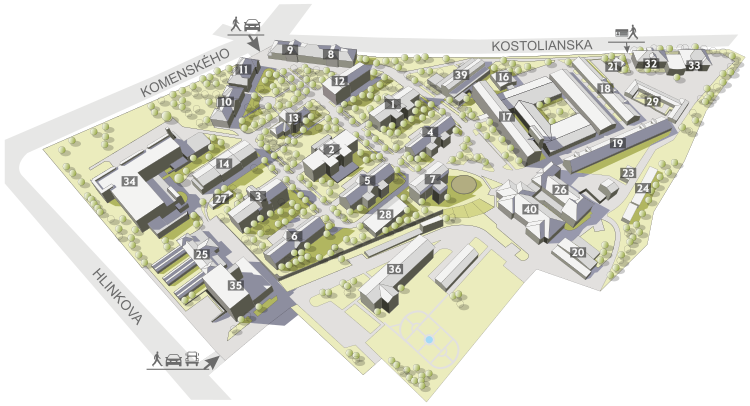
- b) Information resources
-
All literary resources for study outlined in the syllabi are available either in print or electronic form, all information databases purchased and licensed by the university are widely available to students.
- c) Distance learning, e-learning access and procedures
-
UVLF in Košice also provides distance learning for all courses via the MOODLE and MS Teams platforms. Each student can access manuals either in electronic form or in the form of video instructions.
- d) Partners involved in educational activities
-
In the provision of some activities, especially in the field of practical performance of activities of high societal importance, the participation of contractual partners is envisaged, including organizations under the management of the State Veterinary and Food Administration of the Slovak Republic, the Slovak Academy of Sciences and private veterinarians.
- e) Social, sports, cultural, spiritual and community activities
-
UVLF in Košice provides excellent conditions for the above .
- f) Student mobility and placements
-
Students of the Veterinary Morphology and Physiology study programme are guaranteed the opportunity to participate in mobilities. The entire agenda containing instructions and conditions for applying for mobility, conditions and rules of participation as well as rules for recognizing mobility as part of the study plan is covered by the Vice-Rector for International Relations and Internationalisation and the organisational unit managed by her, which is the UVMP Mobility Office. The whole process requires coordination with the supervisor, and is recommended after the study part of the study plan has been completed. Participation in mobility and other contexts are regulated Article 42 of the Internal Regulations of the Study Regulations of the UVMP in Košice, Part.
9. Required skills of the applicant and prerequisites
- a) Required abilities and admission prerequisites
-
These are laid down in Articles 1 and 2 of the Study Regulations of the UVMP in Košice, Part B, II. Part Organisation of studies.
- Admission procedure requirements:
These are laid down in Articles 3 and 4 of the Study Regulations of the UVMP in Košice, Part B, II. Part Organisation of studies.
- b) Admission procedures
- Not provided yet.
- c) Admission results over the standard duration of study
-
Academic year Applicants Admitted Enrolled Graduates —
10. Feedback regarding the quality of education provided
- a) Monitoring and assessment of student feedback
-
- Procedures for monitoring and evaluating students' views on the quality of the study programme:
The students of UVMP in Košice can evaluate the quality of teaching anonymously through an anonymous questionnaire after graduation, where they evaluate the quality of a particular study programme and the quality of the lecturers who provide the course. Monitoring of study programmes is also continuously carried out by the coordinators of individual fields (5) of science and research at UVMP.
- b) Student feedback and measures to improve programme quality
-
The feedback and measures to improve the quality of the study programme are part of the Annual Reports on the Educational Activity at UVLF in Košice for individual academic years and the Annual Reports on the Quality of UVLF in Košice for individual academic years. They are also presented at the Teachers' meeting, which is held at the beginning of each academic year. In general, the principle that the results of the feedback are very important for drawing conclusions from the evaluations, as these are implemented into concrete measures aimed at improving the quality of the study programme.
- c) Graduate feedback and measures to improve programme quality
-
The results of alumni feedback and related measures to improve the quality of the study programme are part of the Annual Reports on Scientific and Research Activities at UVMP in Košice for individual AY and Annual Reports on the Quality of UVMP in Košice for individual AY. The Vice-Rector for Science, Research and Doctoral Studies and the coordinators of the individual domains of science and research act within the framework of the measures to improve the quality of the study programme by personally entering into the solution of the problems arising from the results of the feedback.
11. Demonstration of long-term and continuous success in obtaining financial support
- a) Demonstration of long-term and continuous success in obtaining financial support
-
P.no.
Project number
From
To
Project name
Provider
Principal Investigator / Co-Principal Investigator
1
1/0970/11
2011
2013
Cause analysis and nutritional prevention of peripartum disorders in dairy cows
SGA
Prof. Vladimír Vajda, DVM PhD.
2
016UVLF-4/2012
2012
2014
Nutrition, dietetics and nutritional prevention of production and health disorders in dairy cows
CEGA
Prof. Vladimír Vajda, DVM PhD.
3
1/0373/15
2015
2017
The level of mineral metabolism of livestock in relation to modified feeds
SGA
Magdaléna Skalická, DVM PhD.
4
1/0785/16
2016
2018
Nutritional influence on the regulation of milk quantity and components in dairy cows
SGA
Assoc. Prof. Iveta Maskaľová, DVM PhD.
5
1/0161/17
2017
2019
Utilization of feed supplemented with probiotics in fish nutrition for the production of healthy food
SGA
Prof. Peter Popelka, DVM PhD.
6
19314410-2018
2018
2018
Etiology and resistance of bacterial pathogens causing mastitis in dairy cows and sheep in Slovakian farms
EFSA
Assoc. Prof. František Zigo, DVM PhD.
7
SK-PL-18-0088
2019
2020
Effect of environmental mastitis agents on milk quality and antioxidant status in cows and sheep.
RDPA
Assoc. Prof. František Zigo, DVM PhD.
8
1/0529/19
2019
2021
Effect of environmental mastitis agents on the formation and degree of oxidative stress in production dairy cows and ewes
SGA
Assoc. Prof. František Zigo, DVM PhD.
9
011UVLF-4/2020
2020
2022
Analysis of the impact of nutrition on production, metabolic and ecological stress levels in dairy cows - application of knowledge for diagnostics and education
CEGA
Assoc. Prof. Iveta Maskaľová, DVM PhD.
10
006UVLF-4/2020
2020
2022
Implementation of new scientific knowledge into teaching and improvement of practical education of students in livestock breeding technologies of Zootechnics
CEGA
Assoc. Prof. František Zigo, DVM PhD.
11
1/0402/20
2020
2023
Impact of additives in monogastric animal nutrition on production health, production, product quality and the environment.
SGA
Assoc. Prof.. Pavel Naď, DVM PhD.
12
009UVLF-4/2021
2021
2023
Innovation and implementation of new knowledge of scientific research and breeding practice to improve the quality of teaching of foreign students in the course Zootechnics
CEGA
Zuzana Farkašová, DVM PhD.
13
22010056
2021
2022
Influence of critical factors on the incidence of bovine mastitis in dairy cattle farms located in marginal areas
Visegrad Fund
Assoc. Prof. František Zigo, DVM PhD.
12. Links to other relevant internal regulations and information regarding the study or the student of the study programme
- Relevant internal regulations and other information
If the window remains open, close this browser tab.