

- a) Name and registration code of the study programme:
- Food hygiene · 104004 · UIPŠ 4332V00
- b) Degree of study and ISCED level:
- Third degree · ISCED 8
- c) Place of delivery:
- University of Veterinary Medicine and Pharmacy in Košice · Komenského 73, 041 81 Košice
- d) Field of study and ISCED-F code:
- Veterinary Medicine
- e) Type of study programme:
- Single degree study
- f) Awarded academic degree:
- PhD (philosophiae doctor)
- g) Form of study:
- part-time study
- h) Partner universities and distribution of study obligations in a joint study programme
- i) Language of instruction:
- English language
- j) Standard duration of study:
- 5 years
- k) Programme capacity and applicants over the last six academic years
-
Planned student capacity Applicants over the last 6 academic years Admitted students over the last 6 academic years Enrolled students over the last 6 academic years — 0 — — - l) Information about the study programme:
- Programme details
Study programme description
Food hygiene
part-time study ·  · 104004 · 2025/2026
Last updated: 30.10.2026
- Higher education institution
- University of Veterinary Medicine and Pharmacy in Košice
- Registered address
- Komenského 73, 041 81 Košice
- Institution identification number
- 00397474
- Programme approval body
- UVMP Accreditation Commission in Košice
- Approval date
- 22.08.2022
1. Basic data on the study programme
2. Profile of a graduate and aims of education
- a) Educational objectives and main learning outcomes
-
The learning objectives achieved in the study programme Food Hygiene, Level 3 are methodologically based on the European Qualifications Framework for Lifelong Learning (EQF). This defines the requirements for learning outcomes for knowledge, skills and competences. For level 8, highly specialised knowledge, some of which is at the forefront of the field of work or study and underpins original thinking and/or research; a fundamental awareness of knowledge in the field and at the interface between fields; are required as learning outcomes. The learning situation in this programme of study requires solving problems in which many related factors are at work; learning is often highly specialised. The carriers of the core knowledge are the profile subjects, which have information sheets describing the knowledge to be achieved as learning outcomes. Additional knowledge is achieved by completing the other compulsory elective subjects of the study programme. By completing the profile subjects, the graduate will gain knowledge about the importance of hygiene and quality of production of food of animal origin for their health safety. They will acquire the latest methods of food production technology, while acquiring the latest scientific knowledge in the field of food production.
Graduates of the study programme in food hygiene are qualified to exercise the profession of a veterinary surgeon specialising in the hygiene, quality and health safety of produced food after completing the 3rd level of higher education. Graduates are proficient in scientific methods of research and development, with an orientation towards research in the field of hygiene and quality of food of animal and plant origin, development of food technology, laboratory diagnostic methods, development of food legislation, etc. The graduate can create and formulate new hypotheses, judgments and strategies for further development of the scientific or working field, evaluate theories, concepts and innovations, apply own findings resulting from theoretical analysis and own scientific research of complex and interdisciplinary nature, design, verify and implement new research and working procedures. The graduate is characterized by critical, independent and analytical thinking in the direction of further development of society, responsibility for leadership in the field of study and planning for their own development and the development of society in the field of hygiene and quality of produced food. The graduate is able to present and publish their evidence-based research results to the professional and scientific community. Designs, validates and implements new research and working methods, based on the results obtained, which are then presented and used in the application of new scientific and working practices. He/she is able to determine the focus of research and coordinate a team in the scientific field in research organisations, as well as to manage the solution of problems in food practice. In proportion to the impact of the issues studied, the need for professionals and the relevance of education in the field of specialisation of food hygiene increases.
Responsibility and autonomy, defined for EQF Level 8, are the ability to display considerable authority, innovation, independence, scientific and professional integrity and a sustained commitment to developing new ideas or practices that are at the forefront of a given work or learning environment, including research.
A graduate of the Food Hygiene programme is characterised by independent, critical and analytical thinking. He/she takes into account social, scientific and ethical aspects when formulating research intentions and interpreting research results. The results of his/her own creative work contribute to the development of science, scientific knowledge and the application of acquired knowledge in practice. He/she presents the results of research and development independently to the professional community. Can determine the focus of research and coordinate a team in scientific investigation. Can independently design, validate and implement new research and working practices based on their outputs and findings.
- Graduates of the study programme Food Hygiene, 3rd degree can apply themselves in independent research in the field of production of safe and quality food, management of hygiene of food processing plants, as well as management of production technology in food processing companies. Graduates are prepared to work in accredited laboratories in the field of food analysis, as well as to provide consultancy in the field of food production and sales hygiene.
Graduates of doctoral studies will also find employment in:
- mastery of data, statistical and information processes, correct setting of hygiene conditions and processing of raw materials of animal and plant origin,
- management of food processing enterprises with a focus mainly on the hygiene of food production, evaluation of raw materials entering the production process and their impact on the quality of products of animal origin,
- advice and control in the field of hygiene of food production and sale, feed production, welfare compliance, advice and prevention of livestock diseases.
- b) Occupations and graduate employment opportunities
- Not provided yet.
- c) Statements of relevant external stakeholders
-
Relevant external stakeholders who have provided a statement or a favourable opinion on the compliance of the acquired qualification with the sector-specific requirements for the exercise of the profession: State Veterinary and Food Administration of the Slovak Republic.
Company or external stakeholder Statement Štátna veterinárna a potravinová správa Slovenskej republiky View
3. Job prospects
- a) Assessment of graduate employability
-
- On the basis of the previous long-term experience with the graduates of the study programme Food Hygiene, 3rd degree, it is possible to state their applicability at university workplaces and workplaces of the Slovak Academy of Sciences, as well as at workplaces of the State Veterinary and Food Administration of the Slovak Republic and also in the private sphere in the field of food production as well as in the field of consultancy in the field of hygiene of food production and sales.
- b) Examples of successful graduates
-
Examples of successful graduates of the study programme Food Hygiene, 3rd degree are: As of the 2008/2009 academic year, there have been no successful graduates in this degree programme in the part-time form to date.
- Employers' assessment of the quality of the study programme (feedback): this is not the case. However, the quality of the study programme can be positively assessed indirectly, on the basis of the interest in the study programme from graduates of 2nd cycle universities from different fields (medical and pharmaceutical sciences, natural sciences and agricultural sciences). UVMP has prepared questionnaires about graduates for employers.
- c) Employer feedback on programme quality
- Not provided yet.
4. Structure and content of the study programme
- a) Rules for designing study plans
-
- The rules for the formation of study plans in the study programme Food Hygiene are based on the general provisions contained in Article 2 of the internal regulation Study Regulations of the UVMP in Košice, Part B.
- b) Recommended study plan:
- Study plan 2025/2026
- c) Information included in the study plan
-
- individual parts of the study programme (in the structure of profile and compulsory elective subjects),
- for each educational part (subject), the learning outcomes and related criteria and rules for their assessment are defined in the course information sheet so that all the educational objectives of the study programme are met,
- for each educational part of the curriculum (subject), the course information sheet sets out the learning activities used that are suitable for achieving the learning outcomes,
- the course information sheet lists the methods by which the learning activity is carried out,
- the course outline (topic headings) is given in the course information sheet,
- the course information sheet indicates the student's workload,
- credits allocated to each section based on the learning outcomes achieved
and associated workload, - the course information sheet identifies the course guarantor as well as other persons responsible for teaching the course.
- the location of the course (if the study programme is carried out at more than one location).
- The condition for the proper completion of studies is the acquisition of 240 credits, which include credits for passing the dissertation examination and defending the dissertation. Other conditions that the student must fulfil during the study programme and for its proper completion, including the conditions of state examinations, rules for repeating the study and rules for extension, interruption of the study are specified in Articles 2, 15, 18, 19 and 29 of the internal regulation Study Regulations of UVMP in Košice, Part B.
Course information sheets for the Food hygiene study programme are available through links directly in the study plan.
- d) Credits and other requirements for completion of study
- Not provided yet.
- e) Requirements for individual programme components and student progression
-
Conditions for completion of individual parts of the study programme and student progression
in the study programme structure: the UVMP in Košice in the study plan for the part-time form of study has specified the conditions for completing the individual parts of the study programme and the student's progress in the study programme structure:
- number of credits for profile courses required for proper completion of studies: 50
- Number of credits for 2 selected compulsory elective courses required for proper completion of studies: 10,
- number of credits for the dissertation examination: 20
- number of credits for the defence of the final thesis required for proper completion of studies: 30
- Rules for verification of learning outcomes and student assessment and possibilities of corrective procedures against this assessment: the UVMP in Košice has described the rules for verification of learning outcomes and student assessment and possibilities of corrective procedures against this assessment in Articles 17, 18 and 25 of the internal regulation Study Regulations of the UVMP in Košice, Part B.
- Conditions for the recognition of studies or part of studies: UVMP in Košice has regulated the conditions for recognition of studies or part of studies in Articles 19, 38 and 42 of the internal regulation Study Regulations of UVMP in Košice, Part B.
- Topics of the final theses of the study programme: Since the academic year 2008/2009 no dissertation topic has been announced in this study programme in the part-time form of study.
- f) Assessment of learning outcomes and appeal procedures
- Not provided yet.
- g) Recognition of studies or parts of studies
- Not provided yet.
- h) Thesis topics
-
Thesis topics and supervisors are listed in Table 2 in section 7.e of this description.
- i) Other study rules and procedures
-
- the rules for assigning, processing, opposing, defending and evaluating final theses in Articles 25 - 27 of the internal regulation Study Regulations of the UVMP in Košice, Part B,
- possibilities and procedures for participation in student mobility in Article 42 of the internal regulation Study Regulations of UVMP in Košice, Part B,
- rules of observing academic ethics and drawing consequences in the internal regulation Disciplinary Regulations for Students of the University of Veterinary Medicine and Pharmacy in Košice, in the internal regulation Code of Ethics of UVMP Employees and in the internal regulation Code of Ethics of UVMP Students,
- procedures applicable to students with special needs in Part II, Article 2, point 7; Article 3, point 12 of the internal regulation Study Regulations of the UVMP in Košice, Part B,
- the procedures for filing complaints and appeals by the student are specified, in addition to the Study Regulations of UVMP in Košice, in particular in the internal regulation Directive on the handling of complaints at UVMP in Košice.
5. Study programme’s information letters
- Course information sheets
-
Course information sheets are available through links directly in the study plan. Study plan 2025/2026
6. Current schedule of the academic year and current timetables
- Current academic calendar and timetables
- Not provided yet.
7. Staff
- a) Person responsible for the delivery, development and quality of the study programme
- Prof. Marcinčák Slavomír, DVM, PhD
- b) Teachers of profile courses
- c) Research/art/teaching profiles of teachers of profile courses
- d) Teachers, courses and links to the central register of university employees
-
(Click the teacher’s name to open their profile and contact details, where available.)
Table 1 – Teachers and courses of the study programme Teacher Courses Portál VŠ Assoc. prof. Dudriková Eva, DVM, PhD Hygiene and quality of milk and milk products; Hygiene and quality of plant foods Portál VŠ Assoc. prof. Kožárová Ivona, DVM, PhD Legislative requirements for health safety and food quality Portál VŠ Assoc. prof. Pipová Monika, DVM, CSc. Food microbiology and foodborne diseases Portál VŠ Bartková Valéria, M.A. Foreign language Portál VŠ Dvorská Oľga, M.Sc. Foreign language Portál VŠ Eibenová Andrea, M.Sc. Foreign language Portál VŠ Petrillová Monika, M.Sc. Foreign language Portál VŠ Prof. Legáth Jaroslav, DVM, CSc. Food toxicology Portál VŠ Prof. Marcinčák Slavomír, DVM, PhD Hygiene and quality of meat and meat products; Biotechnological production and quality of beverages Portál VŠ Prof. Nagy Jozef, DVM, PhD Hygiene and quality of poultry meat, eggs and game Portál VŠ Prof. Popelka Peter, DVM, PhD Hygiene and quality of fish and fishery products Portál VŠ Straková Katarína, M.Sc. Foreign language Portál VŠ - e) Thesis supervisors and topics 5 years
-
(Click the teacher’s name to open their profile and contact details, where available.)
Table 2 – Thesis supervisors and topics Teacher Thesis topics Academic year — - f) Research/art/teaching profiles of thesis supervisors
-
The supervisors’ research/art/teaching profiles are available through their personal profiles using the name buttons in the preceding table.
- g) Student representatives and contacts
-
Student representatives who represent the interests of the students of the study programme (name and contact) - a member of the committee for the modification of the study programme Food Hygiene was a student of the study programme Mgr. Miriam Sondorová; e-mail: miriam. sondorova@student.uvlf.sk.
- h) Study adviser
- Not provided yet.
- i) Other support staff
-
Study programme support staff - assigned study officer, Júlia Jančura, Mgr., e-mail: julia.jancura@uvlf.sk.
8. Premises, tools and technical equipment
- a) Teaching premises and their technical equipment
-
Subject
Characteristics of material and technical equipment
Location Hygiene and quality of milk and milk products
Laboratory equipment for milk and dairy analysis: Lactoscan SCC, Lactoscan MCCV, Cryostar 1, PCR equipment for microbiological analysis,
Analyzer LactiCheck LC-01/A, laboratory balances, pH meters, Conductometer 1C10 VR07400997/0736037
Spekol 11, Centrifuge EBA 20 Hettich, Centrifuge cold..,HETTICH MICRO table, RADWAG MA50.R dryer for cheese dry matter determination, Refrigerators (3x), Electrophoresis CHU 20 + electrophoretic source PS 503, Laboratory fume hood 12 HPL, Microwave oven Whirlpool, Water bath Memmert, Colorimeter CR 410 v.no.B8407092 with data processor, sterilizers, autoclaves, microbiological thermostats and microscopes, microbiological thermometers
Fully equipped technological laboratory (technological workshop) for milk processing and production of dairy products (shepherd, milk centrifuge, butcher, smoker, vacuum packer, cheese salting tank, cheese lys, etc.)
Department of Hygiene, Technology and Health Food Safety, Building P-10, Door No. 6 and 7
Hygiene and meat quality of poultry, eggs and game
Laboratory of chemical analysis of foodstuffs equipped with Egg Quality Analyzer, Eggshell Strength Meter, VELP analyzer for protein content analysis, spectrophotometers for analysis of fat and protein degradation changes, salt content, nitrogenous substances, analyzer for determination of water activity, homogenisers, HPLC equipment for the analysis of contaminants in foodstuffs, refrigerators and freezers for the storage of samples, pH meters, needle thermometers, oximeter, electrophoretic analyser, laboratory equipment for the analysis of food components by titration methods.
For the needs of the subject is also used fully equipped technological workshop equipped with technology for meat production and production of meat products.
For the needs of the subject is also used gaastronomic training room equipped with equipment for heat treatment, packaging and storage of meat (contact grill, el. Stoves, sous vide equipment, refrigerators, freezers, vacuum food packer).
For the needs of the course, the microbiology laboratory mentioned in the course "Food microbiology and foodborne diseases" is also used.
Department of Hygiene, Technology and Health Food Safety, building P-6, Laboratory of Chemical Food Analysis, no. ; Building P-6 Microbiology and Mycology Laboratory, Nos. 21 and 47
Building P-6 - basement; Building P-14 - basement
Food microbiology and foodborne diseases
Material and equipment for bacteriological, mycological and molecular diagnostics: Thermostats, autoclaves, hot air sterilizer, refrigerators, freezers, deep freezers, BSL2 laminar boxes, PCR box, centrifuges, ultracentrifuges, gradient thermocycler for PCR, Real time PCR equipment, electrophoretic apparatus, photo-documentation equipment for visualization and photo-documentation of agarose gels, micro-volume spectrophotometer for DNA quantification. Spectrophotometers, pH meters, ultrasonic bath, ELISA reader, optical microscopes, digital microscopes, thin layer chromatography chamber,
Building P-6, Microbiology and Mycology Laboratory in the Department of Food Hygiene, Technology and Health Safety,
Nos 21 and 47
Food toxicology
Standard laboratory equipment, analytical sets, spectrophotometers, thin layer chromatography equipment, stereoscope, microscope, camera, histology equipment including microtome, imaging, staining equipment, analytical and evaluation software.
Material and equipment for animal dissection or for other diagnostic laboratory methods/examinations: sledge microtomes (pfm Slide 2003 - pfm medical Germany and Histoslide 2000, Leica - Reichert - Jung), Shandon Citadel - tissue processor, watering device WD4, light microscopes with camera: MOTIC + photocamera MOTICAM 2330, NICON Eclipse Tí + photocamera), thermostat, refrigerator, laminar box, PCR box, centrifuge and cytocentrifuge, thermocycler for PCR, CO2 incubator, deep freezer box.
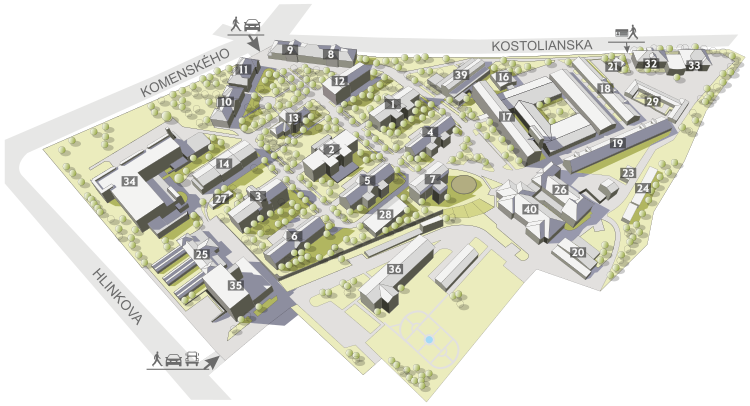
Pavilion 36: Department of Pharmacology and Toxicology - rooms 310, 311;
Pavilion 4: Department of Pharmacology and Toxicology
Hygiene and quality of meat and meat products
Laboratory of chemical analysis of foodstuffs equipped with VELP analyzer for the analysis of protein content, spectrophotometers for the analysis of degradation changes of fats and proteins, salt content, nitrogenous substances, analyzer for the determination of water activity, homogenizers, HPLC equipment for the analysis of contaminants in foodstuffs, refrigerators and freezers for sample storage, pH meters, needle thermometers, oximeters, electrophoretic analysers, laboratory equipment for the analysis of food constituents by titration methods, dryers, laboratory fume cupboards and necessary accessories.
For the needs of the subject is also used fully equipped technological workshop equipped with technology for meat production and production of meat products.
For the needs of the subject is also used gaastronomic training room equipped with equipment for heat treatment, packaging and storage of meat (contact grill, el. Stoves, sous vide equipment, refrigerators, freezers, vacuum food packer).
For the needs of the course, the microbiology laboratory mentioned in the course "Food microbiology and foodborne diseases" is also used.
Department of Food Hygiene, Technology and Health Safety, Building P-6 Chemical Food Analysis Laboratory, Building P-6 Basement Culinary Training Room and Building P-14 - Basement Meat Processing Shop, Building P-6, Microbiology and Mycology Laboratory in the Department of Food Hygiene, Technology and Health Safety,
Nos 21 and 47
Legislative requirements for health safety and food quality
Lecture room ground floor of the building, multimedia projector, desktop computer, laptop, access to necessary databases and food safety systems
Department of Hygiene, Technology and Health Food Safety building P-6 - lecture room ground floor
Biotechnological production and beverage quality
Biotechnological workshop for the production of biotechnological beverages (beer, mead and wine): grinding and milling machine, fruit press, stainless steel containers, beverage filter, vacuum beverage filler, auxiliary tools and aids for the implementation of the production process of the above-mentioned beverages.
Fully equipped laboratory for chemical analysis of wine, beer and spirits: electric ebulioscope, acid analyzer, biochemical analyzer of wine components (sugar, free and total sulfur dioxide, content of individual acids, electrophoretic analyzer EA102+column, software for the analysis of individual acids in beverages, spectrophotometric analyzers for the analysis of antioxidant components in beverages, part of the room is also a sensory room for sensory analysis of beverages (wine, beer).
For the needs of the course, the microbiology laboratory mentioned in the course "Food microbiology and foodborne diseases" is also used.
Department of Hygiene, Technology and Food Health Safety, building P-6 rooms, ;building P-14 - basement; building P-10 - basement; building P-6 Microbiological and Mycological Laboratory, Nos. 21 and 47
Hygiene and quality of fish and fishery products
Laboratory of chemical analysis of foodstuffs equipped with VELP analyzer for the analysis of protein content, spectrophotometers for the analysis of degradation changes of fats and proteins, salt content, nitrogenous substances, analyzer for the determination of water activity, homogenizers, HPLC equipment for the analysis of contaminants in foodstuffs, refrigerators and freezers for sample storage, pH meters, needle thermometers, oximeters, electrophoretic analysers, laboratory equipment for the analysis of food constituents by titration methods, dryers, laboratory fume cupboards and necessary accessories.
For the needs of the subject is also used fully equipped technological workshop equipped with technology for meat production and production of meat products.
For the needs of the subject is also used gaastronomic training room equipped with equipment for heat treatment, packaging and storage of meat (contact grill, el. Stoves, sous vide equipment, refrigerators, freezers, vacuum food packer).
For the needs of the course, the microbiology laboratory mentioned in the course "Food microbiology and foodborne diseases" is also used.
Department of Food Hygiene, Technology and Health Safety, Building P-6 Chemical Food Analysis Laboratory, Building P-6 Basement Culinary Training Room and Building P-14 - Basement Meat Processing Shop, Building P-6, Microbiology and Mycology Laboratory in the Department of Food Hygiene, Technology and Health Safety,
Nos 21 and 47
- Characteristics of information provision of the study programme (access to study literature according to course information sheets), access to information databases
and other information resources, information technology, etc.):
All literary resources for study listed in the fact sheets are available in either print or electronic form, and all information databases purchased and licensed by the University are accessible to students.
- Characteristics and scope of distance learning applied in the curriculum with assignment to courses. Approaches, manuals of e-learning portals. Procedures for transition from full-time to distance learning.
UVMP also has distance education for all subjects, which is currently provided through MOODLE and MS-Teams platforms. Each student has manuals available either in electronic form or in the form of a video tutorial.
- Characteristics of information provision of the study programme (access to study literature according to course information sheets), access to information databases
- b) Information resources
- Not provided yet.
- c) Distance learning, e-learning access and procedures
- Not provided yet.
- d) Partners involved in educational activities
-
In the provision of some activities, especially in the field of practical performance of activities of high societal importance, the participation of contractual partners is envisaged, including organizations under the management of the State Veterinary and Food Administration of the Slovak Republic, the Slovak Academy of Sciences and private companies in the food industry.
- Characteristics on social, sporting, cultural, spiritual and social opportunities:
UVMP in Košice provides students with the maximum possible conditions for their enjoyment in the above areas.
- e) Social, sports, cultural, spiritual and community activities
- Not provided yet.
- f) Student mobility and placements
-
Students of the Food Hygiene study programme in the 3rd cycle of studies are guaranteed the possibility to participate in mobility. The whole agenda, including the guidelines and conditions for applying for mobility, the conditions and rules for participation, as well as the rules for recognition of participation in mobility as part of the curriculum, is covered by the Vice-Rector for International Relations and internationalisation and the organisational unit managed by her, which is the Mobility Department of UVMP Košice. Participation in mobility and other aspects are regulated in Article 42 of the internal regulation Study Regulations of the UVMP in Košice, Part B.
9. Required skills of the applicant and prerequisites
- a) Required abilities and admission prerequisites
- Not provided yet.
- b) Admission procedures
-
Admission procedures: they are laid down in Article 3a Article 4, Part B, Part II Organisation of Studies of the Internal Regulations of the Study Regulations of the UVMP in Košice. The examination boards for admission examinations are at least 4-member and are appointed by the Rector on an ad hoc basis according to the focus of the study programmes to which students apply.
- c) Admission results over the standard duration of study
-
Academic year Applicants Admitted Enrolled Graduates —
10. Feedback regarding the quality of education provided
- a) Monitoring and assessment of student feedback
-
- Procedures for monitoring and evaluating students' views on the quality of the study programme:
Students of UVMP in Košice have the possibility of anonymous evaluation of the quality of teaching by an anonymous questionnaire after graduation, where they evaluate the quality of a particular study programme and the quality of the instructors who provide the course. Monitoring of study programmes is also continuously carried out by the coordinators of individual domains of science and research at UVMP, while 5 domains of science and research are established at UVMP.
- b) Student feedback and measures to improve programme quality
-
The results of the evaluation of doctoral studies are part of the Annual Reports on Scientific and Research Activities at UVMP in Košice for individual ARs and Annual Reports on the Quality of UVMP in Košice for individual ARs. They are also presented at the Teachers' Forum, which is held at the beginning of each academic year. In general, the principle that the results of the feedback are very important for drawing conclusions from the evaluations, which are implemented into concrete measures implemented with the aim of improving the quality of the study programme in its entire breadth and depth.
- c) Graduate feedback and measures to improve programme quality
-
- The results of alumni feedback and related measures to improve the quality of the study programme are part of the Annual Reports on Scientific and Research Activities at UVMP in Košice for individual AR and Annual Reports on the Quality of UVMP in Košice for individual AR. The Vice-Rector for Science, Research and Doctoral Studies and the coordinators of the individual domains of science and research act within the framework of measures to improve the quality of the study programme by personally entering into the solution of the problems arising from the results of the feedback.
11. Demonstration of long-term and continuous success in obtaining financial support
- a) Demonstration of long-term and continuous success in obtaining financial support
-
P.no.
Project number
From
To
Project name
Provider
Principal Investigator / Co-Principal Investigator
1
1/0939/12
2012
2014
New alternatives for screening antimicrobial residues in food-producing animal tissues
SGA
Assoc. Prof. Ivona Kožárová, DVM PhD.
2
001UVLF-4/2013
2013
2015
Preparation of the university textbook "Hygiene and Technology of Meat and Meat Products"
CEGA
prof. MVDr. Peter Turek, PhD.
3
APVV-14-0397
2015
2019
Application of bio-feeds in poultry nutrition for the production of functional foods enriched with essential polyunsaturated fatty acids
RDPA
Prof. Slavomír Marcinčák, DVM PhD.
4
011UVLF-4/2015
2015
2017
Food safety-study material and didactic aids for the joint study programme
CEGA
Prof. Jozef Nagy, DVM PhD.
5
005UVLF-4/2015
2015
2017
Multimedia support for teaching of hygiene and milk technology as an innovative study in the School of General Veterinary Medicine
CEGA
doc. MVDr. Eva Dudríková, PhD.
6
1/0705/16
2016
2018
Impact of microscopic filamentous fungi and their secondary metabolites on egg quality and safety
SGA
MVDr. Pavlína Jevinová, PhD.
7
1/0576/17
2017
2019
Study of the use of new alternative methods for antibiotic residue screening in the control system of coccidiostats and their residues in food and feed
SGA
Assoc. Prof. Ivona Kožárová, DVM PhD.
8
1/0161/17
2017
2019
Utilization of feed supplemented with probiotics in fish nutrition for the production of healthy food
SGA
Prof. Peter Popelka, DVM PhD.
9
PPI/APM/2018/1/00010/U/001
2018
2022
Cultural heritage of small regions
Prof. Slavomír Marcinčák, DVM PhD.
10
APVV-18-0039
2019
2023
Application of fermented bioproducts and humic substances in poultry nutrition, a new approach to improve animal health and produce safe and functional food
RDPA
Prof. Slavomír Marcinčák, DVM PhD.
11
313011V336
2019
2023
Demand-driven research for sustainable and innovative food, Drive4SIFood
EU SF
Prof. Slavomír Marcinčák, DVM PhD.
12
007UVLF-4/2020
2020
2022
Innovation in teaching of hygiene and technology of dairy products at the University of Veterinary Medicine and Pharmacy in Košice
CEGA
MVDr. Jana Maľová, PhD.
13
020-1-SK01-KA203-078333
2021
2023
ERASMUS+ 2020-1- SK01-KA203-078333_FOODINOVO
Erasmus+
Prof. Slavomír Marcinčák, DVM PhD.
14
015UVLF-4/2021
2021
2023
The use of digital online communication tools in the implementation of distance learning in the study subject Official Food Inspection
CEGA
Assoc. Prof. Ivona Kožárová, DVM PhD.
15
1/0156/21
2021
2024
Application of multiple factor analysis to the qualitative and quantitative parameters of the wine produced to achieve a reduction of biogenic amines
SGA
MVDr. Boris Semjon, PhD.
16
1/0073/22
2022
2024
Evaluation of the impact of innovative coffee processing methods on coffee health safety and quality
SGA
Prof. Peter Popelka, DVM PhD.
12. Links to other relevant internal regulations and information regarding the study or the student of the study programme
- Relevant internal regulations and other information
If the window remains open, close this browser tab.